

There’s something a little off about seeing a band set up on a bridge that hasn’t been used in fifty years. There are no trains. No cars. Not many people. There was only steel, rust, and the slow, brown pull of the Kansas River below. For about fifty years, that was the Rock Island Bridge. Then, in June, Kansas City‘s sixth annual Make Music Day turned it into something else: a stage, a place for people to gather, and a spot where the city seemed to remember what it could do.
Make Music Day is an idea that has been around for a long time. The event takes place every year on June 21 at the same time as the summer solstice. It started in France and has since spread to hundreds of cities around the world. It’s been taken very seriously in Kansas City. 59 artists performed at 28 venues across the metro area for this year’s event. But the Rock Island Bridge, which reopened to the public this spring after being fixed up for years, was the main attraction all day, and it deserved it.
There is something about the bridge that is hard to fake. It was built in 1905 for the Chicago, Rock Island, and Pacific Railroad out of Carnegie steel. Its purpose was to move animals to the West Bottoms stockyards, not to host musicians. About 700 feet of truss spans cross the Kansas River. In 1921, a third span was added. In the 1970s, rail service stopped, and the bridge just sat there, waiting. It turned out that the long period of silence was a good thing. The steel was still in good enough shape because it had never been salted against snow like roads do. This meant that engineers could use what was already there instead of starting from scratch.
Multistudio, an architecture firm, made the deck wider, covered a 35-foot-tall event hall with polycarbonate panels, and left the original trusses visible all the way through. It is said that Multistudio principal Dennis Strait said walking onto old bridges like this was like walking into a gothic cathedral. When you stand inside the American Royal Hall, the event space tucked inside the trusses, you can see why he said that. When it comes to new venues, most spend a lot of money trying to create an industrial feel that this one just doesn’t quite manage.
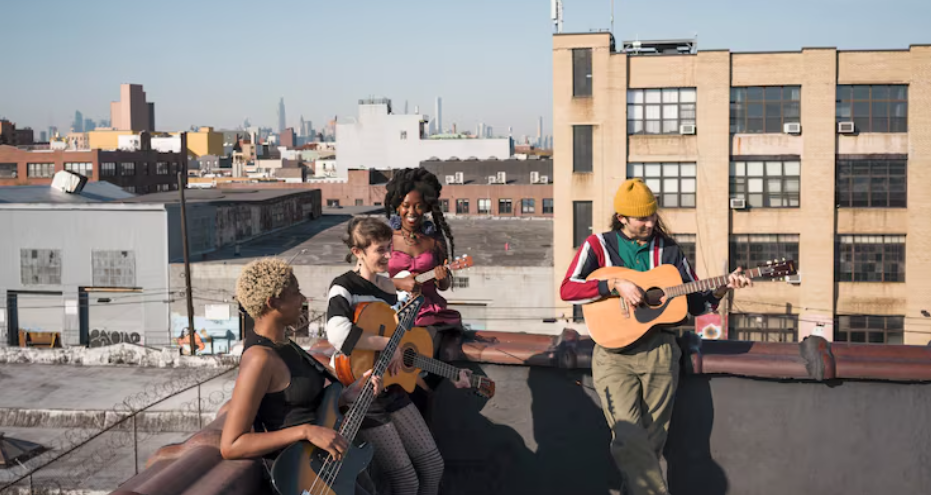
That place was almost too perfect for Make Music Day. Music and old buildings have something in common: they both make you notice what’s already there. The performers sixty feet above the river, with views of the Armourdale neighborhood in Kansas City, Kansas, in one direction and the skyline of Kansas City in the other, weren’t just taking up space. They had something going on with it. Two states, two neighborhoods, and two different versions of the same metro area are linked by the bridge. Everyone who was there during the day got that sense.
With all the changes that have been made to Kansas City’s downtown over the years, it’s reasonable to be skeptical of each new project. But the Rock Island Bridge doesn’t feel like a pitch for development. Instead, it feels more like a real act of civic duty. There is a restaurant by chef Bradley Gilmore, a walk-up food window, a second bar on the upper deck, and a public trail that anyone can walk for free. The venue can hold up to 1,500 people. The project’s developer, Flying Truss, has said that it looks like New York’s High Line. In 2023, the bridge became part of the High Line’s network of used structures. We still don’t know if it will reach that level of cultural weight. The idea behind Make Music Day is that Kansas City is trying to find out.
It’s still a little strange that a railroad bridge that was built to move cattle is now used by musicians, families, and people who just want to listen to music on a summer afternoon. This place was built over fifty years and with a lot of structural engineering. It was worth the wait on Make Music Day.
