

A childhood sequel is the only one that can deliver a certain kind of disappointment. It’s not the blatant betrayal of a truly awful movie, but rather something more subdued—the gradual realization, around the halfway point, that what you’re watching won’t provide you with what the first two did. That’s the impression that many people have of The Karate Kid Part III, the 1989 finale to a franchise that had been genuinely heartwarming up until that point.
When the movie was released on June 30, 1989, it was expected to live up to expectations. Each of the first two Karate Kid movies brought in about $130 million at the box office. Although technically profitable, Part III’s $38.9 million revenue on a $12.5 million budget is the kind of figure that speaks for itself. Loyalty drove audiences to attend, and they departed with little to say.
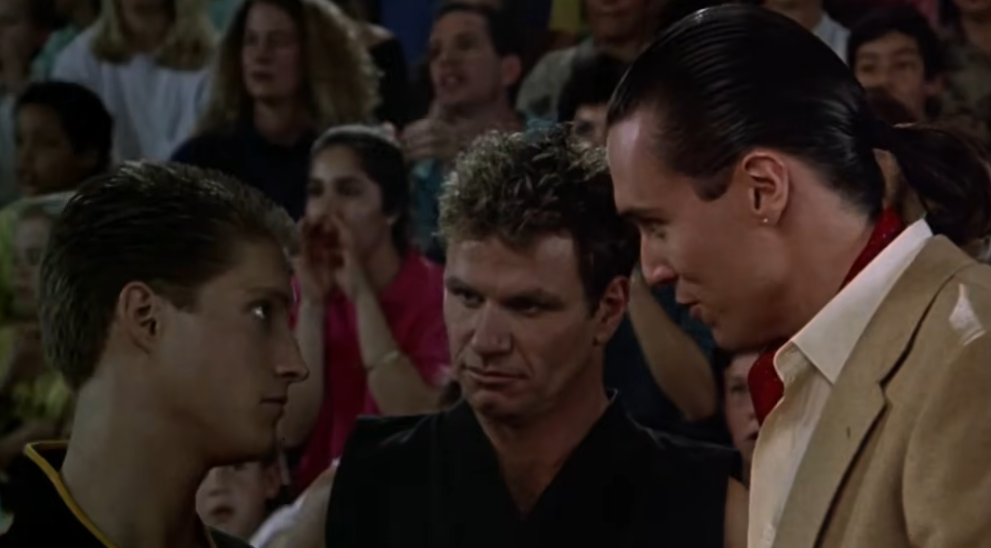
The story revolves around disgraced John Kreese, who asks Terry Silver, a wealthy Vietnam War comrade with a toxic waste empire and, presumably, plenty of free time, for a favor after the events of the first movie. Together, they devise a complex plan to destroy Mr. Miyagi and Daniel LaRusso—not physically, but emotionally, spiritually, and in terms of their reputations. It’s so complicated that you have to wonder who this plan was intended to impress. The movie even unintentionally admits that if Miyagi had only agreed to train Daniel in the first place, the whole thing would have fallen apart.
Thomas Ian Griffith’s portrayal of Terry Silver is what the movie really gets right. It’s possible that Silver, who is theatrical, menacing, and obviously enjoying himself more than anyone else on screen, is the most interesting antagonist in the entire original trilogy. Griffith portrays him with a gleeful malevolence that seems almost inappropriate for a martial arts film with a PG rating. Yes, he chews scenery, but there’s skill involved. It’s interesting to note that, despite playing a Vietnam veteran decades older than Ralph Macchio, Griffith was four months younger at the time of filming.
Robert Mark Kamen wrote the screenplay while somewhat protesting. Kamen had proposed something much more ambitious: a time-travel prequel with a female lead and a wuxia sensibility that takes place in 16th-century China. It was turned down by the producers. The script that Kamen eventually produced occasionally seems like the product of someone going thru the motions, and he only came back after Columbia Pictures offered him a substantially higher salary. The rhythms are recognizable. The bully is more cruel. There are greater stakes in this tournament. However, plot mechanics largely overshadow the emotional texture that made the original memorable, such as the quiet moments between Macchio and Pat Morita and the sense of a child truly learning something.
Watching it now gives me the impression that the movie was scared of its own more subdued tendencies. For example, the bonsai tree subplot, a tiny metaphor about resiliency and healing that runs throughout the entire narrative, is actually pretty lovely. However, it is constantly cut off by Silver giving another monolog or Mike Barnes arriving to do something evil. The movie doesn’t have enough faith in its viewers to keep them motionless.
For his part, Pat Morita is still completely entertaining. In one scene, Miyagi quickly eliminates Barnes, Kreese, and Silver in a calm, economical, and almost bored manner that speaks to something the character has always carried. To be interesting, he doesn’t require drama. That could have taught the film surrounding him something.
Part III of Karate Kid is not a catastrophe. It’s a skillful movie that made wise decisions at every turn and ended up somewhere that no one found especially memorable. Cobra Kai eventually changed the direction of the franchise by using the plots of Silver and this movie to create much richer content. In retrospect, it’s difficult to avoid the impression that the film was just the wrong sequel at the wrong time, created by people who knew the formula but had given up on figuring out why it worked in the first place.
