

A certain type of television can catch you off guard. Maybe a friend kept bringing it up, or perhaps it appeared at the top of your Netflix queue on a slow Sunday, so you start watching it out of mild curiosity. By episode three, you realize you’re stuck with it. That kind of show is Cobra Kai. What started out as a 1984 movie sequel series When The Karate Kid debuted on YouTube Red in May 2018, it turned out to be much more complex than anyone had predicted.
Cobra Kai appears to be about two middle-aged men who are unable to move on from a high school karate competition. Ralph Macchio reprises his role as Daniel LaRusso, a prosperous car dealership owner who is at ease, well-liked, and the type of person who smiles in his own billboard advertisements. William Zabka’s character, Johnny Lawrence, is leading the opposite life. He’s a man who peaked at seventeen and has been quietly falling apart ever since. He’s bearded, broke, and drinking Coors Banquet beers in a dilapidated Reseda apartment. Their worlds collide once more thirty-three years after that notorious tournament, and neither of them handles it very well.
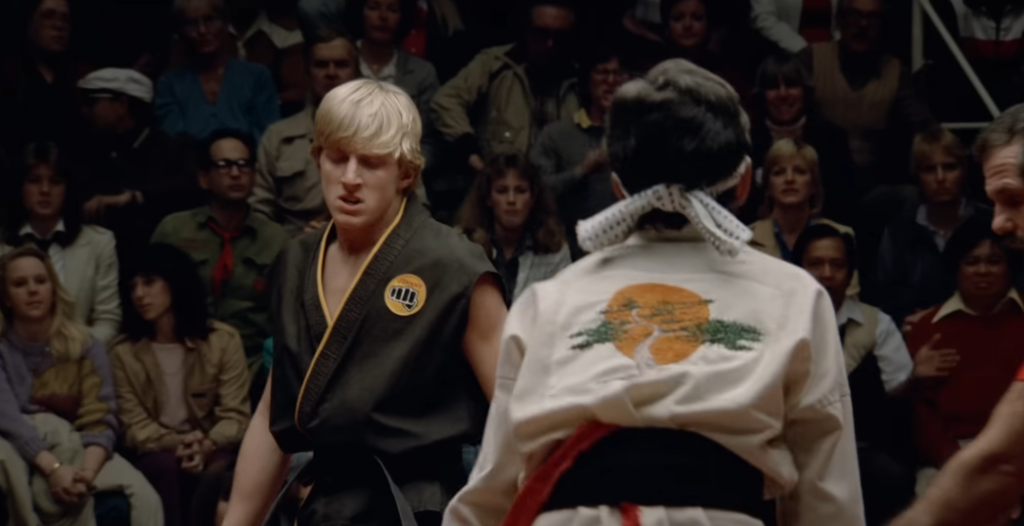
The way the show frames that long-standing rivalry is what makes it truly fascinating. Daniel was the protagonist and Johnny was the antagonist in the first Karate Kid. Cobra Kai asks what that story looked like from the other side, which is a more honest approach. Johnny was more than just a bully. Raised in a harsh dojo culture, he was taught cruelty as a way of life by a man named John Kreese. Knowing that makes things more difficult, but it doesn’t absolve everything. Furthermore, complexity is nearly always more fascinating.
When Johnny protects Miguel Diaz, his teenage neighbor, from a gang of high school bullies in a parking lot, his journey back into karate begins. It’s a brief, impulsive, almost accidental moment, but it gives Johnny a reason to come, something he hasn’t had in years. He reopens the Cobra Kai dojo and begins instructing a group of children who are easily pushed around and feel invisible and out of place. Those early dojo scenes have a genuine warmth to them. Johnny doesn’t make a good mentor. He gives life advice that would cause controversy at a parent-teacher conference, is direct, and lacks social awareness. However, his students react to him, and one of the show’s more subdued pleasures is seeing that relationship grow.
In the meantime, Daniel starts his own dojo, Miyagi-Do, which is based on the patient, defensive mindset that his late mentor Mr. Miyagi taught him. The majority of the drama over the course of six seasons is driven by the tension between the two men and the two styles. In ways that feel genuinely messy rather than well-constructed, their kids and students are drawn into the conflict.
Before ending in February 2025, Cobra Kai, which was created by Josh Heald, Jon Hurwitz, and Hayden Schlossberg, ran for six seasons and 65 episodes. It developed a devoted following that seemed to get bigger the longer it ran, and it received praise from critics, including an Emmy nomination for Outstanding Comedy Series. Perhaps no one anticipated how well it would endure. With ratings of 8.4 on IMDb and 94% on Rotten Tomatoes, the show appears to have found something genuine rather than merely relying on nostalgia.
Watching the later seasons in particular gives the impression that the show is less about karate and more about fathers and sons, the harm people carry with them unknowingly, and whether someone who has spent decades doing bad things can truly change. In particular, Johnny Lawrence develops into an unexpectedly poignant character. Zabka portrays him with a worn-out sincerity that makes every moment worthwhile. He is annoying, funny, and sometimes heartbreaking.
The show Cobra Kai is not flawless. By the later seasons, some storylines become overly complex, and the intensifying conflicts can sometimes veer into areas where credibility is compromised. Fundamentally, tho, it raises an important question: what does it mean to continue fighting when the war you started was never really about what you believed it to be?
