

Organizing a whole nation around a shadow has a subtle surreal quality. Before dusk, highways fill up. Families are transporting solar-filtered cardboard boxes. Tarragona hotels have been fully booked since spring. There isn’t really a contemporary parallel to what is happening in Spain on the eve of August 12, 2026, at least not one that most living people can recall.
The public’s interest in tomorrow’s total solar eclipse over Spain has been growing for months. And the main query that keeps people looking, texting, and debating is straightforward: what time does it truly occur?
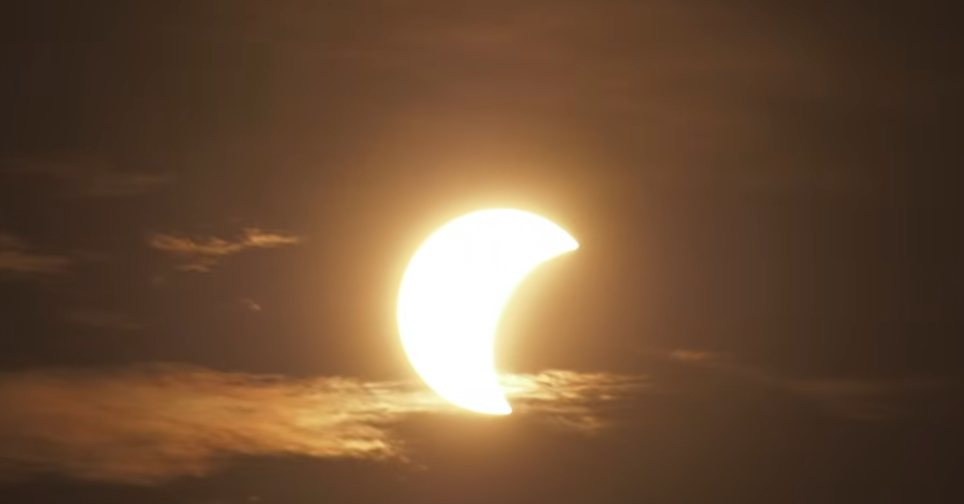
The quick fix is approximately 20:30 peninsular time, but that number flattens a more complex situation. The Moon begins its slow, deliberate slide across the face of the Sun at 19:34 or 19:35 in most places, marking the beginning of the eclipse’s partial phase. Although it’s worth watching, people aren’t traveling hundreds of kilometers for it. Depending on your location, the totality—the fleeting, confusing moment when the Moon totally obscures the Sun—occurs between roughly 20:26 and 20:33.
Totality arrives in Tarragona shortly after 20:29. Although there is only a 25-second window of total darkness in Lleida, the maximum occurs at 20:29:20. A longer stretch, from 20:30:13 to 20:31:50, is available further south in Alcanar. These are actual distinctions. A few kilometers can make all the difference between an unforgettable experience and something truly alien.
It’s important to comprehend why the timing seems so hurried. Since this is a sunset eclipse, the Sun will be as low as five or six degrees above the western horizon at totality. That presents a unique difficulty. You require more than just geographic location, even within the totality corridor, which extends from Galicia in the northwest thru Castilla, Madrid, Aragón, Cataluña, and the Balearic Islands. A clear, unhindered western horizon is necessary. A building, a hill, or a tree line can all completely obscure the view.
An additional degree of uncertainty is introduced by meteorology. Given how dramatic the eclipse would be over the Atlantic, it is unfortunate that cloud cover is predicted to be heavier along the Cantabrian coast and portions of the Galician shoreline. Although nothing is certain just yet, the central and southern corridors—Aragón, inland Cataluña, and Valencia—seem more promising. Anyone who is interested in watching has been updating the AEMET’s forecasts every day, much like a stock trader keeping an eye on price movements.
The last total solar eclipse to pass over Spain was in 1912. The generation watching this one is living in a world with smartphone cameras, real-time traffic alerts, and social media countdowns more than a century later, which makes it extremely hard to predict the crowd situation. Emergency transportation plans have been activated by regional governments. A formal civil protection protocol was introduced by the national government. Particularly after the eclipse, when return traffic tends to peak abruptly and roads congest quickly, authorities are specifically discouraging last-minute improvised travel.
Between 2026 and 2028, Spain will see three eclipses—two total and one annular—which astronomers are referring to as an extraordinary concentration. The most recent similar run occurred in 1900, 1905, and 1912. The first of those three eclipses will occur tomorrow, and observers seem to realize that this won’t occur again in their lifetimes. What’s filling the roads tonight is precisely that understanding.
If you are still in the totality corridor, you should wear eclipse glasses during the partial phases, turn them off only during full totality, and put them back on as soon as the first hint of sunlight appears again. The window is brief, sometimes lasting less than a minute. Whether the skies will cooperate everyplace is still up in the air. However, the shadow is approaching in both directions.
