

On the surface, the question seems almost ridiculous. Is Mike Tyson, the man who defeated some of the greatest heavyweights in history in less than two minutes, practicing karate? It seems like a joke’s setup. However, Tyson has made a statement that keeps this discussion going, and once you consider it, the assertion is more difficult to reject than most people realize.
“Our style was pretty much Japanese Karate,” Tyson once remarked, referring to the system developed by his trainer Cus D’Amato. For years, that quote has been circulating in online forums and gyms, and it usually divides people in two. It is interpreted by some as evidence of a true martial arts foundation. Others believe it’s Tyson’s tendency to be colorful when discussing his past. As is often the case, the truth lies in the middle of those two interpretations.
To be clear, Tyson was not, in any formal sense, a trained karateka. He wasn’t raised in a dojo. In Brooklyn, he was not studying kata after school or earning belts. His journey to boxing began in juvenile detention, followed by a fortuitous encounter with Bobby Stewart, a counselor, and D’Amato, who had his own opinions about what a fighter should look like and how they should move. D’Amato did not create karate. However, it wasn’t totally devoid of it either.
D’Amato’s observations of Eastern martial arts served as mechanical inspiration for the Peek-a-Boo style’s crouching guard, continuous head movement, and explosive short-arc punches delivered from close range. Karate practitioners had been honing the full-body torque produced by the hips and legs rather than just the arms, the angular attacks, and the notion of changing direction mid-approach for a considerable amount of time. They were not imitated by D’Amato. However, he observed them. He then translated them into the context of boxing, which is a completely different thing.
Before boxing discovered him, Tyson may have also briefly practiced karate. In at least one interview, he has stated that he received training in it prior to Cus. Given the turbulent circumstances of his early life, there is some doubt about that, but it doesn’t seem impossible. There were many martial arts schools and gyms in the Brownsville neighborhood where he grew up in the late 1970s, and many young people from that era tried one thing before settling on another.
The mechanics of his punching are where the connection becomes truly fascinating. Tyson’s hip and shoulder rotation has been compared by analysts to a traditional karate technique known as hikate, which involves pulling the non-striking hand sharply back toward the hip while the other hand fires forward.
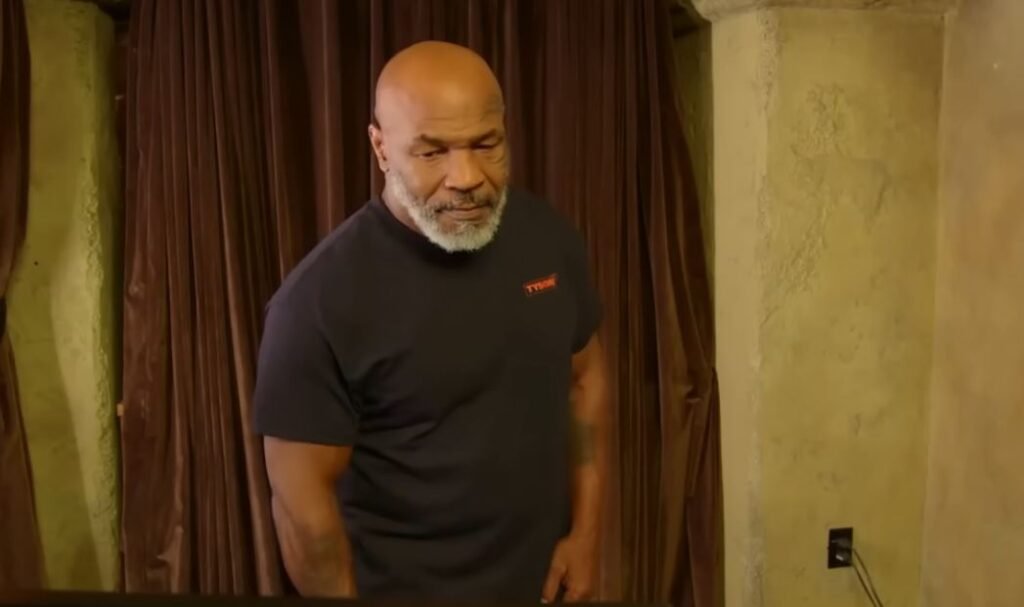
Power is amplified throughout the entire body as a result of the motion’s whipping counter-rotation. Tyson achieved a functionally similar result, but he did so by using D’Amato’s drills instead of any official kata practice. The question of whether that qualifies as karate or just good physics is one that combat sports enthusiasts debate endlessly.
Jesse Enkamp, a YouTuber and karate practitioner who has thoroughly dissected Tyson’s movements, even went so far as to refer to him as a “karate master,” which is a stretch by any strict definition. His own boxing partner refuted some of the specific comparisons. However, Enkamp’s main point—that traditional karate and old-school boxing have more in common than most people realize—is not wholly incorrect. Both evolved prior to the widespread use of gloves and pads. Evasion, angles, and creating force from the bottom up are priorities for both. Although they evolved on different surfaces, some of the underlying logic is the same.
When the labels were removed, Tyson was actually a heavyweight with the movement patterns of a much smaller fighter. He punched from positions that shouldn’t have produced the kind of power they did, closed distance at angles, and absorbed space with his body rather than his guard. For most people watching boxing in the 1980s, that combination seemed alien. It was confusing. Watching the old footage still makes me feel that way. It’s probably oversimplified to refer to it as karate. However, completely rejecting the connection may also be one.
