

For decades, the argument has been discussed in Reddit threads, barbershops, gym locker rooms, and even a breakroom scene from “Better Call Saul,” but it never really goes away. Bruce Lee or Muhammad Ali: who would prevail in a fight?
On the surface, it seems unanswerable. Two myths. Two entirely distinct fields of study. There is a noticeable difference between two bodies operating in different weight classes. However, the answer strongly leans in one direction when you examine the details, which are highly specific.
Let’s start with the numbers. Ali weighed between 210 and 236 pounds and stood about 6’3″. At his heaviest, Lee weighed about 145 pounds and stood 5’7″. That’s a different class of human, not just a size difference. For this reason, combat sports have weight classes, and no amount of speed or skill can completely close a seventy-five-pound gap. In the words of Ali’s biographer, Jonathan Eig, “street fight, no rules, Ali wins.” It wouldn’t be difficult.
However, the fact that Bruce Lee appeared to comprehend all of this is what makes this debate intriguing. At one point, he pointed to his own hand and simply acknowledged that Ali would kill him because it was a small Chinese hand. That level of clarity is almost admirable; there’s no pretentious arrogance or shifting to a hypothetical situation where skill rebalances the math. Just be truthful. In these discussions, it is uncommon.
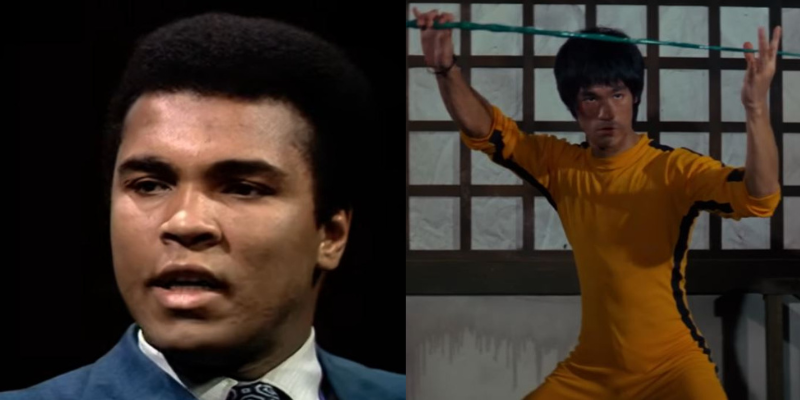
However, there is some merit to the arguments made by those who support Lee. The foundation of his martial philosophy, Jeet Kune Do, was flexibility, understanding the opponent, and dismantling structure before using force. He had a true obsession with Ali. watched videos of him all the time. According to his biographer Matthew Polly, Lee would have put a great deal of effort into figuring out how to defeat the heavyweight champion in the same manner that he once described fighting Kareem Abdul-Jabbar: remove the foundation first, take out the knees, and then improvise from there.
In theory, it’s a good idea. But it’s difficult to get close enough to deliver low kicks against a fighter with Ali’s reach and footwork. Throughout his career, Ali’s speed confounded much larger opponents in addition to his size. At this point, the defense of Lee begins to feel less like a serious fight analysis and more like a thought experiment.
The issue of record is another. George Foreman, Joe Frazier, and Sonny Liston are listed on Ali’s resume. Although Lee’s skill was highly regarded, it was never put to the test in a high-level, full-contact public competition. That’s not a critique of the man; his main roles were those of a teacher, a filmmaker, and a movement philosopher. However, this implies that when the hypothetical becomes serious, there is no actual data to project from.
According to the rules, this isn’t even a conversation during a boxing match. If Lee’s kicks land before Ali’s jab reaches his jaw in an open-format street situation, he stands a ten to fifteen percent chance. Even so, those are not good odds. The venue change does not eliminate the disparity in size and reach.
It might be worthwhile to consider why this question keeps coming up. Two individuals who never engaged in combat. who lived in entirely different worlds. who truly excelled at what they did. That kind of pairing creates a mythology: the champion versus the philosopher, the speed versus the power.
However, what if they were placed in a room together without any rules or cameras? Muhammad Ali is the truthful response, as stated by both men’s biographers and by Lee himself while gazing at his own hand. Furthermore, it most likely wouldn’t be very close.
