

Being charged for resisting an arrest that never should have occurred, being arrested for something you didn’t do, and then witnessing the perpetrators leave with their jobs and records intact are all forms of cruelty. In the summer of 2019, Mark Domino experienced that in a Clarkston, Washington, Walmart parking lot. His age was fifty-two. His shift had just ended. He was making his way to his wife’s car to get her something. A Black man was seen entering a car by a bystander, who then dialed 911.
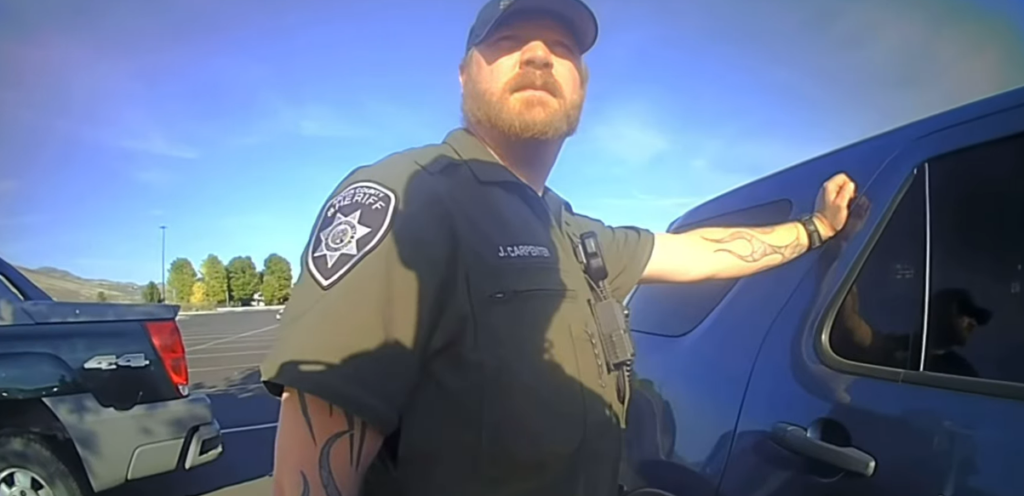
It’s worth taking a moment to sit with the call itself. According to reports, the woman on the tape informed the dispatcher that Domino had gone through three distinct vehicles. Then it became a single car with three doors as the account changed. She also mentioned that onlookers had claimed it was his car at some point during the call. Despite this, the police showed up, demanded identification, and used a taser when Domino questioned what he had done wrong. They carried him to the floor. He had handcuffs on. He was accused of obstructing justice and resisting arrest, which are common companion charges that come up whenever someone dares to ask why they are being held in the first place.
The encounter’s video went viral online and attracted the kind of public attention that worries city attorneys. Domino’s question, “What did I do wrong?” is the kind of thing that, to nearly everyone watching, sounds perfectly reasonable, but to the officer on the other end, it sounds completely menacing. By the time the video went viral, anyone who watched it could see the discrepancy between what the bystander reported and what actually occurred.
After conducting an internal investigation, the Clarkston Police Department concluded that none of the involved officers had committed any wrongdoing. Even though anyone familiar with police internal reviews would not be surprised by that result, the story didn’t end there. The criminal charges against Domino were still pending, and he had already filed a $5 million tort claim against the city. From the start, he insisted on total dismissal—a public admission that the accusations were false, not a postponement or a private settlement.
Following months of court proceedings, Domino and the prosecutor came to an agreement in November 2019. After ninety days, all charges would be dropped as long as he didn’t commit any crimes. Everything was dismissed by the city. At that point, Domino consented not to file a direct lawsuit against the City of Clarkston. The city attorney referred to it as a “win-win”—a term typically used when one party has made more concessions than the other and would rather keep it quiet. Neither side formally acknowledged any wrongdoing.
The Parking Lot, the Taser, and the $5 Million Question: Inside the Mark Domino Lawsuit
| Full Name | Mark Domino |
|---|---|
| Age at Time of Incident | 52 |
| Occupation | Walmart employee |
| Incident Location | Walmart parking lot, Clarkston, Washington |
| Date of Original Incident | Late June 2019 |
| Reason Police Were Called | Bystander reported seeing a man going through cars |
| What Domino Was Actually Doing | Retrieving items from his wife’s car after his work shift |
| Police Response | Demanded ID; when Domino questioned the stop, he was tased, taken to the ground, and handcuffed |
| Charges Filed Against Domino | Resisting arrest and obstruction of justice |
| Internal Police Investigation | Clarkston Police Department found no officer wrongdoing (August 2019) |
| Criminal Case Resolution | November 2019 — all charges dropped after 90-day crime-free agreement |
| Civil Lawsuit Filed | $5 million tort claim against the City of Clarkston |
| Settlement Amount | $25,000 paid by city’s insurance carrier |
| Domino’s Stated Primary Goal | A public apology — not financial compensation |
| Additional Agreement | Domino met with Clarkston PD to discuss future protocols |
| Legal Representation Context | Case highlighted by Chicago civil rights attorney Julian Johnson |
| Broader Significance | Widely cited as an example of racial profiling and excessive force against a Black man during a routine activity |
After the city’s insurance company paid $25,000 to settle the civil case, Domino withdrew his $5 million claim. Financially speaking, that’s a big step down. However, Domino was clear about his true desires. He desired an apology. He wanted someone in a position of authority to state unequivocally that what had happened to him was wrong. The public record doesn’t fully explain whether that apology was ever delivered in the manner he had envisioned.
For years, civil rights lawyers and academics have documented a pattern that the case fits into. A Black man going about his daily business, such as walking to a car in a parking lot, going to work, or simply being in an area where a white bystander finds his presence suspicious, suddenly finds himself in a police encounter that intensifies due to an incorrect or racially motivated call. Neutrality is not the starting point for the responding officers. The encounter has already been framed by the call. Additionally, the charge of resisting arrest arises when the person ceases to cooperate with what they rightly believe to be an unfair detention, sometimes even before anything else has been formally established.
Reading the specifics of Domino’s case gives me the impression that the $25,000 settlement and the dropped charges, while welcome, were insufficient to address the issues. He was tased by an officer who kept his job. Internal misconduct was not discovered by the department. There were no legal repercussions for the bystander who made the call. Although it’s difficult to determine how much weight that discussion carried once the cameras moved on, the agreement did include a meeting between Domino and the Clarkston Police Department to discuss future protocols for similar situations.
Julian Johnson, a civil rights lawyer from Chicago whose firm documented the case, presented it in a way that is hard to dispute: innocent activities like going to work shouldn’t be dangerous. There should be no need to write that sentence. The fact that it does, as well as the fact that cases like Domino’s continue to occur frequently enough to fill a case archive, speaks to the gap between the stated goals of the legal system and how it actually functions, especially when it comes to Black Americans going about their daily lives. After a long shift, Mark Domino strolled to his wife’s car. He lost months of his life, gained $25,000, and, according to his own account, was still awaiting the apology that was more important than the cash.
