

Investor tension tends to increase in the days leading up to a significant earnings release, and Microsoft is currently bearing the brunt of this tension. MSFT continued to rise from lows that appeared genuinely concerning earlier this year, rising roughly 1.5 percent on Tuesday to trade at about $424. At its low of $355, the stock was down almost 36% from its peak of $555 in July 2025. Since then, it has recovered a significant amount of those losses. Now, the monthly gain exceeds 10%. However, it’s still down nearly 12% year to date. Investors will learn from the April 30th earnings report whether the recovery has a solid basis or if it’s primarily the result of overconfidence.
Even by themselves, the numbers leading up to the print are encouraging. In the second quarter, Intelligent Cloud revenue increased by 29%, with Azure in particular growing by 26%. This is the kind of growth rate that most enterprise software companies can only see from a distance. Microsoft’s AI productivity suite Copilot, which is integrated into Teams and Office, has 15 million users. The most recent quarter’s revenue was $81.27 billion, up more than 16% from the previous year. Over $100 billion is the net income for the entire year. These are not the figures of a troubled business. They are the figures of a business with high expectations, which is a completely different kind of pressure.
| Category | Details |
|---|---|
| Company | Microsoft Corporation |
| Ticker | MSFT (NASDAQ) |
| Current Price (April 21, 2026) | ~$424.08–$424.38 USD |
| Day Change | +$6.01–$6.32 (+1.44–1.51%) |
| Opening Price | $420.24 |
| Day High | $427.18 |
| Day Low | $417.20 |
| Previous Close | $418.07 |
| 52-Week High | $555.45 (July 31, 2025) |
| 52-Week Low | $355.67 |
| Market Capitalization | ~$3.15 trillion |
| P/E Ratio (TTM) | ~26.16–26.54 |
| EPS (TTM) | $16.05 |
| Annual Revenue (FY) | $281.72 billion |
| Net Income (FY) | $101.83 billion |
| Dividend Yield | ~0.86–0.87% |
| Quarterly Dividend | $0.91 per share |
| Q2 FY2026 Revenue | $81.27 billion (+16.72% Y/Y) |
| Next Earnings Date | April 30, 2026 (Q3 FY2026) |
| EPS Estimate (Q3) | $4.05 |
| Revenue Estimate (Q3) | $81.37 billion |
| 1-Year Return | +17.55% |
| 10-Year Return | +664.30% |
| YTD Performance | −11.95% |
| CEO | Satya Nadella |
| Founded | 1975, by Bill Gates and Paul Allen |
| Headquarters | Redmond, Washington |
| Employees | ~228,000 |
The capital expenditure story is what really complicates MSFT’s current situation. Microsoft is expected to spend about $120 billion in fiscal 2026 on data centers, GPUs, and AI infrastructure, making it one of the biggest spenders in the entire global technology sector, along with Google and Amazon. The general consensus among analysts is that investments will eventually yield returns, and estimates indicate that once monetization matures, AI could add at least $25 billion in additional yearly revenue. However, terms like “eventually” and “once monetization matures” call for patience, and the market hasn’t always been understanding of Microsoft’s AI story. This ambivalence is reflected in real time in the stock’s 52-week journey from $555 to $355 and back to $424.
An additional level of complexity is introduced by the technical image. MSFT is currently trading above its 20-day and 50-day moving averages, which is a positive indication that it has recovered well from its lows. However, the price has had difficulty breaking through resistance around $428 to $430, and the 200-day moving average is currently at $472. Technical analysts closely monitoring the chart are observing that if that level is not cleared, the stock may return to the $405 to $410 range before making another attempt to move higher. It’s questionable if that matters to a long-term investor who holds for decades. It’s currently the key figure for traders keeping an eye on the market on a weekly basis.
Over the past year, there has been a noticeable shift in the narrative surrounding the AI competition. At one point, Microsoft appeared to have gained an advantage over its competitors when it made its historic wager on OpenAI and started integrating Copilot throughout its product line. Amazon’s AWS continues to dominate cloud infrastructure, Google’s Gemini is now integrated into enterprise workflows, and the distinction that seemed so clear in late 2023 seems a little less clear. There is pressure on pricing power. On April 30th, analysts will be questioning whether Copilot can turn its user base into significant revenue rather than just impressive adoption statistics.
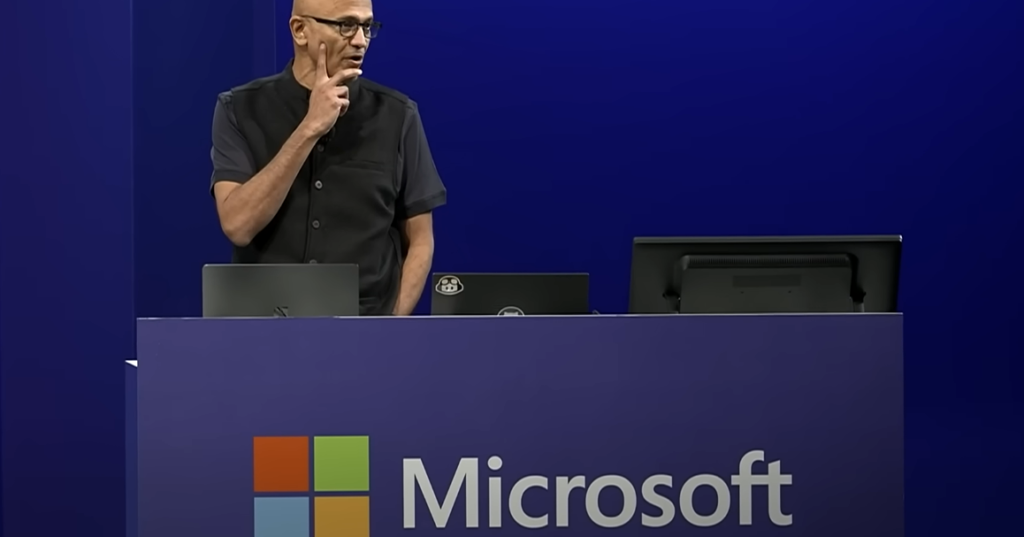
After leading Microsoft from a slow decline under a consumer software model to the cloud-first, enterprise-dominant business it became after 2014, Satya Nadella has already completely changed the company. This change resulted in one of the most impressive stock returns in the history of contemporary technology—more than 600 percent in just ten years. It’s really unclear if the AI part of that story yields similar outcomes. The infrastructure is being constructed quickly and at a high immediate cost. Next week’s earnings will offer the first concrete proof of whether it’s beginning to pay.
