

Near the town of Rivière-Beaudette, just east of the Ontario border, there is a specific stretch of pavement where Highway 401 simply ceases to be Ontario’s problem and becomes Quebec’s. There isn’t any fanfare or a sign that says “welcome to something bigger.” It simply becomes Autoroute 20 after that, and depending on which stretch you’re counting, it doesn’t really let up for an additional 585 kilometers.
As a result, it is the province’s longest autoroute. Additionally, it is one of only two actual thoroughfares that connect Quebec City and Montreal; the other is the A-40. Regular drivers of both have strong, somewhat illogical opinions about which is superior. For the majority of its length, the 20 hugs the St. Lawrence, which sounds picturesque until you consider that it also transports about 145,000 cars every day through its busiest section on Montreal’s West Island. That number is anything but leisurely.
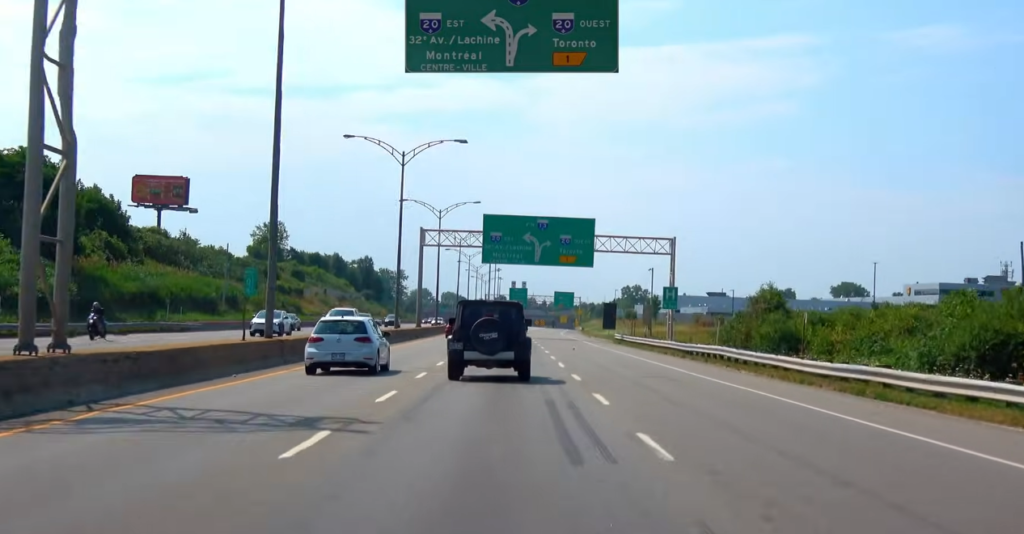
When driving at highway speed, it’s easy to overlook how much history is woven into the pavement. In honor of Canadian veterans, the westernmost portion was given the name Autoroute du Souvenir in 2007. A tiny poppy is still displayed on the road signs there. The majority of drivers ignore it as they drive by. It’s the kind of detail you only notice if you’ve been stuck in traffic long enough to read the signage, which can be easily arranged depending on the day.
The highway is renamed Autoroute Jean-Lesage, after the premier who led Quebec through the Quiet Revolution, as it continues east past the Champlain Bridge crossing and the renovated Turcot Interchange. Naming a section of concrete after a political period is an odd choice. However, compared to most places, Quebec treats its roads as a kind of ongoing commentary on its own history.
The gap comes next. A second, shorter section that avoids Rimouski and ends at a roundabout in Mont-Joli is about 55 kilometers away from the main segment, which ends close to Trois-Pistoles. The environmental reviews have been completed by the province. The economic studies have been completed. It hasn’t invested the funds necessary to truly close the gap for years. Tolls have been suggested by local mayors. The unfinished two-lane section near Rimouski, where moose occasionally wander into traffic and where an electric fence and a wildlife underpass were eventually built to prevent that from happening as frequently, has been the subject of accident statistics cited by politicians. It’s difficult not to interpret that as a modest, pragmatic acknowledgement that the highway’s current design was never fully completed.
Another expression that Quebecers use almost automatically is “the other end of the 20,” or “theautre bout de la 20.” It means Montreal when said in Quebec City. It refers to Quebec City when spoken in Montreal. It’s an oddly neat way to describe distance, and it illustrates how important this one road has become to the way the locals think about moving from one life to another.
Currently, workers are adding a third westbound lane through the median and widening a section close to Lévis. It’s the type of project that creates its own delays while promising to correct them later, which seems to be the highway’s defining characteristic.
