

Mike Debus had limited knowledge of Dutch soccer. He would be the first to acknowledge it. However, he ordered a Netherlands jersey from Etsy last Thursday after a friend told him to show up at the intersection of Grand Boulevard and Pershing Road without providing a clear explanation. He reasoned that he would find out what the commotion was about.
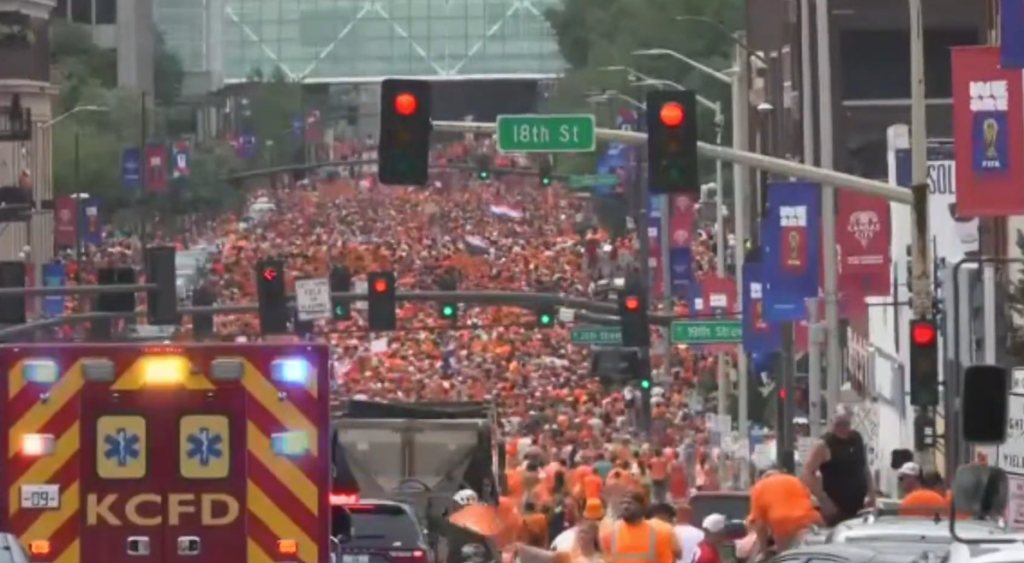
This World Cup, Kansas City has followed that pattern, and it’s worth pondering for a moment. The city did not choose a favorite nation to become fixated on. It has been worked through multiple times. Early in the competition, Argentina had its moment. A week later, Ecuador filled Arrowhead Stadium. Algeria developed a relationship with the locals that was almost authentic. Now it’s the Netherlands, where an estimated 20,000 supporters marched down Grand Boulevard in an orange wave that extended over a mile, with locals joining in on the chants as though they had been rehearsing for months.
Observing a Midwestern city that based its sports identity on tight end records and barbecue become the “Soccer Capital of America,” according to its own marketing department, is almost humorous. Until you actually witness it, it seems like a stretch. Growing up in Kansas City and witnessing a few Chiefs Super Bowl parades along that same stretch of Grand, Brian Hudson said this one felt different. He wasn’t merely observing from the pavement. It contained him.
Almost unintentionally, FIFA Kansas City continues to produce that texture. To watch the Oranje Fanwalk go by, office workers got up from their desks. Marchers who weren’t even customers were given bottled water by a PNC Bank branch a few blocks north. FIFA and the host committee did not organize any of it. It just happened, the way a city occasionally determines, unanimously and without much debate, that something is worth attending.
The storms were not very helpful. The FIFA Fan Festival had to close early as a precaution due to a wall of severe weather that rolled through Thursday afternoon. Lightning strikes and strong winds are risks that organizers cannot take. Fans hardly seemed to notice. The rain that followed didn’t dampen much more than people’s shoes, and many had already relocated from Fan Fest to the Power & Light District. By Tuesday, 147,000 people had attended the Fan Festival; however, this figure was probably out of date within hours of Thursday’s spike in attendance.
That night, in front of an almost entirely orange stadium, the Netherlands defeated Tunisia 3-1 inside Arrowhead. Moe and Hamza Salhi, two Tunisian supporters who had flown in from Miami specifically to participate, stood out in red and white from the second floor of Power & Light. Salhi said he wasn’t prepared for Kansas City to be so hospitable. It’s a brief remark that is simple to overlook, but it sums up what this host city has accomplished. People continue to arrive with low expectations and depart in shock.
It’s difficult to predict if that kindness will endure beyond the competition. After the cameras leave, host cities frequently experience a brief period of euphoria before discreetly returning to normal. Algeria and Austria are still to come this weekend, but Kansas City has already had practice, having taken in Messi’s supporters in mid-June and Dutch ones by late-June. It’s difficult to ignore the fact that every new wave of tourists seems to flow into the city rather than collide with it; this might be FIFA’s most enduring legacy here.
