

Occasionally, a collegiate athlete does more than just upset a stat sheet; they change the legal landscape of an entire school. Diego Pavia has done precisely that. The eligibility of one athlete was not the only issue at hand. It was a calculated blow to a system that was densely woven, and it was incredibly successful in revealing the weakest stitch.
By the end of 2024, Pavia had already shown himself as a resilient and adaptable quarterback, making waves in junior college before making waves at New Mexico State and Vanderbilt. But it was his choice to sue the NCAA for denying him his final year of eligibility, not his on-field skill, that garnered national notice. The cause? He was fined for years as he worked his way up from JUCO by a regulation hidden in the transfer policy. More than that, though, the law might have deprived him of his most profitable window for NIL earnings.
The case, which was filed under the Sherman Antitrust Act, touched a chord. It questioned more than simply policy. By claiming that the NCAA’s regulations placed unjust financial constraints on student-athletes like Pavia who had already cleared all the requirements, it presented the regulations as market meddling. The judges paid close attention. A federal judge granted a preliminary injunction, enabling him to participate in the 2025 season—a rather creative strategy. Even outside of Nashville, that one decision had an impact on campuses.
Key Context Table
| Element | Details |
|---|---|
| Plaintiff | Diego Pavia, quarterback at Vanderbilt University |
| Defendant | NCAA (National Collegiate Athletic Association) |
| Filed | November 2024, U.S. District Court for the Middle District of Tennessee |
| Legal Basis | Alleged violation of the Sherman Antitrust Act |
| Core Issue | JUCO transfer eligibility rules & NIL earning restrictions |
| Outcome So Far | Preliminary injunction granted; eligibility upheld by federal appeals panel |
| Broader Impact | Could spark class-action lawsuits and reshape JUCO/NIL policies |
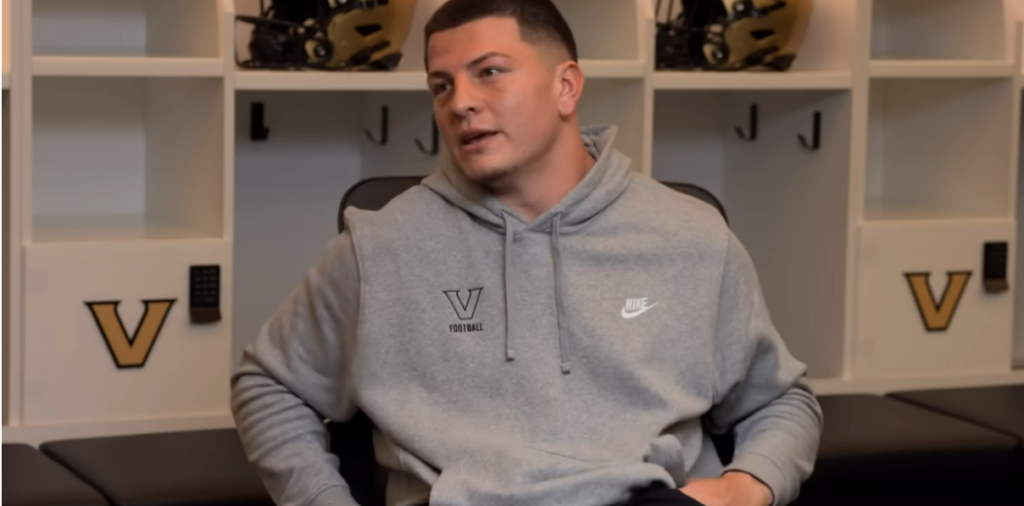
The NCAA filed an appeal right away in an attempt to regain its power. Despite the rapidly evolving legal and cultural landscape, the Sixth Circuit remained unfazed. The panel maintained the injunction while allowing for a more thorough examination. It was becoming very evident that this case would not be forgotten, even though the appeal was rejected as moot.
As athletes navigate the complex web of eligibility clocks and transfer regulations, Pavia’s legal position has evolved to resemble their own frustrations. His story is similar to that of hundreds of other players who followed every step just to have their most valuable years disappear because the rules were out of date.
Pavia did something fairly audacious by inviting antitrust law to regulate amateur sports, relying on the courts rather than the conference table. Instead of turmoil, the outcome was clarity.
Athlete rights discourse has significantly improved over the last ten years. Earning potential was made possible by Name, Image, and Likeness policies, but NCAA transfer regulations were still lagging behind and functioning more like holdovers from a time before the internet. Pavia’s case was therefore about more than just justice. Catching policy up to reality was the goal.
It wasn’t only that he wanted to play, I recall thinking. He wants to be allowed to develop without being penalized for his beginnings.
What’s especially advantageous is how this lawsuit changed the dynamics of power in collegiate athletics. Athletes were told for years that their rights ended at the institutional system. That line is now changing, though, with NIL and legal precedent on their side. Scholars of law have begun referring to it as a model for future reform, particularly if this becomes a class-action lawsuit. The likelihood of that happening increases every week.
By using this perspective, the Pavia case becomes less about a quarterback and more about a more comprehensive review of how we handle talent, particularly when it doesn’t come with five-star recruitment status. JUCO athletes and athletes from poor programs are frequently less visible. However, they now have a method to battle for seasons that are still valuable, both financially and competitively, after gaining legal momentum.
Meanwhile, the NCAA is straddling a more precarious line. At first glance, this position—that uniform principles must be applied consistently—seems reasonable. However, the legality of those regulations is undermined if it is demonstrated that they hinder fair competition or opportunity. In a system that makes millions from sponsorships, conference agreements, and television rights, that is particularly true. The disparity between player limits and institutional earnings is now too stark to overlook.
Support for Pavia’s position has progressively increased since the beginning of the court conflict. Legal experts, advocacy organizations, and other athletes are keeping a careful eye on this outcome, prepared to use it as leverage in other conflicts. One rule at a time, challenge the system’s most antiquated mechanics rather than trying to blow it up. This is a straightforward yet incredibly effective approach.
For student-athletes, this marks a real change, particularly for those who are switching programs. Transfer years don’t have to be viewed as wasted time. Once governed by mysterious rules, eligibility may become negotiable, adaptable enough to change in response to institutional preferences rather than real-life advancements.
Diego Pavia had no intention of becoming a symbol. He desired to play, compete, and maximize his little opportunity to play in Division I. He provided others with a legal vocabulary to demand the same, though, by refusing to silently accept a rule that didn’t match his quest. And when new difficulties arise, that might show to be incredibly resilient.
