

The buildings are difficult to miss when you pull off nearly any major highway corridor in Missouri, such as I-70 heading east toward St. Louis or the section of I-35 passing through Kansas City’s northern suburbs. Huge, barely noticeable, and nearly featureless from the outside. There are no signs that would be significant to a passing motorist. loading dock rows. Semi-truck parking lots are endless. The light is captured by a few security cameras. They don’t appear to be much from the road. They contain some of the world’s most intricate logistics infrastructure, with robotic systems operating around the clock and moving bins at speeds that are unmatched by human labor.
It wasn’t by accident that Missouri became a center for logistics. In a practical as well as symbolic sense, the state’s location at the nation’s geographic center makes it possible for freight traveling from the coast to reach the majority of Americans within a day’s drive from a strategically located facility outside of Kansas City or St. Louis. Amazon was the first to notice this. In 2017, the company leased its first two Missouri warehouses, which at the time seemed like a subtle hint of something bigger. Since then, the footprint has expanded significantly, bringing with it a whole ecosystem of rival retailers, developers, and industrial landlords attempting to keep up with Amazon.
In 2024 alone, Amazon spent $98.5 billion on fulfillment. To put it another way, the company operates over 680 million square feet of logistics-related real estate worldwide, which is roughly equivalent to 340 NFL stadiums. That figure is nearly unimaginable on any human scale. One node in a network created to shorten the time between a consumer clicking “buy” and a package reaching their door, Missouri is a part of that empire. Building in Missouri makes sense because you can quickly reach a sizable portion of the American population, land costs are more affordable than in coastal markets, and the transportation infrastructure is already in place. The physical geography created for distribution includes interstate highways, rail connections, and a river system that continues to transport industrial freight.
| Category | Details |
|---|---|
| Key Company | Amazon.com, Inc. |
| Amazon Fulfillment Spend (2024) | $98.5 billion |
| Amazon Logistics Real Estate | Over 680 million sq ft globally |
| Amazon Property Added (2024) | $48.5 billion in property and equipment |
| Missouri’s Geographic Advantage | Central U.S. location; intersection of major interstates (I-70, I-44, I-55) |
| Amazon’s First Missouri Warehouse | Signed 2017 (two buildings) |
| Walmart U.S. Distribution Centers | 164 nationally; 29 dedicated e-commerce fulfillment centers |
| Key Industrial REIT Players | Prologis, Link Logistics, Rexford |
| Automation Technologies | Symbotic SymBots, Amazon Sparrow/Proteus/Sequoia, Ocado systems |
| Missouri’s Logistics Appeal | Low land costs, central freight position, highway and rail access |
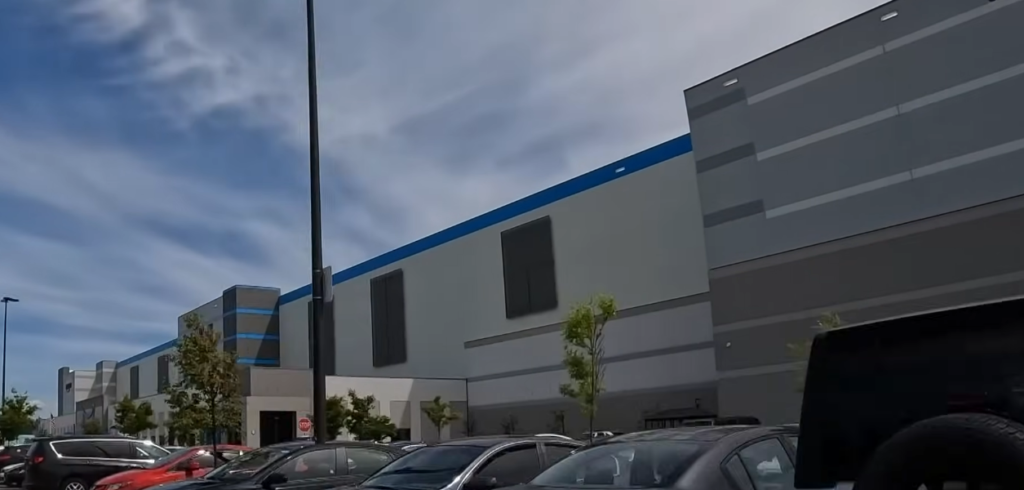
The technology within these structures is evolving, in addition to their scale. The steel-and-concrete boxes of twenty years ago are very different from the warehouses being constructed or renovated today. Higher clear heights of 36 to 55 feet to accommodate robotic storage systems, reinforced floors for autonomous mobile robots, and power infrastructure for fleets of machines that run lights-out during overnight shifts are all examples of how modern fulfillment centers are built with automation in mind. Instead of just building boxes, industrial real estate firms like Prologis are now investing directly in the robotics startups that will occupy those boxes, viewing the entire enterprise as integrated infrastructure rather than passive real estate. That strategy makes sense. Only if technology continues to advance and the real estate can sustain it will the buildings continue to be valuable.
Although it receives less attention than Amazon’s, Walmart operates a parallel business. Walmart has effectively transformed its store network into a last-mile logistics asset, with 164 distribution centers across the country and 29 e-commerce fulfillment facilities. The majority of its more than 4,600 U.S. locations now serve as fulfillment hubs for curbside pickup and same-day delivery. In fiscal 2025, the company made $23.8 billion in capital expenditures, of which more than $14.6 billion went toward automation and supply chain technology. This investment is evident in communities that have long relied on Walmart as an anchor employer in Missouri, where the company has deep roots, through improved distribution infrastructure.
It’s difficult to ignore the implications of all of this for Missouri’s economic identity. The Missouri River, railroad networks, and highway system have always made the state a freight corridor, but the current wave of warehouse construction is different in scope, if not in kind. Though they differ from the manufacturing jobs that characterized Missouri’s industrial economy in previous decades, the jobs it generates typically pay fairly well by regional standards. It is genuinely unclear whether warehouse automation will eventually result in the creation or elimination of large-scale jobs, and it most likely won’t be for years. It is evident that the infrastructure is being developed, the investment is substantial, and Missouri is well-positioned to play a major role in the flow of American trade for a very long time.
