

There is a certain type of Washington story that begins with genuine promise and concludes with a social media post from a White House aide. This isn’t even a presidential statement, but rather a subtle announcement from the communications director that gets lost in the day’s commotion. On Monday, Lori Chavez-DeRemer’s term as Labor Secretary came to an end. Not much fanfare. No farewell to the Oval Office. Steven Cheung’s brief statement about her “phenomenal job” was followed by the announcement that she was leaving to pursue a position in the private sector. That phrase is doing a lot of work in Washington.
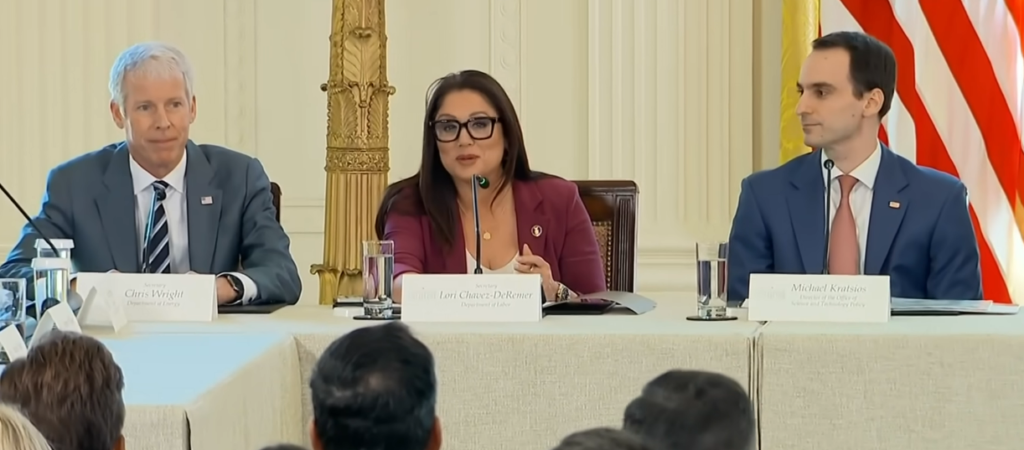
In March 2025, Chavez-DeRemer joined the Labor Department with a truly unique set of qualifications for a Republican Cabinet nominee. Raised in Hanford, California, and the daughter of a Teamsters member, she eventually found political success in Happy Valley, Oregon, a suburb outside of Portland, where she was elected as the city’s first Latina and female mayor in 2010. Her willingness to deviate from the party line on labor issues was a defining characteristic of her one term in Congress as a representative of a competitive swing district. She supported legislation that would facilitate unionization at the federal level. She cast her vote to keep public sector employees’ Social Security benefits intact. She was recommended for Labor Secretary by the Teamsters. She received a confirmation vote of 67-32 as a result of these signals, which was exceptionally comfortable given the current political environment. It also suggested that she might be able to bridge the gap between the labor constituency, which at least partially trusted her, and a deregulatory Republican administration.
Lori Chavez-DeRemer Is Out — And the Allegations That Brought Her Down Are Worse Than You Think
| Category | Details |
|---|---|
| Full Name | Lori Michelle Chavez-DeRemer |
| Date of Birth | April 7, 1968 |
| Age | 58 |
| Birthplace | Santa Clara, California |
| Party | Republican |
| Spouse | Shawn DeRemer |
| Education | California State University, Fresno (1986–1990) |
| Political Career | Mayor of Happy Valley, OR (2010–); U.S. Representative, Oregon’s 5th District (2023–2025) |
| Cabinet Role | 30th U.S. Secretary of Labor (sworn in March 11, 2025) |
| Senate Confirmation Vote | 67–32 (bipartisan) |
| Reason for Departure | Multiple misconduct allegations, Inspector General investigation |
| Successor (Acting) | Keith Sonderling |
| Departure Announced | April 21, 2026 |
| Notable Distinction | First woman and first Latina mayor of Happy Valley, OR |
Her tenure’s reality was far more nuanced. Despite this, the deregulatory agenda proceeded. Under her direction, the Labor Department revised or eliminated over sixty workplace regulations, lowered the minimum wage requirements for home health care providers, and relaxed restrictions on exposure to hazardous materials at mines, among other things. There was a clear disparity between her policy record and her reputation. However, that might not have caused her to fail on its own. Something messier and more intimate was what derailed her.
In January, word leaked out that Chavez-DeRemer, her top aides, and her family were the subject of an investigation by the department’s inspector general. When combined, the various accusations depicted an office functioning more like a personal fiefdom than a federal agency. She was charged with having an extramarital affair with a subordinate who was part of her security detail. This raises clear ethical and professional issues that go beyond the personal. It is said that she drank alcohol at work. Allegations surfaced that she assigned junior employees to organize official travel mainly for personal purposes, utilizing departmental resources more for convenience than for a purpose. Separately, after female employees accused her husband, Dr. Shawn DeRemer, of inappropriate physical contact, he was prohibited from entering the Department of Labor headquarters. It has also been reported that her father texted young female employees. It was hard to defend the entire tableau in a logical manner.
The timing of the White House’s response is difficult to ignore. Official statements referred to the reports as unfounded for weeks. As the accusations increased, the denials became less certain, and eventually the question in Washington changed from whether the accusations were true to just when the departure would be made public. By the time Chavez-DeRemer herself departed, at least four Labor Department employees had already been fired, including her former chief of staff, her deputy chief of staff, and the security detail member at the center of the alleged affair. What was going on inside the building was revealed by the internal turnover alone.
On her personal social media, Chavez-DeRemer blamed the accusations on “deep state actors” working with the media, while she denied any wrongdoing in the specific legal sense (her lawyer pointed out that no formal finding of law-breaking had been made). Even with sympathetic audiences, it’s unclear how much traction that framing, which has become a common exit strategy in Trump-era Washington, gains. “I think the secretary demonstrated a lot of wisdom in resigning,” said Republican Senator John Kennedy of Louisiana.
After Kristi Noem and Pam Bondi, she is the third member of the Trump Cabinet to leave this term. It is genuinely unclear whether this rate of Cabinet turnover speaks to the administration’s management culture, personnel screening, or just the challenges of governing under constant scrutiny. It is evident that Chavez-DeRemer left under circumstances that make it difficult to recall why she was initially viewed as promising and that she arrived with more cross-aisle goodwill than the majority of her colleagues. Her deputy, Keith Sonderling, assumes the role of acting secretary. The department is still working. Presumably, the investigations also do.
