

When you stand at the intersection of Fourth and Pierce streets in Phoenix’s downtown, you’ll notice something that no longer quite fits the skyline. A pale, worn-out Queen Anne house is surrounded by the geometric aspirations of a university campus that is still developing. On what ASU is referring to as its Health Headquarters, construction has already begun.
This one house, which was constructed around 1900 by a butcher named Louis Emerson, is the last thing separating the institution from complete ownership of the block. Emerson could not have predicted that his home would eventually be the focus of a lawsuit brought by one of the biggest public universities in the nation.
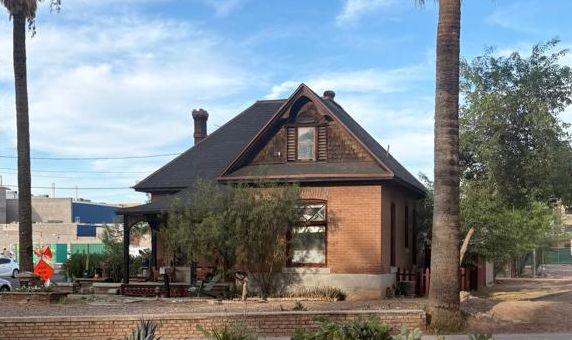
After talks with the owner allegedly came to a standstill, the Arizona Board of Regents, acting on behalf of ASU, launched the ASU eminent domain action in Phoenix to compel the sale of the land through legal means. Robert Young, the owner of the house, is eighty-nine. He bought the property in the 1970s, when downtown Phoenix didn’t look like it does now, and he and his wife had lived there for decades. For the last eight years, Barry Schwartz has been his renter. By all accounts, neither man wants to go.
According to the university, it submitted a number of proposals, some of which called for moving the home instead of demolishing it. A state-certified appraiser determined its final bid of $815,000, which was given to Young in a letter in April. On the surface, ASU’s stance seems sense because the offer was formally evaluated, the project is already in progress, and it appears that the campus layout cannot accommodate the house in its current location. From the inside of a planning office, everything can appear well-organized and logical. Schwartz, however, has a different perspective on the math.
According to him, moving a 124-year-old Queen Anne building might cost between $2 and $3 million, including lifting, carrying, and pouring a new foundation. There is no rounding error in the difference between that amount and $815,000.”They’re all about sustainability,” Schwartz remarked with a sense of justified annoyance. “Well, you need to sustain this house and its history.” The line is crisp.
Like many large colleges, ASU places a strong emphasis on community and environmental principles in its marketing. The question of whether Phoenix should remove a portion of its architectural history in order to create a medical school square with that identity is one that the institution hasn’t completely addressed, at least not in public.
Marshall Shore, a local historian, has spoken out about issues that go beyond the legal dispute. According to Shore, the house shouldn’t be viewed as a barrier. In his opinion, it ought to be absorbed, built around, and transformed into something that gives the new campus a feeling of place. “Instead of treating it like an eyesore, turn it into a crown jewel,” he said. The notion that ancient things may survive with new aspirations instead of being wiped by them is the kind of argument that seems clear until money is involved. It seems as though ASU has already made up its mind, and the lawsuit is more of a formality than a negotiation.
In the hopes that sufficient public pressure will cause the institution to pause, Schwartz and Young are gathering signatures on the petition. It’s a well-known strategy in battles like this one, and its track record is, at best, uneven. Eminent domain lawsuits typically end in the public institution’s favor, especially when the institution is asserting a public benefit. Since the historic 2005 Kelo v. City of New London decision, which increased government seizure powers and ignited indignation that still simmers in property rights circles, courts have typically construed “public use” broadly. Since then, Arizona has passed some protections, but it’s unclear how those will work in this situation.
Young and Schwartz are scheduled to appear in court on June 19. It’s difficult not to question if the conclusion was predetermined when ASU started construction in April, even before the case was filed and before Young had officially turned down any offer. The home remains intact. For the time being. However, a single Queen Anne residence, no matter how legendary, is rarely enough to stop universities since they have longer budgets and memory. The outcome of Phoenix’s ASU eminent domain case may reveal more about the city’s decision to measure the costs of what it is willing to lose against the weight of what it is creating than it does about a single old house.
