

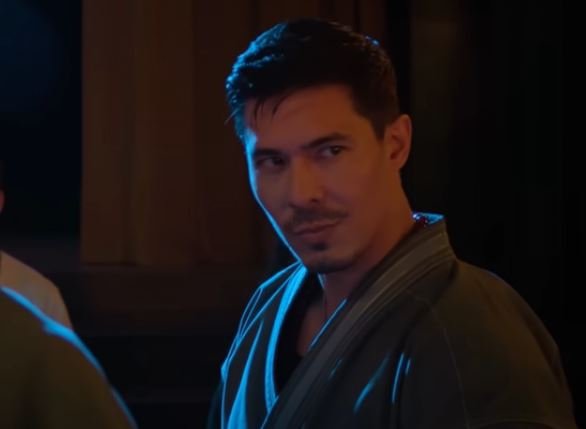
One little thing about Lewis Tan says a lot. Sensei Wolf, a character in Cobra Kai’s sixth and final season, has prayer beads tucked under his training gear, which isn’t exactly sensible for a man whose job it is to toss people across a dojo floor. The script doesn’t mention the beads. Tan placed them there himself, inspired by a recollection of a sensei from his early years who wore the same item and whose beads he could feel pressing against his skin when he was flung to the ground as a young boy. An actor who is familiar with the material can be distinguished from one who has only studied it by this level of specificity.
In Season 6, Tan joined Cobra Kai as Sensei Wolf, one of the main antagonists propelling the Sekai Taikai international tournament arc and the head of the Iron Dragons dojo. He debuted in Part 2, left in November 2024, and continued to play the character until Part 3’s series finale. The choice to bring in a new rival at this late stage was risky for a show that spent five seasons building toward a conclusion. Tan is largely responsible for the fact that it mostly worked out.
Tan was raised mostly in Los Angeles after being born in Salford. His father, Philip Tan, a martial artist and stunt coordinator whose work literally shaped the industry, was half Chinese and half English. From an early age, Philip trained Lewis and exposed him to movies such as The Karate Kid. He also sat with Lewis on the couch and showed him films starring Marlon Brando, Sidney Poitier, and Jackie Chan. It’s the type of upbringing that either results in real depth or turns into something an actor brings up in every interview. It appears to be the former when Tan is involved.
His career developed over time. Early television appearances include Hawaii Five-0, NCIS, and CSI. A supporting part in the first season of Iron Fist on Netflix. He then portrayed Shatterstar in Deadpool 2, Wu Assassins, Shadow, and Bone, and the lead role in the Mortal Kombat reboot. As the roles grew, so did his physical dedication to them. He does his own stunts in a variety of styles, including Japanese katana work, Jiu-Jitsu, Kung Fu, and Muay Thai. It appears on screen, so it’s not a marketing point. Most choreography, no matter how well-designed, tends to flatten the weight of the action in his scenes.
The challenge posed by Sensei Wolf was different. Tan has discussed training in the San Fernando Valley, where a large portion of Cobra Kai is set, and participating in competitions similar to those portrayed in the show. He was familiar with the particular tension that precedes a game and the smell of those gyms. Because the setting was so familiar, creating a character who felt unique required careful decisions, such as the accent, which elicited conflicting responses from online viewers. It was distracting to some. Others turned it into content, maybe with less generosity. Tan has proposed that the ambiguity was deliberate, that the enigma surrounding Wolf’s beginnings was intended to make him unsettling in ways that would not be possible with clear exposition.
Tan also expressed the hope that viewers would see a softer Wolf in the last episodes, a character whose early ferocity was surface-level rather than fundamental. This is something to think about. It’s questionable if the show’s concluding chapters fulfilled that promise. The physicality and peculiar quiet that Tan added to scenes in between the confrontations—a stillness that most action actors overlook—are more difficult to dispute.
His current roles in Mortal Kombat II and a comedy starring Vince Vaughn and James Marsden indicate that he is making a conscious effort to branch out from the genre that Hollywood typically assigns to actors with his background. Whether the industry will allow him to make that change is still up in the air. However, it’s difficult not to believe he’s earned the right to try after seeing what he created with Sensei Wolf in the closing moments of one of Netflix’s most popular action series.
