

In Cobra Kai, Kenny Payne’s introduction is almost purposefully unglamorous. Unaware that the bus has arrived and that the other students are already making fun of him, he is dancing by himself at a bus stop. It’s a brief, distinct moment that sticks. In the first few episodes of season four, Kenny is lured to Balboa Park in a video game costume by Anthony LaRusso and his pals, who then beat him on camera. While they are searching for him, he hides in a garbage dumpster to get away. It’s really challenging to watch.
Kenny Payne is based on that. His dad is serving overseas. Shawn, his brother, is in juvenile detention. Kenny is mostly on his own at a new school where he doesn’t know anyone because his mother works nonstop. Those early scenes are especially raw thanks to Dallas Dupree Young, who plays Kenny and was the youngest cast member of Cobra Kai when he joined in season four at the age of fifteen. He simply appears to be a child who has experienced something real and is unsure of how to deal with it; he is not acting vulnerable.
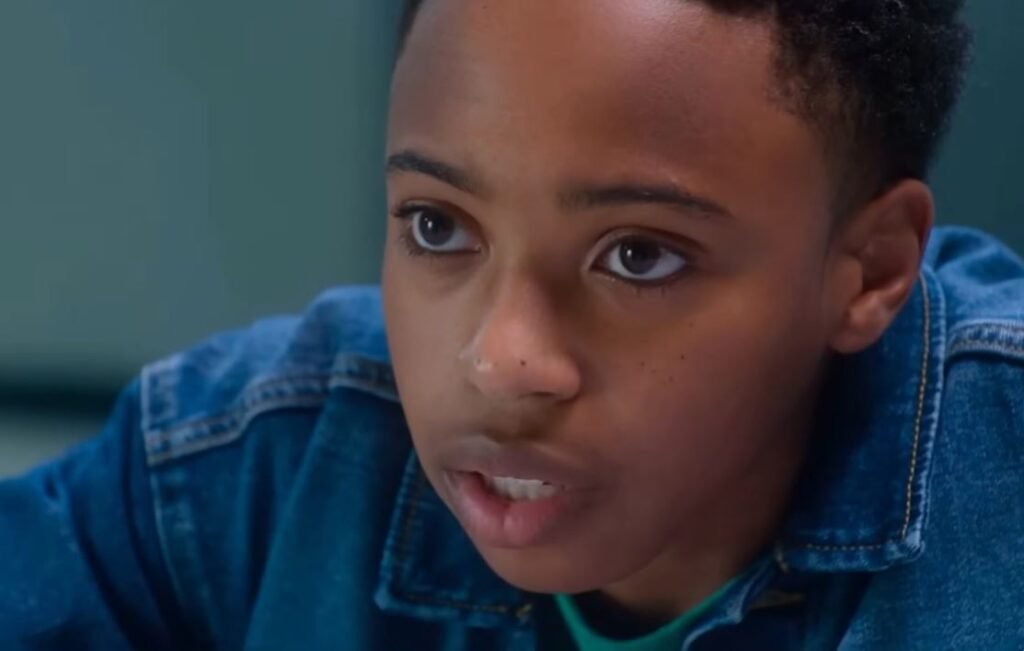
Robby Keene, via his imprisoned brother, is the conduit to Cobra Kai. When Kenny shows up at the dojo in search of Robby, he instead encounters Cobra Kai’s organized aggression and finds something he hasn’t had much access to: a sense of physical strength and community. For a boy who has been on the losing end of every encounter for months, the “strike first, strike hard, no mercy” philosophy appeals. That makes sense. It also makes it more difficult to watch what comes next.
Kenny is no longer the kid in the dumpster by the fifth season. He now poses a threat in the hallway, treating Anthony with the same deliberate brutality that was previously used against him. Near the end of season four, in a scene in the library, Kenny turns off the lights and methodically corners Anthony’s friends one by one until only the two are left. Unlike the early bullying, it is controlled and intentional. It is not romanticized in the show. The issue is that Kenny has mastered Cobra Kai’s lessons.
Despite some online criticism that Kenny rose thru Cobra Kai’s ranks too quickly, this arc works because the show never forgets why Kenny got there. He isn’t a blatantly evil individual who opted for brutality. He is a lonely adolescent who discovered a setting that encouraged the worst kind of suffering. Cobra Kai typically handles that distinction better than the majority of shows in this genre. Playing both the victim and the offender was a “honor,” according to Dallas Dupree Young, who also noted the range it required.
In season six, the redemption comes when the building surrounding Kenny begins to fall apart. Terry Silver is no longer with us. As far as he was aware, Cobra Kai broke. Kenny must discover his true self without the institutional support of the dojo’s darker ideology. Eventually, he competes for Miyagi-Do in Barcelona, makes amends with Anthony in a way that feels earned rather than abrupt, and finishes the series training with Devon and Anthony in a dojo that isn’t based on “no mercy” anymore.
Looking back at Kenny’s three-season arc, it seems as tho Cobra Kai used him to illustrate a point that the older characters had already made, but from a younger, more direct perspective. This cycle was experienced by Miguel, Hawk, and Tory. Perhaps as a result, Kenny’s version is a little more honest about how quickly a mistreated child can turn into the thing they feared, but it is also more condensed and angry. That observation is uncomfortable. The show doesn’t shy away from it either.
