

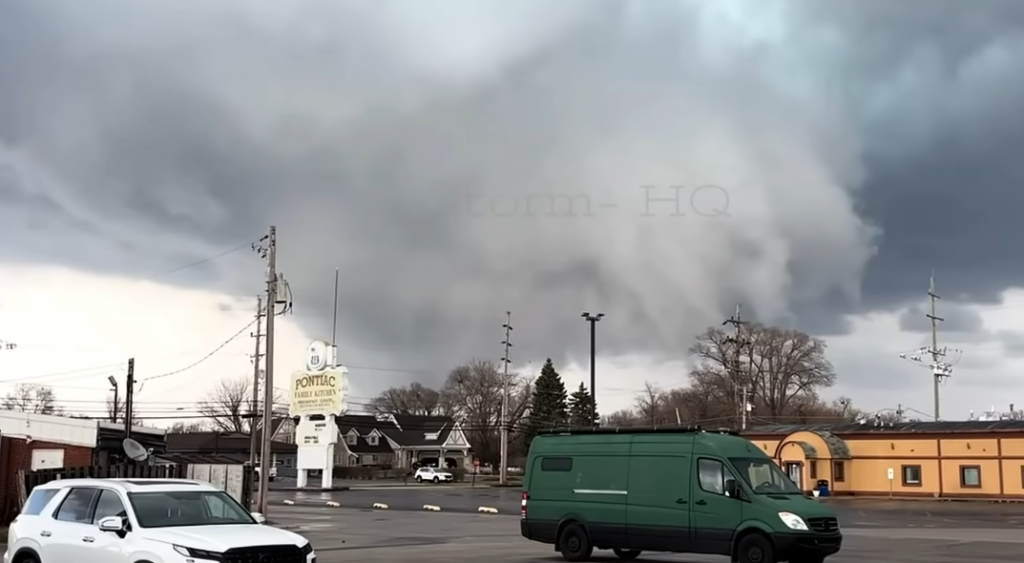
Baseball-sized hail ripped through Paola and Osawatomie in Miami County, Kansas, which is just across the state line from Missouri, on the evening of April 15. Before the storm cells had completely passed, roofs were destroyed, car windshields collapsed, and an emergency was declared. Images from that night quickly went viral on the local news: fist-sized hailstones on driveways, siding stripped off of homes, and the unique kind of neighborhood silence that follows disastrous weather when people are still inside evaluating what they’ve lost. It was the beginning of a routine procedure for insurance adjusters. It was just another line item in what is turning into a costly yearly ritual for homeowners in Missouri and the surrounding area.
Tornadoes receive more cultural attention than hail. Hailstorms are not given names. The dramatic footage of a funnel cloud descending over level farmland is not produced by them. However, hail is by far the bigger issue for the insurance sector. Hail, not tornadoes, accounts for between 50 and 80 percent of all homeowner insurance claims resulting from severe weather events. Although they have a smaller footprint, tornadoes are more destructive when they strike. In an hour, a hailstorm can cover hundreds of square miles, shattering every unshielded window, denting every car, and puncturing every roof in a large area of suburban Missouri. Even though each of the subsequent claims appears to be manageable, taken as a whole, they are enormous.
Between 2017 and 2019, Missouri had more than 133,000 hail insurance claims, placing it seventh in the country. The only states that scored higher were Texas, Colorado, Nebraska, Minnesota, Illinois, and Kansas, all of which are located in the regions that storm researchers monitor the most. The area isn’t particularly unlucky. It is simply in the path of an atmospheric pattern that consistently produces severe convective storms from spring through early fall, year after year, producing hailstones that, according to researchers, are getting bigger as atmospheric conditions change.
| Missouri & National Hail / Insurance — Key Data | |
|---|---|
| Missouri Hail Claims Rank | 7th in the nation (133,704 hail loss claims, 2017–2019 — Insurance Information Institute) |
| National Avg. Premium Increase | +24% in recent years (Consumer Federation of America) |
| State Premium Increases (nearby) | Nebraska +35%; Arkansas +34%; Minnesota +32%; Iowa +27%; Texas +27%; Colorado +27% |
| ZIP Code Shock (April 2026) | 12 zip codes in MO, AR, TN, IL, MS saw premiums triple overnight |
| State Farm 2025 Hail Claims | 394,000+ claims nationally; $5.6 billion in payouts |
| Industry Losses (Severe Convective) | $60 billion in 2023 (NY Times); $20B+ annually since 2016 (Aon) |
| Hail’s Share of Claims | 50–80% of all homeowner claims from severe convective storms (WTW) |
| Hail Size Trend | Scientists predict hailstones will grow larger as Earth heats up (Science Daily); large hail incidents +2%/yr since 1990 (Aon) |
| Fortified Roof Cost vs. Savings | Approx. $15,000 investment vs. ~$80 annual premium discount (First Street) |
| Recent Missouri Events | Baseball-sized hail: Paola & Osawatomie, Kansas (April 15, 2026); State of Emergency declared in Miami County |
| Insurer Response | Shifting from replacement cost to actual cash value for roofs; dropping policyholders in high-risk areas; raising deductibles |
This pattern is giving rise to a premium image that is not subtle. The Consumer Federation of America reports that in recent years, the average national increase in insurance costs has been 24%. The increases are more pronounced in the states that border Missouri: Nebraska has increased by 35 percent, Arkansas by 34 percent, Minnesota by 32 percent, Iowa by 27 percent, Texas by 27 percent, and Colorado by 27 percent. Additionally, a dozen zip codes in Missouri, Arkansas, Tennessee, Mississippi, and Illinois reportedly saw their premiums triple overnight in April 2026 as a result of insurers updating their risk models to account for an eastward shift in severe weather patterns. Three times. not progressively greater. Not twenty percent more costly. Unannounced to homeowners who had already purchased property and established lives in those communities, the price was tripled.
Some of those increases may be contested or modified. However, the trend is evident and reflects what insurers have been observing for the past ten years. In 2025 alone, State Farm paid out $5.6 billion after processing over 394,000 hail claims nationwide. One of the biggest reinsurance brokers, Aon, has come to the conclusion that the financial costs of hail have reached what it refers to as a “new normal”—language that has significant weight when coming from a business whose operations rely on accurately pricing risk. Their data shows that large hail incidents have increased at a rate of about 2 percent annually since 1990. However, because more people than ever before reside in hail-prone areas and because the cost of repairing hail damage has increased along with everything else, insurance payouts have increased far more quickly than the frequency of storms.
The term “expanding bull’s-eye” refers to what happens when suburban sprawl pushes population growth outward from city centers into previously less densely developed areas. It originated in a 2014 academic study and has since become widely used in the insurance industry. This includes Missouri’s mid-sized cities like Springfield and Columbia, as well as the suburbs of Kansas City and St. Louis, all of which have experienced steady growth over the previous 20 years. There will be more claims in Hail Country if there are more homes there. It’s that mechanical, really.
The gap between what they can realistically do and what would truly make a significant financial difference is what irritates homeowners attempting to navigate this terrain. Investing in resilient roofing—impact-rated materials, steeper slopes, and improved drainage—is advised by risk consultants and insurers. The cost of a fortified roof could be $15,000. It usually receives a premium discount of about $80 annually. Many people are not motivated to take action by the payback period’s math. Instead of considering a roofing investment’s 187-year return, the majority of Missouri homeowners are focused on their mortgage payment for the upcoming month.
In other climate-stressed markets, the insurers have responded to increasing losses in a predictable manner. They are switching from replacement cost coverage to actual cash value coverage for roofs, which means that the value of a damaged roof is determined by the policy’s depreciated value rather than the cost of installing a new one. They are increasing deductibles, frequently to percentages of the home’s value rather than fixed monetary amounts, so that after a significant storm, what appears to be a manageable deductible on paper ends up costing several thousand dollars. Additionally, some markets are refusing to renew policies at all, especially for older roofs or in areas with a high claim history. The most prominent examples of this trend have been Florida and California, but Missouri is not exempt as the pressure moves inland.
Speaking with anyone working in the construction or insurance industries in the Kansas City or St. Louis metro areas gives me the impression that we are in a transitional period and that the current price adjustments are the floor rather than the ceiling. Although the precise relationship between warming and hail formation is still up for debate, preliminary research indicates that while the frequency of hailstorms may level off or slightly decline in some areas, the stones themselves are predicted to get bigger. More damage per event is associated with larger hailstones. Higher claims result from more damage per event. Premiums rise in response to more claims. It is easy to follow the feedback loop.
There aren’t many options available to Missouri homeowners who have been watching their renewal notices with increasing discomfort. They can spend money on resilience strategies that might eventually be beneficial. Although there are fewer options for reasonably priced hail coverage in high-risk zip codes, they can still shop for better coverage. Alternatively, they could absorb the increases and modify their household budgets in the hopes that the roof will last another season. These options are no longer hypothetical for the families in Paola and Osawatomie who discovered baseball-sized dents in their roofs this week.
