

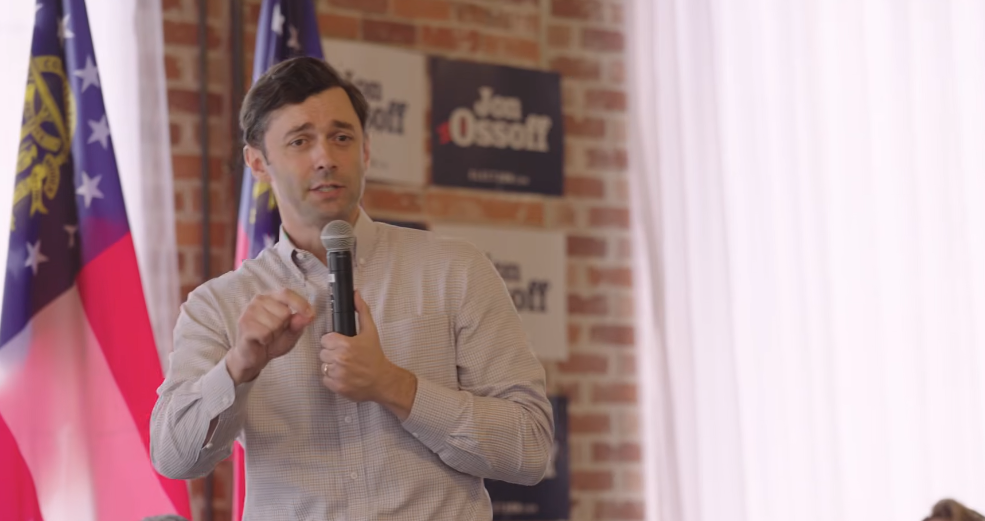
A certain type of political moment doesn’t come with a floor speech or a policy announcement. Wrapped in a list of other criticisms, it quietly—almost casually—arrives during a Sunday rally in Atlanta before exploding over the course of the next 48 hours. That’s essentially what happened when Senator Jon Ossoff brought up the name “Natalie” during a campaign speech, and the White House quickly demonstrated his point by becoming agitated.
Ossoff was criticizing what he called a president who is disinterested in the real task of governing during a Sunday campaign appearance in Atlanta. Although the language he used was harsh, it was not out of the ordinary for Ossoff, who has a reputation for criticizing Trump in a direct and occasionally personal manner. However, one line broke through the clutter. “He doesn’t want to do the job,” Ossoff stated. “He wants to build his ballroom and travel with Natalie on their apparently defenseless flying palace, gifted by the Emir of Qatar.”
The “Natalie” in question is Natalie Harp, an executive assistant to President Trump who has frequently been seen in pictures with the president in recent months. She is not a member of the cabinet. Before this week, she wasn’t well-known. She was part of a small group of aides who boarded a separate, covert flight out of Turkey with Trump, while other officials and journalists flew on what was described as a decoy Air Force One. However, she has garnered quiet attention within some Washington reporting circles. Just that particular detail raises unanswered questions.
On Monday, Ossoff was questioned about why he mentioned Harp by name. He didn’t change his mind. He claimed to have seen numerous photos of her with Trump and to have heard him refer to her as Trump’s “security blanket.” He went on to say that the president is told what he wants to hear rather than what he needs to hear by those who work in the West Wing. Although this criticism has already been made, adding a specific name to it gave it a different weight—something tangible as opposed to abstract.
To put it simply, the White House’s and Trump’s response was excessive. When a reporter questioned Trump about the remarks, he referred to Ossoff as a “Pee-wee Herman look-alike.” The CNN reporter who asked the question was attacked by the White House communications office, which wrote a remarkable statement implying that her children would eventually be “sickened and embarrassed” by her. CNN vigorously defended its journalists. It’s possible that the intensity of the backlash indicates how much the comment resonated, but it’s also possible that the White House just responds forcefully to everything, every time.
Ossoff was honing the language even more by Tuesday. When he appeared with Senator Mark Kelly in Georgia, he referred to Trump as a “draft-dodging, crook president” and purposefully used harsh language to contrast him with Kelly, a former Navy captain. The escalation seemed deliberate. Despite Ossoff’s repeated denials of rumors that he would run for president in 2028, there seems to be a perception that he is acting in a way that encourages such rumors.
The name alone isn’t what makes the Natalie Harp episode truly intriguing; rather, it’s what it says about the state of political struggle today. Ossoff did not criticize a policy. He made reference to something more ethereal and difficult to measure: the way Trump is said to spend his time, the people in his immediate vicinity, and the potential implications for the presidency as a whole. Depending on where you stand, that may or may not be political theatrics or fair criticism. However, it’s difficult to ignore the fact that the White House’s own response became the second headline, and a remark made about a little-known White House aide is now a national story. That is not insignificant.
In November, Ossoff will take on Republican Representative Mike Collins in a genuinely competitive Senate race in Georgia. The majority of polls favor him, but “favored” in a state where there is a tie is a delicate term. It’s likely that it won’t be evident until November, and perhaps not even then, whether incidents like this strengthen his appeal or go too far in his message.
