

Before the peak of a total solar eclipse, there is a certain kind of silence that falls over a crowd. Not the quiet that you’d find in a library. Something else. That feeling of not believing what you’re seeing, like everyone watching has forgotten how to speak all at once.
People from all over the world are drawn to that moment, that silence. On August 12, 2026, millions of people will wait in open spaces across Spain, Iceland, and Greenland with their heads tilted up and cardboard-frame eclipse glasses on. And if the weather is good, they will see something that the brain never quite files away right because it doesn’t have a ready-made category for it.
A total solar eclipse starts out pretty normally. The moon moves into line with the Earth and the sun during its new phase. The math behind it is almost too exact: the moon is 400 times smaller than the sun and, by a coincidence that still doesn’t make sense, it’s also about 400 times closer to Earth. Because of this, the two disks look almost the same size from where we are standing. If you stack them on top of each other at the right time, they fit almost perfectly.
It is the partial phase that comes in first. At “first contact,” the moon’s disk makes its first cut into the sun’s edge. You might not notice it if you don’t have your glasses on, which is why you should never look without them. In the next hour and a half, the sun slowly changes shape, going from a perfect circle to a thin, sharp crescent the size of a fingernail. It seems like the light around you isn’t right. Even tho it’s still daylight, the light is different. Strange shadows get darker. The colors get dull. The temperature drops a few degrees, and the birds stop singing because they are really confused.
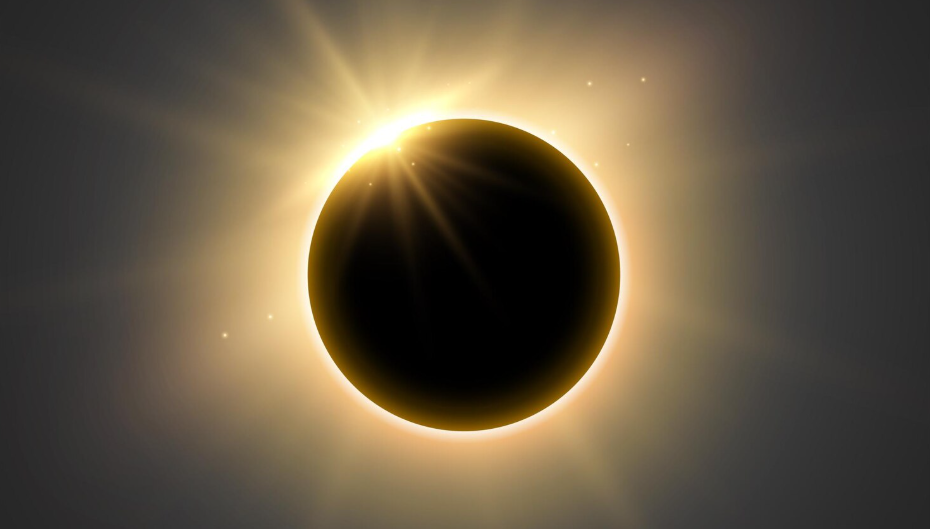
Things get strange in a beautiful way after that. In the last minute before totality, something called Baily’s Beads shows up: sparkling points of light along the moon’s rough edge, where the last of the sunlight squeezes thru craters and valleys on the surface. There is one burning point left just before the moon covers everything. This is known as the “diamond ring effect” by astronomers. It only lasts a second or two. A lot of people gasp. After that, the sun is gone.
In the best spots, totality for the August 12 eclipse will last for up to two minutes and eighteen seconds. That doesn’t sound like a lot. It is really too much to handle. The corona, the sun’s outer atmosphere, appears as a thin, white halo of very hot gas that can’t be seen otherwise. A pink line of prominences points away from the sun’s edge. A thin red layer below the corona is called the chromosphere. It flashes briefly at the beginning and end of totality. In the dark sky, planets can be seen. Right below the eclipsed sun will be Jupiter and Mercury. To the upper left will be Venus, which will be so bright that it could be mistaken for a nearby plane. At nite, if you watch from a very dark part of the path, a meteor from the Perseid shower might shoot thru the frame.
It’s important to be clear: no picture can capture this. The corona is shrunk down on screens so that it looks like a part of graphic design. It’s different to be under it. In a way that’s hard to explain without sounding overly emotional, you briefly see the solar system as a machine, with real scale and moving parts, rather than a diagram in a textbook.
It ends the same way it started, but backward. The glasses are put back on, Baily’s Beads show up again, and the diamond ring flares out again. The partial phases will last for another hour or so, with the moon slowly letting go of the sun as they move apart. It’s over when, at 3:57 p.m. EDT, the moon’s outline completely leaves the sun’s disk, somewhere over the water west of Africa.
People who have seen totality more than once usually agree: it’s not enough just to see it once. Maybe that’s the most honest thing you can say about a solar eclipse. You want another one before the first one is even over.
