

In 2025, Cairo was not a calm place. For anyone interested in the sport, the results of the 27th WKF World Individual Karate Championships held in the city read more like a changing of the guard than a typical podium ceremony. In both the men’s and women’s divisions, twelve titles were awarded. Nine different nations produced the champions. Additionally, Egypt, the host country, won two gold medals in one day.
It’s worth stopping to watch Egypt’s performance. Abdalla Mamduh Abdelaziz, who competed in front of a home crowd in Cairo with all the weight that goes along with it, won gold in the men’s kumite -75 kg category. In the -84 kg division, Youssef Badawy came next, adding another Egyptian victory to the day’s total. Ahlam Youssef won gold at -55 kg in women’s kumite. Three champions from the host nation, representing several weight classes and two genders. It’s not a coincidence. The program has been developing for some time.
In some ways, the most anticipated outcome of the championships was Japan’s position at the top of the kata podiums. The men’s individual kata title was won by Kakeru Nishiyama, carrying on a decades-long tradition of Japanese supremacy in that sport. Japan has always competed with a kind of subdued authority in kata, the formalized sequences of movements evaluated on technique, power, and precision.
It was more of a confirmation than a surprise when Nishiyama won in Cairo. Mo Sheung Grace Lau of Hong Kong won the kata gold on the women’s side, defeating rivals in a division where margins of a point frequently make all the difference. She currently holds the top spot in the WKF world ranking after winning the final with a score of 46.10 against her opponent’s 43.30.
The geographical spread of the kumite results has become a defining characteristic of contemporary competitive karate. The men’s -60 kg division was won by Eray Şamdan of Turkey, who defeated his opponent 4-0 in the final with a cool, collected performance. In a weight class that has historically been among the most competitive, Jordan’s Ghaith Afeef won gold at -67 kg, placing Jordan on the championship map.
In the women’s divisions, Gulshan Alimardanova of Uzbekistan won at -50 kg, Atousa Golshadnezhad of Iran won at -61 kg, Thalya Sombe of France won at -68 kg, and Johanna Kneer of Germany won at +68 kg. Matteo Avanzini of Italy won the men’s +84 kg title.
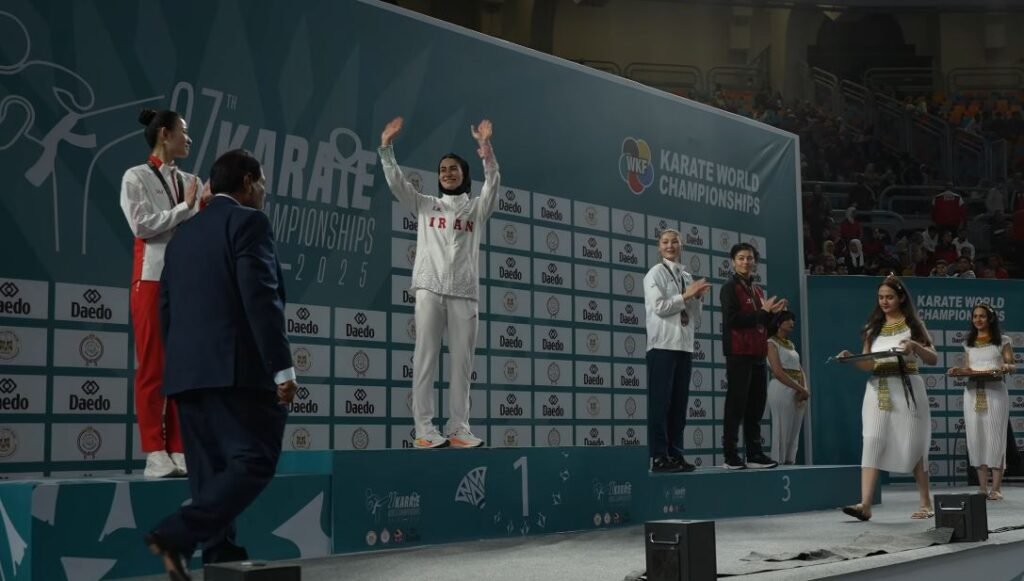
It’s difficult to ignore how truly global this list is. Nine nations from four continents—Uzbekistan, Jordan, Iran, Germany, France, Italy, Turkey, Japan, Hong Kong, and Egypt—share twelve gold medals. In sports, where two or three countries have locked things down, that is not the kind of spread you see. At its highest level, karate has a distribution problem in the best sense of the word—talent keeps emerging from unexpected places.
It’s important to think about the bigger picture going into 2026. The Karate World Cup in Hangzhou, China, in November is the culmination of the WKF’s comprehensive international schedule. The titles won by the athletes who took the podium in Cairo are more than just personal achievements for them; they are ranking points, selection credentials, and goals that their rivals are now directly pursuing. Being the current world champion in a competitive sport is both the greatest accomplishment and the most uncomfortable position. Everyone is aware of who they must defeat.
Observing the sport from the outside, it seems like 2025 was one of the most intriguing championship cycles in recent memory. New names, distributed geography, and a host country that competed rather than just organized. The bar from Cairo has been set fairly clearly, regardless of what Hangzhou brings in November.
