

Every Cobra Kai combat sequence subtly raises the question, “How much of what you’re watching is real?” The kicks land precisely, the punches appear quick, and the footwork has a cadence that seems to have been practiced over years rather than weeks. Stunt choreography is a part of it. There is some excellent editing. However, a greater portion of it—more than you may think—comes from performers who actually lived in a dojo for years before the cameras were ever switched on.
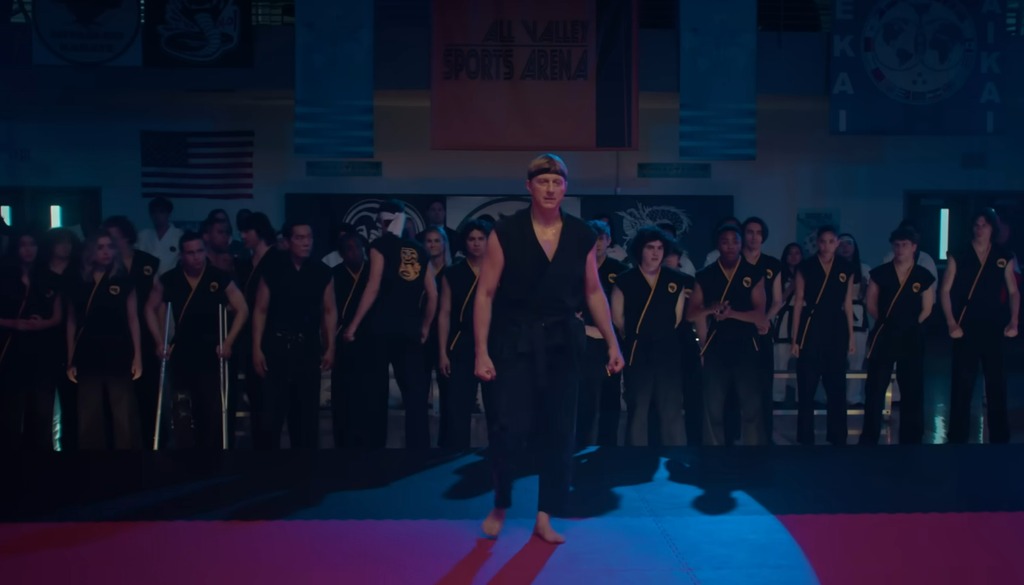
The cast divides into two somewhat different groupings. The performers who rose through the Karate Kid movies and brought at least some martial arts experience with them are known as legacy actors. The younger cast members, on the other hand, were largely unfamiliar with the show and had to pick it up quickly.
| Detail | Information |
|---|---|
| Show | Cobra Kai |
| Network | Netflix (originally YouTube Premium) |
| Seasons | 6 |
| Show Run | 2018 – 2025 |
| Most Trained Actor | Thomas Ian Griffith (Terry Silver) – 40+ years, black belts in Taekwondo and Kenpo Karate |
| Legacy Actor with No Prior Training | Ralph Macchio (Daniel LaRusso) – learned choreography on set |
| William Zabka’s Real Belt | Second-degree green belt in Tang Soo Do |
| Martin Kove’s Martial Arts | Black belt in Okinawan-te, also trained in Kendo and Taekwondo |
| Sean Kanan’s Styles | Shito-Ryu and Shotokan Karate |
| Yuji Okumoto’s Background | Chito-Ryu, Shotokan, Judo, Kajukembo, Yau Kung Moon |
| Ron Thomas’s Rank | 6th-degree black belt in Kodenkan Jujitsu |
| Rayna Vallandingham | 4th-degree black belt, 14-time Taekwondo world champion, first black belt at age 6 |
| Jacob Bertrand’s Belt | Purple belt in Karate (trained from age 8) |
| Tanner Buchanan | Childhood Taekwondo + 8 months Muay Thai before the show |
| Xolo Maridueña | Minimal background; primarily trained on set |
| Peyton List & Mary Mouser | No prior formal training; trained for production |
| Owen Morgan (Bert) | Real-life black belt in Karate |
The most underappreciated martial artist in the entire cast is undoubtedly Thomas Ian Griffith, who portrayed the icy Terry Silver. Since he began training karate in high school, he has practiced nearly every day. He eventually earned black belts in both Taekwondo and Kenpo Karate after more than 40 years of continuous effort. There is a weight to Silver’s approach that is difficult to replicate as you see him go through a scenario. Now it makes sense.
Martin Kove, who portrays the always frightening John Kreese, has a black belt in Okinawan-te karate and has received significant training in Taekwondo and Kendo over the years. During the original Karate Kid production, he reportedly trained three hours a day under stunt coordinator Pat Johnson alongside Ralph Macchio, William Zabka, and Pat Morita. On television, Kreese’s body was consistently realistic. That’s for a reason.
Sean Kanan, who made a comeback as Mike Barnes in Seasons 5 and 6 of Cobra Kai, was initially cast in The Karate Kid Part III in part due to his real karate training. He trained in two different and challenging styles: Shotokan and Shito-Ryu. He reportedly had a fictitious sparring session with Macchio during his audition, which, to be honest, tells you everything.
Yuji Okumoto, who plays Chozen, began practicing Chito-Ryu karate at the age of thirteen. In college, he also learned Shotokan and Judo. Later, he added Kajukembo and Yau Kung Moon, a southern school of Kung Fu. Two-time Black Belt Hall of Fame inductee Hayward Nishioka was his trainer. According to Okumoto, he started martial arts as a child because he was little and wanted to be able to defend himself. For whatever reason, the outcome is one of the show’s most technically sound performances.
Ron Thomas, who portrayed Bobby Brown in the first movie and briefly reappeared in Cobra Kai, is another. He has coached competitive martial artists at the national level for years and holds a sixth-degree black belt in Kodenkan, a type of jujitsu. His qualifications are subtly impressive for a minor character.
Johnny Lawrence, William Zabka, had no prior experience with martial arts when he joined the original Karate Kid. He studied with Pat Johnson in Tang Soo Do for the movie and finally obtained a second-degree green belt, which he has kept up over the years through sporadic sparring. It’s still small in comparison to Griffith or Okumoto, but it’s more than most people know.
Despite playing one of the most well-known martial artists in movies for many years, Ralph Macchio has never been officially ranked in any technique. His movement demonstrates the choreography and on-set technique he has acquired over the course of several movies and all six seasons. However, this is one instance where the performer and the character deviate considerably.
A few names stick out among the younger cast. The actor who portrays Hawk, Jacob Bertrand, began practicing karate at the age of eight and earned a purple belt before quitting. Before joining Cobra Kai, Tanner Buchanan trained in Muay Thai for eight months and practiced Taekwondo as a youth, nearly reaching black belt level. As a four-time global Taekwondo champion who obtained her first black belt at the age of six, Rayna Vallandingham, who arrived in Season 6, is practically in her own class. It would be an understatement to describe her as a prodigy.
The show’s breakout younger character, played by Xolo Maridueña, trained karate for a short period as a boy, but by the time he was cast, he claimed to remember very little of it. Given how crucial his character’s fighting becomes to the plot of the program, it’s a touch ironic. He received extensive on-set training for the majority of what he does on screen. The same is true for Mary Mouser and Peyton List, who both began essentially from scratch and developed their abilities through outside training and production preparation.
Because they perform the most physically demanding roles, audiences could conclude that the younger actors are the most skilled. However, the older generation—those who attended dojos in the 1970s and 1980s, when training was far more difficult and less cinematic—nearly invariably has the deeper roots in martial arts.
