

Three phrases. There are six syllables. And for some reason, almost forty years after they were first painted on a dojo wall in 1984, they continue to spark debates online, philosophical analyzes on YouTube, and sincere discussions about whether they stand for something poisonous or misinterpreted. “Strike First. Strike Hard. No Mercy.”
John Kreese’s dojo’s official motto, Cobra Kai, is ingrained in students from the moment they enter the building. It appears to be written like something a drill sergeant might write over a barracks door. However, the Karate Kid series—and Cobra Kai in particular—has spent years making it difficult to understand the true meaning of those terms depending on who is saying them and why.
The dojo’s beginnings date back to 1975, when Terry Silver and Kreese returned from Vietnam and discovered they were unwanted back home. They were called murderers by demonstrators. They were not exactly welcomed by the nation they had fought for. Cobra Kai was born out of that resentment and with Silver’s financial support, not only as a karate school but also as a reaction to a society that had devoured them. Marketing was not the motto. Teenagers who had no idea where it originated were given a worldview that had been hardened by conflict and animosity.
According to Kreese, the motto serves as a comprehensive life philosophy. Never wait for the world to turn against you; always strike first. Half measures are for losers, so strike hard. Kindness is weakness, and weakness is an invitation for someone to steal what is rightfully yours, so show no mercy. If you were raised feeling insignificant, ignored, or degraded, it’s not a hard system to adhere to.
Cobra Kai was a very successful recruiting tool for insecure teenagers because of this. Their rage was framed by the motto. It informed them that their hostility was a tool to hone rather than a problem to solve.
However, the series’ refusal to keep the motto straightforward is what makes it worthwhile to watch. When Cobra Kai’s original star pupil Johnny Lawrence reopens the dojo in 2017, he automatically takes on the mantra. However, something begins to change at some point in the first season when he is actually teaching a group of children who remind him of his own darkest moments. In one episode, he gives a direct explanation of the motto that seems almost hesitant, like someone translating something they only partially believe.
“To strike first is to act aggressively. Give it your all when you strike hard. Being Mr. Nice Guy means having no mercy. He continues, “If you’re too nice, the world will walk all over you,” with the tiredness of a man who has given it more thought than he lets on. He seems to know he has more to say but isn’t quite ready to share it.
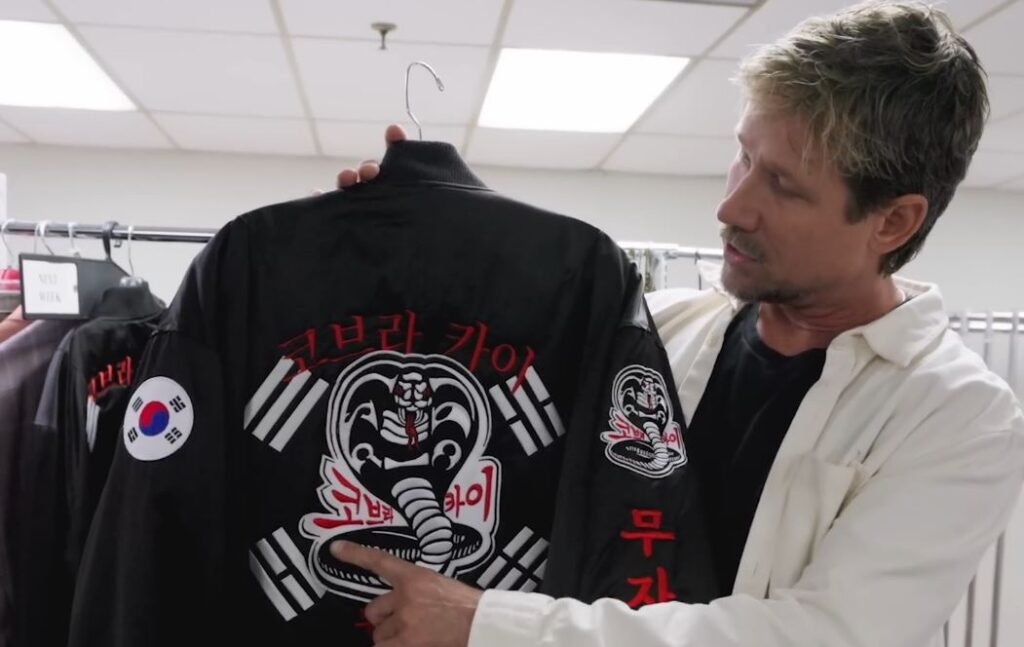
Miyagi-Do Karate, Daniel LaRusso’s inherited style that emphasizes defense, patience, and the notion that strength doesn’t always equate to aggression, serves as the counterpoint to all of this throughout each season. The show is really about the conflict between the two ideologies. Not the kick of the crane. Not the competition. The real question is whether “no mercy” results in better fighters or better people, and whether those two outcomes are as different as they first appear.
The way the motto changed by the end of the series is worth pondering. The Sekai Taikai world tournament is won by Cobra Kai, but under Johnny’s guidance, a man who had been secretly doubting everything Kreese had created for years.
The winning dojo is the one that combined with Miyagi-Do, exchanged students and methods, and acknowledged that a single strategy wasn’t sufficient. The motto remained on the wall. However, the underlying philosophy had subtly evolved into something that the original Kreese would hardly recognize. For three words that initially sounded only like a threat, that is an odd kind of victory.
