

At the conclusion of season one, Miguel Diaz emerged victorious in the All-Valley Karate Tournament. Johnny Lawrence, who was coaching out of a Reseda strip mall with a broom handle and unwavering resolve, had only been his trainer for a few months. Miguel’s victory over kids who had been training for years—cleanly, on points—said something. However, it also raised a question that Cobra Kai has been subtly debating ever since: does winning a tournament make you the best student, or is there another, more difficult-to-quantify factor at play?
Two names are nearly always at the center of the argument. Robby Keene and Miguel. The argument persists in part because they are genuinely different types of fighters. Miguel learned by sheer willpower, by being knocked down by Johnny’s harsh instruction, and by repetition. In addition to absorbing the aggressive Cobra Kai style, he added a level of emotional stability that most of his peers were never able to achieve. In a scene early on in the series, you can see him read his opponent, make decisions instead of just reacting, and adjust in the middle of a fight. It is not the instinct of a novice.
Robby is not the same. He enrolled with Daniel at Miyagi-Do almost by accident, partly to annoy Johnny and partly because he had nowhere else to go. Nevertheless, he was in the finals of one tournament cycle despite having a shoulder injury and relying solely on his nerves. One could argue that Robby is more naturally gifted than Miguel in terms of his physical instincts.
He picks up new skills fast, such as Cobra Kai’s aggression and Miyagi-Do’s defensive principles, and combines them in ways that most fighters find difficult. In that first All-Valley, he narrowly lost to Miguel. Very near.
Eli Moskowitz, the Hawk, should be given more credit in this discussion than he occasionally receives. In what seemed like an almost unbelievable amount of time, he transformed from a quiet, teased child with a lip scar to one of the show’s most technically accurate fighters. In the end, he becomes an All-Valley champion himself. The character behind the karate is the issue with Hawk, at least for a large portion of the series. He lost matches that he should have won because his aggression was out of control. Without discipline, talent usually reaches its limit.
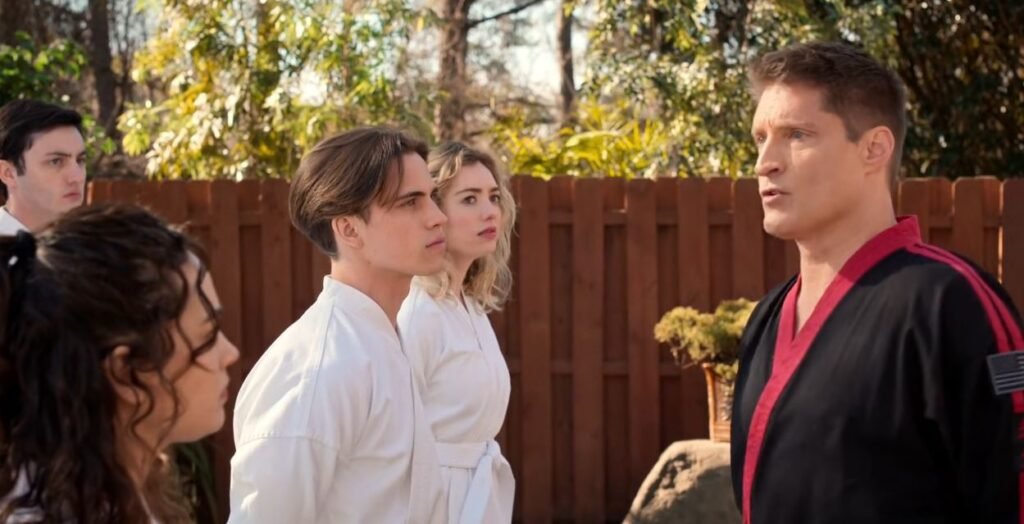
These rankings consistently undervalue the show’s female fighters. Samantha LaRusso has a foundation that no one else in her generation has because she began training in Miyagi-Do as a young child. Tory Nichols arrived at the dojo with unadulterated intensity and soon became one of the All-Valley’s most formidable rivals. Because they are truly evenly matched, their rivalry lasts for several seasons and never gets dull. There may never be a definitive answer to the question of who is superior between them.
There is also the more traditional aspect of this query, which concerns Johnny personally. When Kreese referred to Johnny as his best pupil, it wasn’t merely a sentimental statement. After a thirty-year hiatus, Johnny brought Cobra Kai back to life, trained a teenager with no prior martial arts experience, and helped him win a championship in less than a year. That indicates that he still had a profound comprehension of how karate is taught and passed down. Strangely, Miguel’s accomplishments partially mirror what Johnny learned under Kreese decades earlier.
When it comes to both tournament performance and overall emotional development, Miguel is the most complete student the program has produced. The most innately gifted person is Robby. The most improved is Hawk. Sam’s foundation is the deepest. Because the argument itself is the point—each student represents a different idea of what it means to be great at something you had to fight to learn—it’s difficult not to feel as though the show has purposefully avoided answering the question.
