

The short answer is no. There isn’t a real structure in the San Fernando Valley with a bonsai tree in front and a hand-painted sign. The dojo where Daniel LaRusso learned to “wax on, wax off” was built for a movie set, and Cobra Kai and other locations used in the films were built especially for production. The most recent iteration of the dojo was constructed in Montreal for Karate Kid: Legends. It’s a prop. A cherished prop, but still a prop.
However, it seems to be missing something if the Miyagi dojo is entirely fictional. Because the concepts underlying it—the philosophy, the karate style, even the last name—come directly from a very real tradition that the majority of casual viewers are unaware of.
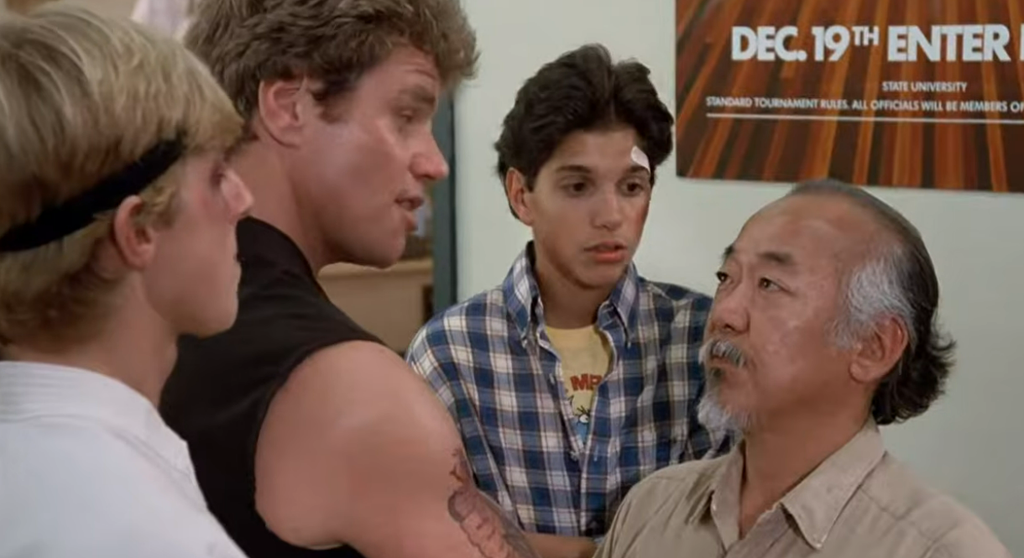
The real Okinawan martial artist Chojun Miyagi, who founded Goju-Ryu karate and lived from 1888 to 1953, has the same last name as the fictional Mr. Miyagi. It’s not a coincidence. While creating the first movie, the screenwriter researched Goju-Ryu, and there is more to the relationship than just a name. Goju-Ryu roughly translates to “hard-soft style,” which is almost exactly how Miyagi-Do is portrayed on screen: defensive, balanced, and prioritizing counterattacks and blocks over outright aggression. Even the patches that students wear in the movies are similar to real Goju-Ryu patches.
Here’s another genuine person worth getting to know. The original Karate Kid trilogy’s main stunt coordinator and fight choreographer was Okinawan Shito-Ryu karate master Fumio Demura. He also executed a lot of Pat Morita’s more strenuous physical routines. The fights in those movies might have appeared much more generic without Demura, similar to how many other martial arts films from that era did. Fans of traditional Okinawan martial arts could truly relate to the choreography’s grounded quality—specific techniques and recognizable forms—thanks to his influence.
Therefore, the honest response to the question of whether Miyagi-Do is a real karate style is that it is a fictional concept with real roots. Although the “wax on, wax off” exercises are new, real karate instructors have been using the fundamental idea of developing muscle memory and defensive instinct through repetitive, functional movements for decades. Kata-based training is completely real, but the crane kick is theatrical. It’s a blend that was meticulously crafted to seem plausible because the participants were aware of the actual situation.
It’s difficult to ignore how meticulously that construction was done. The majority of 1980s action movies were uninteresting. The Karate Kid did, which is probably why, over forty years later, people are still inquiring about the dojo because it felt so authentic.
All of this was further developed by the Cobra Kai series, especially when it introduced pressure point techniques and made reference to the historical Ryukyuan context of Okinawan martial arts—the theory that these fighting systems evolved in part because Okinawan people faced actual threats during Japanese colonization. Although casual viewers might have been taken aback by that layer, it is consistent with recorded history. It’s debatable whether the show accurately depicted that history, but the path it was taking was sincere.
More than any particular technique, the Miyagi dojo embodies a specific notion about the motivation behind learning to fight. Not for dominance, not for awards. Miyagi-Do’s two guiding principles—use karate only for defense and treat it seriously—seem straightforward. They are easy to understand. However, there’s a reason why they’ve struck a chord with viewers of all ages who watched a teenager sand a floor as children and eventually realized why it was important.
The structure never existed. Its foundation was and remains a tradition.
| Field | Details |
|---|---|
| Topic | Miyagi-Do Karate and its real-world origins |
| Fictional Dojo Name | Miyagi-Do Karate (宮城道) |
| First Appearance | The Karate Kid (1984) |
| Latest Appearance | Karate Kid: Legends |
| Filming Location (Recent) | Montreal, Canada (Karate Kid: Legends) |
| Real Karate Inspiration | Goju-Ryu, founded by Chojun Miyagi (1888–1953) |
| Real-Life Stunt Coordinator | Fumio Demura, master of Okinawan Shito-Ryu karate |
| Miyagi-Do Philosophy | Defense only; internal peace; balance |
| Core Training Methods | Kata, blocks, counter-strikes, pressure point techniques |
| Fictional Dojo Founded (In-Universe) | 1585 in Okinawa; 1984 in San Fernando Valley, California |
| Key Fictional Senseis | Mr. Miyagi, Daniel LaRusso, Chozen Toguchi, Johnny Lawrence |
| Related Real Martial Art | Goju-Ryu (“hard-soft style”), Shito-Ryu, Okinawan Kobudo |
| Signature Technique | The Crane Kick; “wax on, wax off” defense drills |
