

In martial arts, the question of greatness seldom ends amicably. In a world where a Muay Thai champion and a judo gold medalist could both rightfully claim the title, there are too many styles, too many formats, and too many ways to define “best.” However, the debate in sport karate, particularly in WKF kumite, the style that eventually made it to the Olympics in Tokyo, has a name that keeps coming up everyplace you look: Rafael Aghayev.
His hometown is Baku, Azerbaijan. The majority of casual sports fans do not associate martial arts royalty with this location. Nevertheless, Aghayev has been accumulating titles in an almost unbelievable manner since the early 2000s. Five gold medals from the World Championship. Eleven titles from Europe. a silver medal in Tokyo. a flawless record in the full-contact professional league of Karate Combat, where he eventually moved to demonstrate that his skills weren’t format-specific tournament tricks.
It’s challenging to explain his fighting style without first seeing it. Despite being listed at 5’4″, he was the shorter man in the majority of his biggest fights, sometimes by several inches. Nearly every external factor went in favor of Raymond Daniels, an American sport karate legend who had competed in Bellator, Glory, and K-1. Daniels was long, athletic, and incredibly dynamic. There was a clear reach advantage. At that point, Aghayev had only three full-contact fights under his belt, compared to Daniels’ dozens. The majority of observers anticipated that the experience gap would manifest.
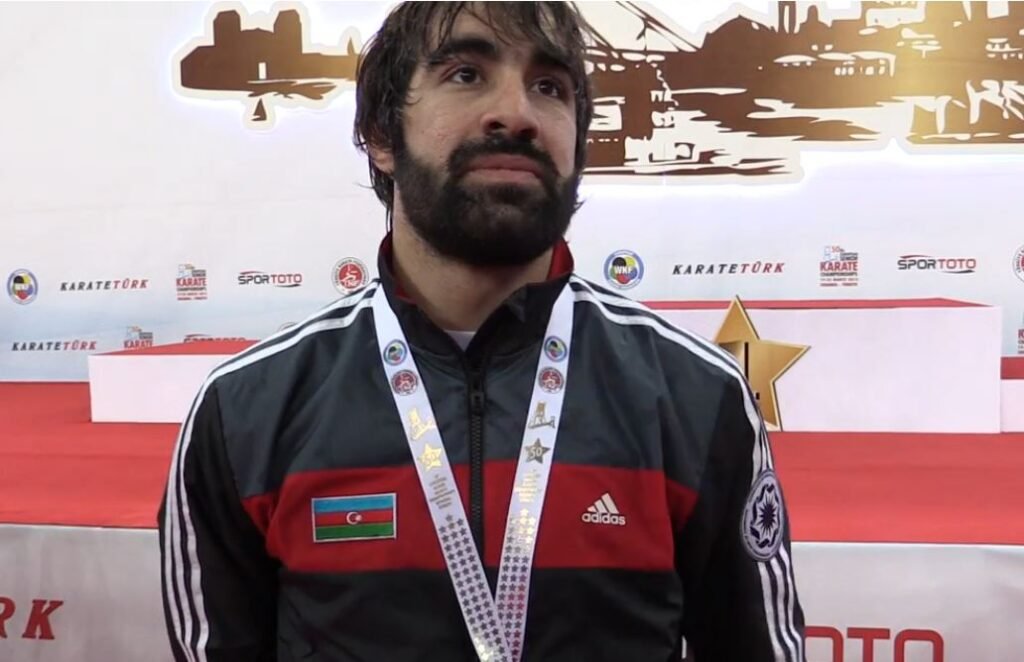
It was not visible. Almost the whole fight was under Aghayev’s control. Daniels’ kicks were all intercepted or rerouted. Nothing was hit by the punches. Aghayev moved with the composure of someone who had planned out the fight before the first round began, selecting slow-moving moments and making a clear decision. Afterward, he was so exhausted that he was on his hands and knees. This wasn’t because the fight was close; rather, it was because he had given it his all, as he seems to always do.
More than any number of medals, that kind of discipline may be what sets him apart. Aghayev’s Shotokan base combines boxing techniques, foot sweeps, and a start-line burst that opponents have said is almost impossible to time. He gets closer to you more quickly than you anticipate. He’s never exactly where you expected him to be. His style has a weight to it, a physical intention, that tends to quiet the criticism in the room for a sport that some critics sometimes write off as organized tag.
Point sparring isn’t a perfect indicator of a fighter’s overall ability, and the WKF format does reward certain habits. However, Aghayev’s standing in the larger combat sports community goes beyond his WKF record, and that is something that cannot be created. Even those from entirely different martial arts traditions have a tendency to be cautious when discussing him. They seem to see something in him that goes beyond the rules.
Aghayev, 35, competed against younger athletes on the biggest stage in the world at the Tokyo Olympics, where karate made its debut under tremendous pressure to prove it belonged. He made it to the championship game. fell just short of gold. However, it felt less like nostalgia and more like a reminder that some athletes just take longer to be fully appreciated because of the way he navigated that bracket and the poise he carried into each round.
When a fighter achieves a noteworthy victory in karate, they are referred to as the GOAT. It has become a term that spreads quickly and frequently lands carelessly. In Aghayev’s case, things are different. It is based on twenty years of competing against various generations, in various weight classes, and under various rulesets, and figuring out how to win without relying on strategies that are specific to one environment. It sounds rare, but that type of record is actually quite uncommon. And it belongs to one person, at least in karate.
