

In military circles, the majority of people have seen this picture at least once. It depicts a general boarding a C-17 cargo aircraft at Hamid Karzai International Airport on August 30, 2021, as seen through night vision goggles. The picture is grainy and green, and night vision always makes things appear a little surreal. General Chris “C.D.” Donahue is the man in the picture. After almost two decades of fighting, he was the final American soldier to depart Afghanistan. Less than five years later, he is quitting the Army itself, but not quietly or on his own terms.
Donahue left his position as commanding general of the U.S. Army Europe and Africa after just eighteen months. Major General Christopher Norrie, his deputy, will temporarily take over as commander on July 2, according to the Army’s confirmation. The statement was succinct and factual. There was no commendation, no farewell words, and no recognition of what Donahue truly stood for within the organization.
The departure of CD Donahue from the Pentagon is consistent with a larger trend that has emerged since Defense Secretary Pete Hegseth assumed office. Under his leadership, almost two dozen senior military leaders have either been forced out or retired early. Hegseth has presented it as a philosophical correction—”less generals, more GIs” is the phrase he reiterates—but to many observers both inside and outside the Pentagon, it appears more like a targeted removal of anyone associated with the withdrawal from Afghanistan, regardless of their actual performance there.
For what it was worth, both parties praised Donahue’s performance. During the evacuation of Kabul, he oversaw security at an airport that was, by all accounts, a pressure cooker while leading the 82nd Airborne Division. A timeline that is impossible, thousands of people, and a collapsing order. He was regarded by many as one of the Army’s most competent officers, making him a strong contender for the position of chief of staff and perhaps even chairman of the Joint Chiefs. It takes decades to establish such an internal reputation.
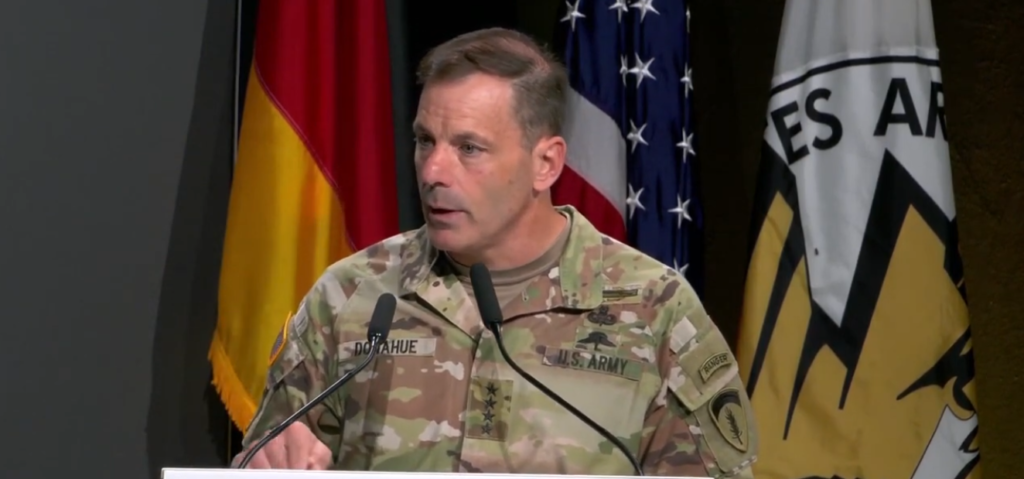
His career seemed to belong to a different period of American military history. He led Delta Force units in Syria, Iraq, and Afghanistan after graduating from West Point. He worked in the tedious, unglamorous field of counterterrorism for twenty years. Then, as the strategic landscape changed and the Pentagon started focusing on conventional warfare and state-level adversaries, Donahue followed suit. His assignment in Europe was directly related to assisting NATO allies in learning from Ukraine. He was working on a real problem.
Observing this develop gives the impression that the institutional logic is difficult to understand. While the command in charge of Army operations throughout Europe and Africa is being demoted from a four-star position to a three-star one, Hegseth has been pressuring European allies to shoulder more of the defense burden. It’s still unclear if Donahue’s departure and that downgrade occur at the same time. It is evident that the officer occupying a four-star slot has nowhere to go once it vanishes. The only way out is retirement.
Some of this may just be bureaucratic housekeeping disguised as ideological reform. It’s also possible that the Army is actually losing the kind of tried-and-true, flexible leadership that takes a generation to cultivate. It’s challenging to write off CD Donahue Pentagon’s departure as a simple turnover because both can be true simultaneously.
The night vision picture is still in circulation. It carries a certain weight because it is the culmination of a lengthy, expensive, and intricate process that has been condensed into a single, grainy frame. The general in that picture provided the Army with all the requirements of the position. In the end, the Army returned only a three-word press release and a change of command ceremony.
