

As soon as you enter Arrowhead’s gates in June 2026, you can tell something is wrong. The signage isn’t there, or it’s incorrect. Fans are not used to seeing the Chiefs’ red and gold throughout the concourses. FIFA logo covers the Ring of Honor, the lengthy scroll honoring team greatness that encircles the stadium’s interior. The field is also unfamiliar: it’s a broad, level soccer field where the NFL hashmarks once stood, with a different kind of grass and a surface designed to meet various requirements. The building itself wouldn’t let you know you were in the Kansas City Chiefs’ home. That’s precisely what FIFA had in mind.
All sixteen World Cup host sites must remove their current commercial identities during tournament play in accordance with FIFA’s “clean stadium” policy. FIFA’s six international sponsors pay huge sums of money to be the only brands visible at these games, and the governing organization preserves that exclusivity with the same ferocity that it applies to the rest of its commercial operations. This is a straightforward and purely financial reasoning. Thus, Levi’s Stadium in Santa Clara becomes “San Francisco Bay Stadium,” and AT&T Stadium in Arlington becomes “Dallas Stadium.”
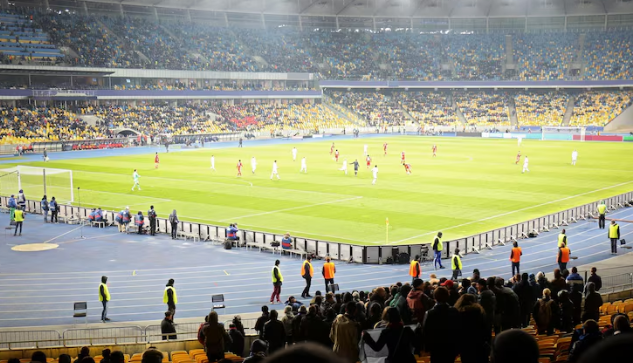
And GEHA Field at Arrowhead Stadium, the building’s sponsorship moniker since 2021, is changed to Kansas City Stadium, a term so purposefully simple that it sounds like it was created using a three-field form. Mark Donovan, the president of the Chiefs, took a philosophical stance, saying, “We respect FIFA and those are their rules.” However, everyone who comes here is aware that it’s Arrowhead. For Chiefs supporters, it is very likely the case. There is no specific reason why a first-time foreign visitor from Seoul or São Paulo would experience the erasure in the same way.
There was much more to the physical makeover needed to host six games, including a quarterfinal, than just hanging new signs. The capacity was reduced from around 76,000 to between 65,000 and 68,000 after 3,500 seats were taken out to make room for FIFA’s media and broadcast infrastructure. The entire field was reconstructed from the ground up using Bermuda grass—the same variety used by the Chiefs—but with synthetic fiber woven into the turf to satisfy FIFA’s exacting standards for playability and ball bounce.
The pitch’s crown, which has a little dome shape, had to be modified to meet FIFA’s requirements, which are different from those of the NFL. In order to preserve turf quality during several games in the June heat, an air circulation system was put in place beneath the surface. It’s a big technical project, and Sportico inquired directly, “Who’s paying for it?” Not the Chiefs, who have a $6.53 billion valuation. Not FIFA, which is expected to make $13 billion over its commercial cycle from 2023 to 2026. Missouri taxpayers are mostly responsible for the solution. Since fiscal year 2025, the state has spent about $77.8 million on World Cup preparations, with an undisclosed amount going toward upgrades at Arrowhead.
A longer-term identity issue that is more difficult to ignore is layered on top of the short-term rebranding. Arrowhead is the third-oldest stadium in the NFL, opened in 1972, and the building holds a specific kind of cultural weight that goes beyond the structure itself. It holds the Guinness World Record for the loudest crowd roar ever recorded at an outdoor stadium — 142.2 decibels, set in 2014, a number that anyone who’s been in the building on a late-season afternoon understands viscerally. It is, by most accounts, a cathedral of a certain kind of Midwestern football experience.
And it is also, by most projections, a building whose NFL days are numbered. The Chiefs have been pursuing a $800 million makeover that would start following the World Cup, provided Jackson County voters prolong a sales tax that has been used for decades to pay for upkeep of the Truman Sports Complex. The outcome of the vote will determine whether Arrowhead is eventually replaced or recreated.
As all of this is happening at once, it seems like Arrowhead is absorbing much more than just the FIFA makeover. It is widely acknowledged that the name change is only temporary. It is possible to undo the bodily changes.
What’s less reversible is the trajectory of a storied venue being asked to host a global soccer tournament, absorb public renovation money, strip its identity for weeks, and then pivot back to NFL football — all while its long-term future remains genuinely uncertain, contingent on a tax referendum and a franchise that, whatever Chiefs fans might prefer to believe, keeps the door to relocation quietly unlocked. It’s difficult to ignore the fact that “Kansas City Stadium”—a name selected to have no particular meaning for anyone—captures a genuine aspect of this precise period in the building’s history.
