

There’s something a little strange about a power plant coming back to life making national news. When most plants shut down, that’s the end of the story. The cooling towers stop making noise, and the only way people remember them is through old photos. Palaisades isn’t going along with that plan.
Palisades Nuclear Generating Station is on a 432-acre plot of land along Lake Michigan in Covert Township, Michigan. For the past few years, it has been trying to do something that no other American nuclear plant has ever done: a full restart after its fuel was taken out and its operating license was changed to stop it from running anymore. That is not a small step in the process. In a sense, that is trying to bring back something that was legally declared dead.
The plant was built between 1967 and 1970, and it started running at full speed in 1973. For almost 50 years, its one Combustion Engineering pressurized water reactor—a 425-ton machine with steel walls almost nine inches thick—made electricity for homes and businesses in Michigan in a quiet way. The numbers always show the same thing: the plant made over seven million megawatt-hours each year in peak years like 2016 and 2021. A big power plant on the shore of a lake in a small township that not many people have heard of gives off that much power.
Entergy paid $380 million for the plant in 2007. It ran for many years, though not always smoothly. Outages, maintenance problems, and money problems happened, especially after Consumers Energy tried to back out of a power purchase agreement, which sped up the plant’s closing for a short time. It was over with Palisades by May 2022. Entergy shut it down, and Holtec International bought it with the plan of taking it out of service. The used fuel was moved outside and stacked on a concrete pad to be stored. This was only meant to be a temporary solution until a permanent location could be found, which still hasn’t happened decades later.
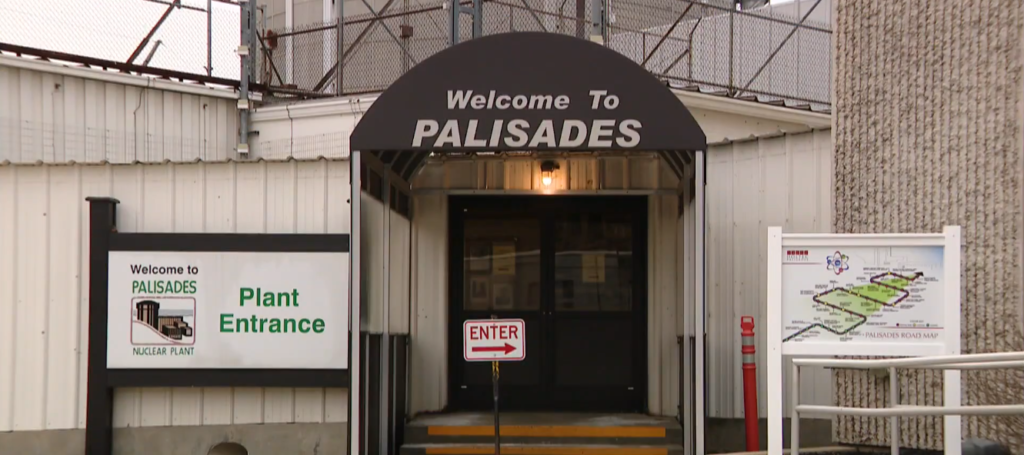
After that, something changed. For years, nuclear energy was seen as a threat to U.S. energy policy. But things started to look different. Energy demand predictions went up. The goals for clean energy got stricter. Holtec also didn’t quietly shut down; instead, they applied for federal Civil Nuclear Credit funding to get the plant back up and running. In November 2022, that first application was turned down. Then there was a second round. Then, in early 2024, the government announced a conditional loan agreement worth $1.5 billion. After that, $300 million in state money was secured in August 2024. It was hard to ignore the slow but steady progress.
Palisades went from being decommissioned to being operational on August 27, 2025. It sounds like a bureaucratic title until you think about what it really means: a plant that was legally closed and had its license revoked so it could no longer operate is now getting ready to receive nuclear fuel and start making electricity again. Around the end of October 2025, 68 nuclear fuel assemblies had been sent to the plant. The reactor had been cleaned thoroughly, and former operators had been re-trained. The slow, careful process of waking up a complicated machine after a long sleep had begun.
It’s still not clear if things will go well from here on out. It’s not as easy as flipping a switch to turn on a nuclear plant again, and Palisades has had its share of problems, like a worker accident in October 2025 that needed decontamination procedures. The NRC’s regulatory approval is still an important part of the equation. People who are paying close attention think that the success or failure of Palisades will reveal a lot about whether the US can really recommit to nuclear power in the real world, not just in policy speeches but also in reactors that are running.
Also, Holtec is thinking about more than just the current plant. The company said in December 2023 that it would build two SMR-300 small modular reactors at the Palisades site by the middle of 2030. In January 2026, it sent an application to the NRC for a partial construction permit. On the other hand, if that goes through, the site by Lake Michigan might end up being used to test out new nuclear technology in the United States.
Regulators, energy analysts, and a lot of doubters are keeping a close eye on the big reactor with its 8.5-inch steel walls for now. It sits on its 432 acres. No matter if Palisades becomes a symbol of how strong the American energy system is or a warning about how weak revival efforts can be, it will always be a part of the history of how this country deals with its complicated relationship with nuclear power.
