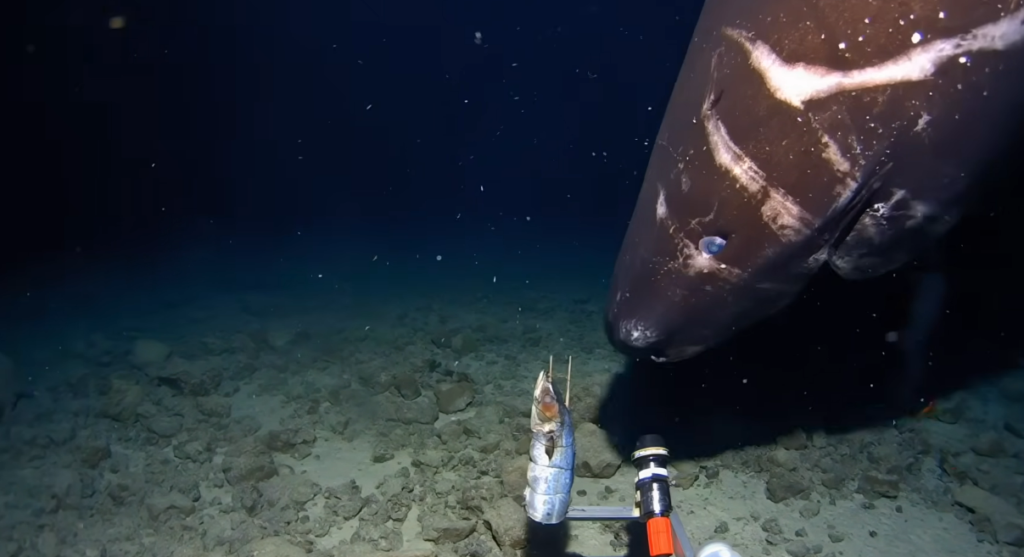
Something about an animal the size of a small boat that most people have never heard of is kind of creepy. The Pacific sleeper shark, whose scientific name is Somniosus pacificus, has been living in the deep ocean for longer than most species do, and they still surprise us. This new one came with amazing video that was shot about 1,630 meters below the surface of the South China Sea.
Sun Yat-sen University and the Southern Marine Science and Engineering Guangdong Laboratory researchers put out the results of a study in June 2025. The study seemed a little odd at first. They put a dead cow on the ocean floor southeast of Hainan Island and pointed a camera at it. It was planned to look at how big animals eat in the deep sea. What they didn’t fully expect was for several Pacific sleeper sharks to show up. That species of shark had never been filmed anywhere in that part of the world before.
It’s more important than it sounds. Sleeper sharks from the Pacific live in the cold, dark waters of the North Pacific, like the Bering Sea, the Gulf of Alaska, and Baja California. The South China Sea is warm and wet. It is a very long way from where these animals should be spending their time. The sightings bring the species’ known range a lot further south. They also bring up a question that researchers are now trying to answer: how far have these animals really spread, and why?
The footage is interesting without being shocking. It’s clear that bigger sharks—those that are more than 2.7 meters long—are attacking the body. Smaller beings circle at a safe distance, as if they are waiting their turn. There seems to be what researchers call a “queuing behavior” going on: sharks coming up behind those that are already feeding seem to get priority. The way they interact with each other feels almost organized, which is not what most people would expect from a creature that usually moves slowly and alone at crushing depths.
Han Tian, one of the study’s lead researchers, said that the aggressive behavior could be a sign of a place that still has a lot to offer. It looks like the deep waters of the South China Sea are not as empty as people thought. That changes the way scientists think about where big predators live in the area.
One thing about the results is very strange and deserves some thought. Pacific sleeper sharks don’t have the nictitating membrane that many other shark species do, which covers their eyes to protect them. People saw these sharks doing an eye retraction motion, which means they pulled their eyes back as a possible reflex defense. The animal is using its body in a simple way to get around a problem. It looks like it was put together quickly and without much thought. Researchers think this reflex keeps the eyes safe during the physical chaos of feeding, but they are still trying to figure out exactly what it does.
The sharks themselves were the most surprising part of the story: every single one caught on camera was a female. The study says that these kinds of bias also happen in other big deep-sea species in the South China Sea, like the megamouth shark. It makes it more likely—not proven yet, but very interesting—that this area may serve as a kind of gathering or nursery zone for large shark species. Scientists and environmentalists would have to rethink how they protect deep-sea habitat in the area because of that.
Pacific sleeper sharks can get up to about 4.4 meters long, but some records show that some have grown to be seven meters or longer. By almost any measure, they are huge. Still, they seem to move so slowly that it’s hard to tell. It’s possible that their lack of visibility is due to both their speed and their depth—they’re easy to miss, even on camera, until all of a sudden they are.