

It’s not really the fighting that draws viewers to The Karate Kid. It’s the sensation of seeing someone work hard, slowly, and without taking any short cuts. Despite being the best, Daniel LaRusso did not win the All Valley tournament. He prevailed because someone had faith in him before he did. More than any crane kick, it was that emotional thread that kept the movie relevant for forty years. It’s also the reason some other fight movies are worth seeing.
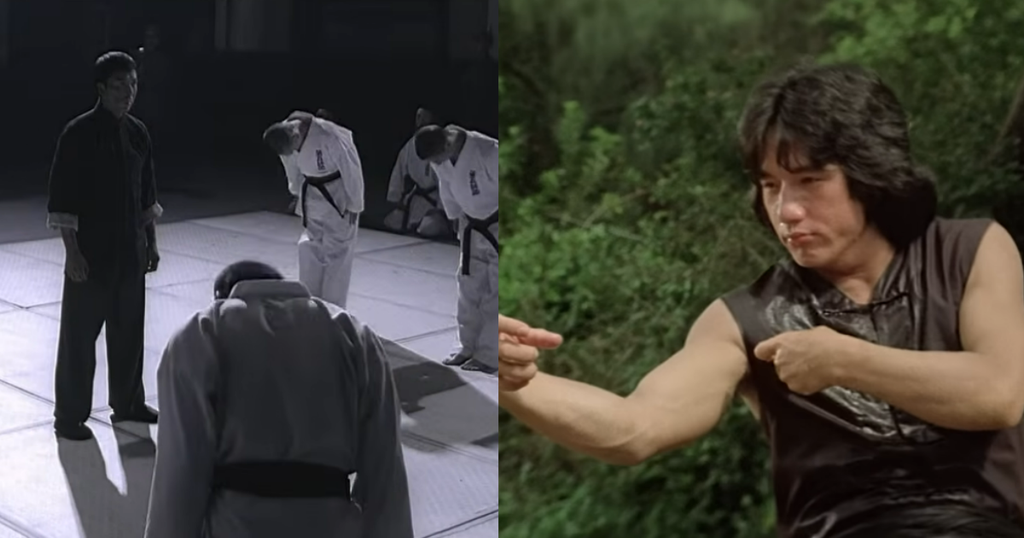
Start with the 1978 film Drunken Master. Jackie Chan’s breakthrough may appear to be pure comedy, but beneath the slapstick is something very similar to what Mr. Miyagi realized: even the most successful training frequently appears useless until it suddenly becomes useful. Wong Fei-hung becomes dissatisfied, rejects his lessons, and almost gives up. Does that sound familiar? In a way that most contemporary action movies can’t quite pull off, the payoff when he eventually adopts the strange discipline of drunk boxing feels earned.
| Film | Year | Director | Key Theme | Martial Art / Style |
|---|---|---|---|---|
| Drunken Master | 1978 | Yuen Woo-ping | Discipline through unconventional training | Drunken Boxing |
| Bloodsport | 1988 | Newt Arnold | Loyalty between student and sensei | Mixed martial arts (Kumite) |
| Ip Man | 2008 | Wilson Yip | Cultural dignity and moral restraint | Wing Chun |
| Never Back Down | 2008 | Jeff Wadlow | Anger transformed through discipline | MMA |
| The Last Dragon | 1985 | Michael Schultz | The search for true mastery | Kung Fu |
| The King of the Kickboxers | 1990 | Lucas Lowe | Revenge-driven training and resilience | Kickboxing |
| The Next Karate Kid | 1994 | Christopher Cain | Miyagi’s Zen philosophy, expanded | Karate |
The emotional restraint of Bloodsport (1988) is underappreciated. It’s easy to write off Jean-Claude Van Damme’s portrayal of Frank Dux as wooden acting, but there’s genuine respect in every frame. The Kumite is more than just a competition; it’s an assessment of Dux’s ability to apply what his sensei taught him. Compared to The Karate Kid, it’s messier and rougher around the edges, but the fundamental loyalty between the teacher and the student always succeeds.
Although Ip Man (2008) operates on a totally different scale—Japanese occupation, wartime China, cultural survival—it consistently returns to the same theme: martial arts as a form of dignity rather than dominance. The Wing Chun master is portrayed by Donnie Yen in a serene, motionless manner. He never seeks out conflict. He fights with a moral clarity that seems more in line with Miyagi’s philosophy than nearly anything else in the genre.
Probably the most overlooked movie on this list is Never Back Down (2008). It wears its Karate Kid influence so blatantly that it practically waves at you, so critics who called it derivative were right. However, there is still something compelling about witnessing a disturbed child discover structure under the guidance of a strict coach. The emotional mechanics—anger gradually giving way to discipline—hold up better than the reviews indicate, and the MMA setting gives it a rawness the original lacked.
The Last Dragon (1985) is a completely different animal. It is set in New York, surrounded by soul music and the excesses of the 1980s, and centers on a young martial artist who is searching for “the glow,” an enigmatic final stage of mastery that is never fully defined. It’s incredibly bizarre. But at the core of everything Karate Kid has ever attempted to say is a genuine curiosity about what it truly means to become a master, not just a fighter.
On purely artistic grounds, it is more difficult to defend The King of the Kickboxers (1990). It’s inexpensive, loud, and has a ridiculous revenge plot. However, the training sequences are extremely intense, and the entire endeavor has an earnestness that is hard to completely detest. On VHS, it found its audience and stayed with them.
The Next Karate Kid (1994) is the film that most likely merits the most liberal reevaluation. Even though the critics at the time couldn’t look past the gender-swapped premise, Hilary Swank, who was 23 when she filmed it, already had something interesting on screen. The movie develops Miyagi’s Zen philosophy in ways that the previous sequels never quite tried, and Pat Morita offers the same subdued warmth that he always did. It’s not flawless. However, it seems unfair to completely ignore it, especially at this point.
When combined, these seven movies create a kind of unofficial curriculum. What does it cost to become someone worth watching? is a question that is posed by a variety of genres, eras, and financial constraints.
