

Early in Cobra Kai, Miguel Diaz is shown standing in a mini-mart parking lot with Pepto-Bismol poured over his head by the school bully. It’s one of those scenes that reveals a lot about a character’s beginning. He is clearly out of his element, meek, asthmatic, and the new kid in the San Fernando Valley.
The same child has won the All-Valley Karate Tournament, recovered from a spinal injury, participated in the Sekai Taikai world championship in Barcelona, and received an acceptance letter from Stanford in the middle of a fight by the time the series concludes six seasons later. Miguel Diaz is one of the more interesting characters in recent streaming television because of the gap between those two moments.
It’s simple to forget how meticulously the show constructed that arc. Miguel wasn’t meant to be a straightforward underdog. He was unfaithful. By taking advantage of Robby Keene’s injury in the All-Valley finals to win in season one, he was corrupted by the very confidence that karate gave him. The more straightforward plot the show could have adopted was complicated by his relationship with Tory.
He made morally dubious decisions that seemed appropriate for a teenager juggling conflicting allegiances to his sensei, his girlfriend, and his own moral compass. Even though viewers didn’t fully agree with the character, they likely trusted him because the show seldom absolved him of responsibility for those decisions.
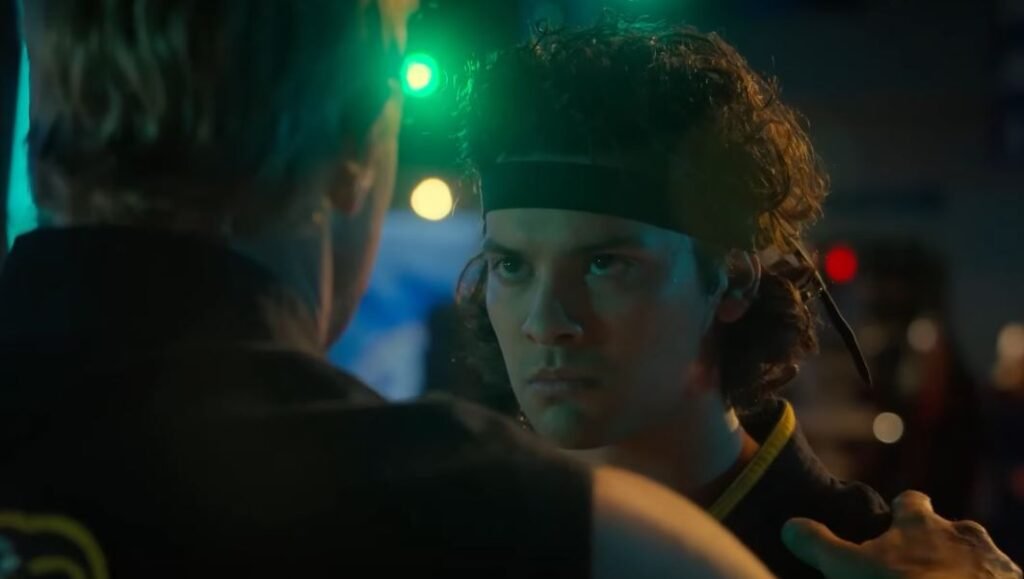
Miguel’s on-screen persona is further enhanced by the behind-the-scenes details. Given that Miguel’s backstory revolves around his mother leaving Ecuador while pregnant in order to avoid his father’s cartel connections, the fact that he is portrayed by Xolo Maridueña, who is of Ecuadorian descent, is more significant than it may first appear.
Maridueña has been in every episode of the show since he was sixteen when he was cast. He trained for four to six hours a day in martial arts, yoga, and boxing to get ready. That commitment isn’t lighthearted. Miguel’s technique clearly changes from season to season in the fight choreography, from the raw aggression of early Cobra Kai to the more balanced hybrid style he develops after training under both Miyagi-Do and Eagle Fang.
Maridueña and Jacob Bertrand, who portrays Hawk or Eli, are actually close friends off-screen. The scenes between Miguel and Hawk, who co-host the podcast Lone Lobos, exhibit a genuine camaraderie that is difficult to fake. When Dallas Dupree Young and Griffin Santopietro joined them as guests on the podcast, it suggested a true ensemble chemistry instead of the polished, PR-managed kind that is frequently confused for it.
The mythology of the show also contains some surprisingly specific details about Miguel’s character. He’s been given nicknames like “El Serpiente,” “The Rainmaker,” and “Speedracer”—the latter thanks to Johnny Lawrence, who in the early seasons referred to him as “Hot Wheels” and “Pontiac” before settling on “Miguel fucking Diaz” as the most genuine way to acknowledge him. His competitive karate record includes two significant titles: the Sekai Taikai world title and the 2018 All-Valley championship. A Stanford waitlist, a rivalry with Robby over the male captain position, and his own tunnel vision almost prevented him from competing in the latter.
As you watch the entire arc, you get the impression that Miguel Diaz served as the show’s emotional center. It makes sense that Johnny Lawrence’s redemption arc is the more well-known plot. However, it’s possible that that redemption doesn’t work out the same way without Miguel—without someone for Johnny to invest in, instruct, and eventually call a son. It turned out that the child wearing Pepto-Bismol on his head was the reason everything worked.
