

As a director, Eli Roth has never shied away from controversy. Hostel, Cabin Fever, and an uncomfortable cameo in a Tarantino war movie are all examples of how his career is practically built on it. However, the reaction to his latest horror film, Ice Cream Man, seems different. It was more like a story that subtly escaped him than the deliberate provocation of a genre filmmaker.
The movie, which debuted on August 7, centers on a suburban community that collapses after its kids buy sweets from an insane ice cream vendor (played by Ari Millen). The idea is crude and purposefully obscene—exactly the kind of material Roth made his name on. Nobody anticipated that the gore would not be the most talked-about aspect of the film. The animation would last for a few seconds.
In an early interview with Polygon, Roth was straightforward when asked if AI was used in the movie. “I have an animation background, and I drew it,” he continued, describing how he worked with animators, drew loop cycles, and chased the jittery vibe of vintage Mickey Mouse cartoons. It was a precise, almost endearing description. A response that conveys a genuine love for the craft. which added to the awkwardness of what followed.
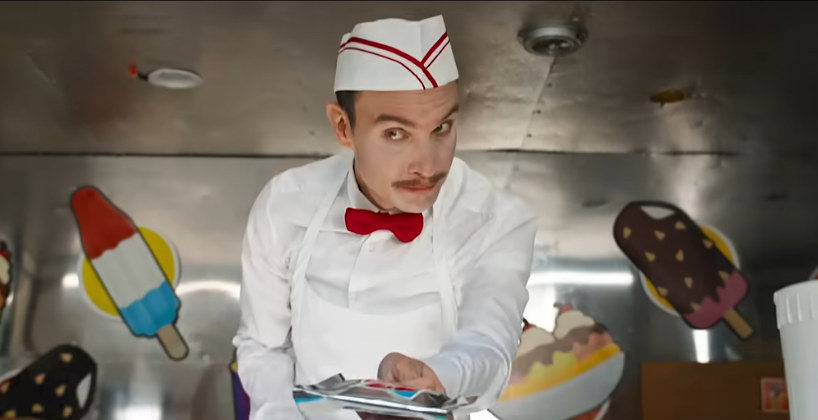
Dark Half, an AI visual effects company, is mentioned in the movie’s credits. Roth released a new statement after that information came to light online. “Misspoken,” he claimed. “Only a few scenes in the movie made use of AI. It was a chance for creativity and technology to work together to realize my vision for the movie.” It’s corporate language that doesn’t quite fit a filmmaker who typically comes across as more direct than circumspect.
Observing this develop gives the impression that Roth wasn’t attempting to trick anyone in a complex way. It’s more likely that the distinction between “I drew it and some animators helped” and “an AI company was also involved” became hazy at some point during the production process, and he responded to the question based on his recollection rather than how the credits showed it. That’s not exactly a defense. Simply put, it’s a more compassionate explanation than the term “lied,” which many people on the internet were quick to use.
Nevertheless, the response from the audience has been harsh. The movie has been referred to on social media as a “AI slop fest.” Viewers are reportedly leaving before the credits have even rolled, according to Reddit threads. The movie currently has a 3.5 on IMDb, and reviews haven’t been much kinder. Roger Ebert’s website identified the AI-generated artwork as one of the movie’s more obvious issues, and reviewers have described it as one of the worst releases of the year. Even tho the AI and quality issues may be distinct issues, it’s difficult to ignore how they have merged in public discourse.
Eli Roth isn’t really the main issue here. It’s about how quickly a movie can become a symbol of something greater than itself and where viewers are currently drawing their boundaries. Generative AI has been used in other productions before, and Ice Cream Man most likely won’t be the last. However, it might be among the first to deal with this specific combination: a director who initially denied it, a credit that went against the denial, and an audience that was already ready to believe that something had been taken from them.
It is now practically irrelevant whether the movie merited its reception based only on its own merits. The topic of discussion has shifted from what is on screen to the significance of how it arrived. For a filmmaker whose entire brand has always been about being unapologetically direct, that’s a difficult place to end up.
