

When a new character enters a long-running show and takes over every scene right away, there’s a certain kind of satisfaction. When Rayna Vallandingham played Zara Malik in Cobra Kai season 6, she did just that, and to be honest, I’m still a little surprised at how well it worked.
Zara shows up as the female captain of the Iron Dragons, a dojo from Hong Kong that was first presented at the international Sekai Taikai competition. As the reigning champions, the Iron Dragons are unbeaten and appear to be unbeatable. Zara, who is both a social media influencer and a martial artist, is their most well-known face. She travels to Barcelona on someone else’s money, livestreams, and has sponsors. She sounds like a caricature on paper. She is anything but in real life.
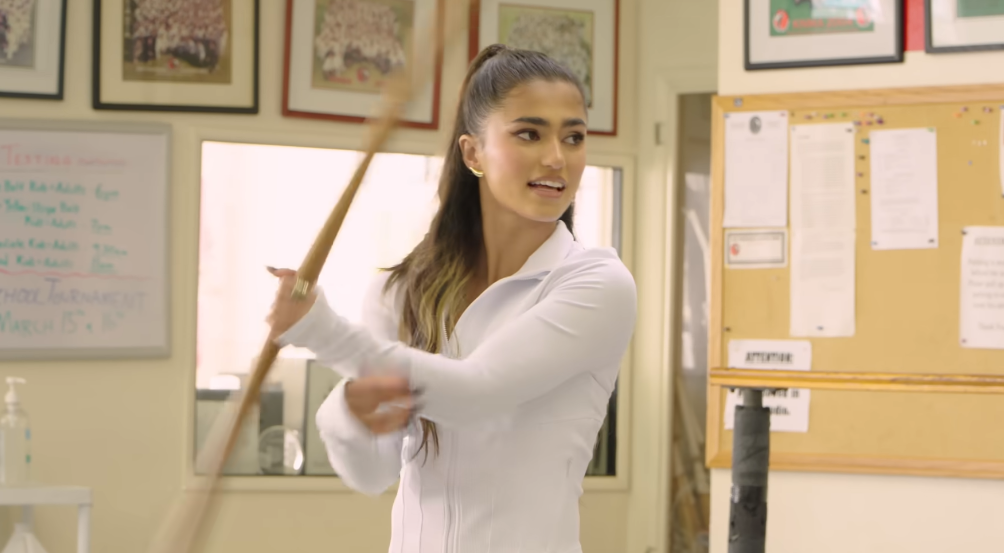
Although Zara’s fighting prowess is truly impressive, it’s not the only thing that makes her compelling. It’s how she employs her image as a weapon. She is knowledgeable about optics. She is aware that a quiet victory in the gym is not as significant as defeating an opponent in front of a camera. She has a sharpness that feels contemporary; she’s the type of villain who just outperforms you and makes sure everyone is watching when she does so, rather than monologuing.
Vallandingham, who was born in 2003 in Encinitas, California, gives the position a lot of legitimacy. At the age of two, she started practicing taekwondo. At six, she obtained her black belt, and at eight, she won a world championship. She had won 13 American Taekwondo Association titles by the time she was cast in Cobra Kai. That background is evident. Vallandingham moves with the kind of fluidity that only comes from doing something for the majority of your life, so the fight choreography around Zara doesn’t require camera tricks or fast cuts to create danger.
It’s important to note how the show pits Zara against Peyton List’s character, Tory Nichols. Over the course of five seasons, Tory has learned to fight for something other than rage by letting go of her rougher tendencies. Zara is a reflection of Tory’s former self; she competes not out of passion for the sport but rather for attention and prestige. Their rivalry has a thematic weight that transcends the typical tournament rivalry because of this contrast. Tory fights because she finds meaning in karate. Because winning looks good on a feed, Zara engages in combat. When the show does eventually lean into it, the difference hits harder than anticipated.
Additionally, Zara’s character is given a layer of deliberate cruelty by the Robby Keene subplot. She doesn’t think twice when she notices tension between Robby and Tory. It seems to be intentional manipulation that is more about psychological warfare than attraction. It’s difficult to argue that it doesn’t enhance Zara’s character on the show, but whether that makes her more intriguing or more problematic will likely depend on the audience.
In Part 3 of Season 6, Zara loses to Tory in the Sekai Taikai girls’ final, which is her first significant setback. In the same way that good TV rivalries typically do, the defeat feels earned. Not cheap, not abrupt. Zara never quite had what drives Tory fights, and the show lets that difference speak for itself without overemphasizing the point.
This is probably not the last time viewers will notice Rayna Vallandingham because she is already scheduled to play Juli in the Street Fighter reboot. However, the majority of people found her through Zara Malik, which is a challenging bar to meet for a final season debut. She easily cleared it.
