

Samantha LaRusso is paralyzed and sitting in her room at one point in the middle seasons of Cobra Kai. Not by anything tangible—everyone is aware of her fighting prowess—but rather by the recollection of a school hallway becoming a battlefield. Most action-packed television programs would skip over this kind of scene in a single episode. Cobra Kai didn’t feel comfortable staying with it for very long. Even though the audience wasn’t quite prepared to do the same, that choice demonstrates how seriously the show took Sam as a character.
It’s easy to underestimate the weight that Mary Mouser’s character, Sam LaRusso, carried into Cobra Kai. She is the daughter of Daniel LaRusso. That in and of itself establishes expectations: she should be a skilled karate practitioner, morally upright, somewhat serious, and most likely the moral center of every space she enters. And the show makes you think that’s all she is for a while. To blend in, she gives up karate. She goes out with the wrong man. Some of the decisions she makes are difficult to defend. Some audiences were aware of this and never fully forgave her.
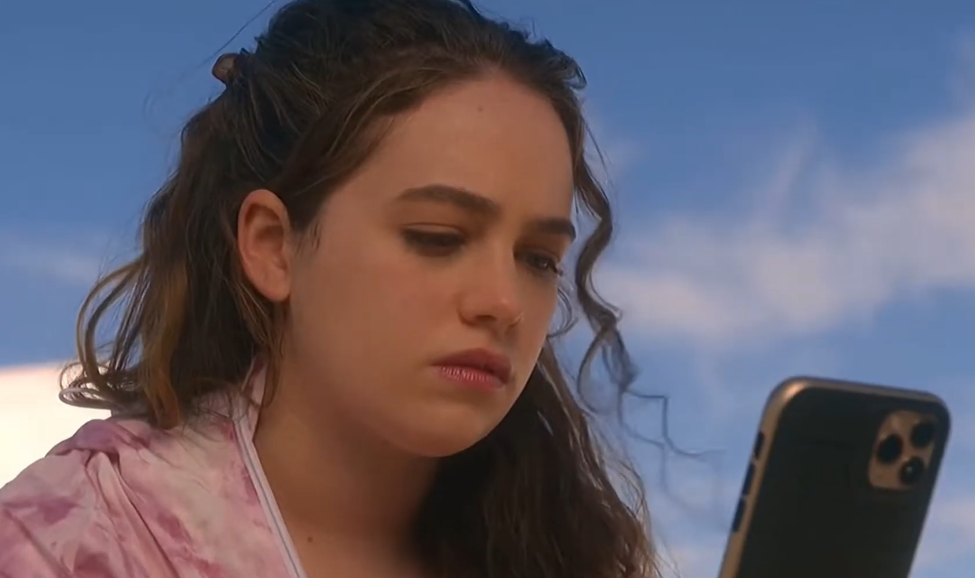
Unbeknownst to those viewers, Sam is written more like a real adolescent than most characters in her role. She isn’t always courageous. She doubts herself, sometimes in front of others. Sam experiences what the show clearly depicts as PTSD following the altercation with Tory Nichols at school, which spans a hallway in one of the more genuinely shocking scenes it produced. She winces. During sparring sessions, she hesitates. The camera doesn’t frame the scene where she gets a drink at a party as a cliché of a teen drama. A poor choice made by someone who is running out of better options, it just sits there.
It’s difficult to ignore how different that is from the typical roles of female characters in martial arts stories. They are usually either purely decorative or unbeatable. Sam isn’t either. The show doesn’t immediately cover up her loss to Tory in the All-Valley girls’ final with a redemption victory, despite the controversial circumstances surrounding a referee who shouldn’t have been anywhere near an officiating role. In ways that feel justified, the pain persists into the following season.
Since the rivalry between Sam and Tory was never really about karate, it is worthwhile to study it on its own terms. Class conflict, rivalry over Miguel, and a fundamental difference in each girl’s background and what she believed the world owed her were all underneath their initial encounter. Tory fights like someone who was taught at a young age that everything has a price. Sam fights like someone who was first taught principles and then had to learn what happens when those principles come into contact with someone who doesn’t share them. One of the more subtly satisfying things Cobra Kai accomplished was watching that unfold over several seasons, leading to a reconciliation that genuinely felt like it had been paid for rather than just written in.
In this role, Mary Mouser does something that isn’t always recognized: she makes Sam’s vulnerability apparent without coming across as weak. Maintaining that balance over the course of six seasons and numerous fight scenes is actually challenging. By the time Sam is getting ready to travel to Okinawa as an exchange student, training under Chozen with Tory of all people, the distance from her beginnings becomes apparent. She remains a LaRusso. There will be no end to that legacy. However, she has also created something that is unique to her and not merely inherited.
Although the moniker “Bonsai Badass” that circulates in the later seasons accurately describes her style—precise, patient, and rooted—it falls short of capturing the emotional labor that goes into the technique. Sam Cobra Kai is not a tale of a girl who was destined for greatness from the beginning. It tells the tale of a girl who, despite having every advantage, found the work to be genuinely difficult. Even though it may seem insignificant, that distinction is what makes her intriguing.
