

In one aspect of Sadie Stanley’s career, she remains cozy in the Disney bubble, adored, dependable, and perhaps a little underutilized. That was not the case. On May 30, 2025, Karate Kid: Legends hit theaters, bringing with it something noteworthy: a 23-year-old actress from South Carolina who appeared to have been given enough space to truly breathe on screen for the first time.
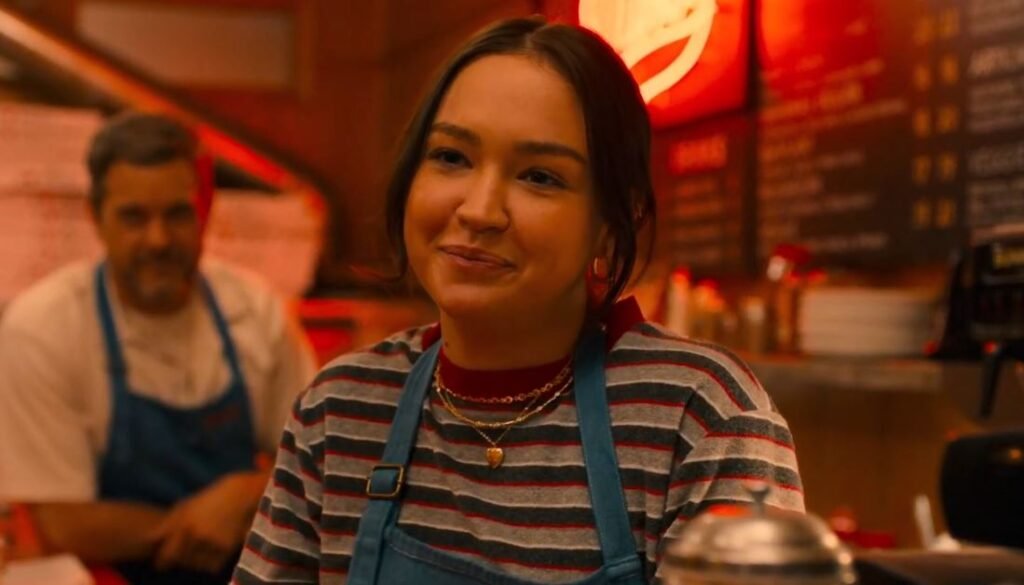
Stanley portrays Mia Lipani, a teenage girl from New York who assists her father Victor, a former boxer played by Joshua Jackson, in running a pizzeria called Victory Pizza. Mia does not practice martial arts. She doesn’t deliver a single blow. Her role is a more subdued kind of anchor in a movie that revolves around kung fu scenes and franchise nostalgia; she is the girl who keeps the narrative human when everything else is choreography and legacy.
The character’s specificity is what makes her compelling. Mia became emotionally mature and fiercely protective of her father as a result of losing her mother when she was a young child. In genre movies, this type of backstory can quickly become a shorthand, a checkbox for depth. Stanley prevents it from falling in that manner. She portrays Mia with a guardedness that seems earned rather than scripted.
There’s a reason why her chemistry with Jackson seems sincere. Stanley has mentioned having lunch with him early in the production process so they could simply chat and get to know one another before the cameras started rolling. Jackson, who has a young daughter of his own, seems to bring that sense of fatherhood into every space he goes into. Stanley put it this way: “He very clearly just has such dad energy.” Even when you can’t quite pinpoint it, that kind of off-screen ease has a way of appearing in the final product.
Jackie Chan and a microphone is the other story from this set that continues to circulate. Chan is said to have climbed onto a platform, borrowed a microphone from an assistant director, and performed a full rendition of “I Can’t Help Falling in Love” during the exhausting final fight sequence, a massive production involving hundreds of extras, long shooting days, and obviously waning energy. It was like a concert, according to Stanley. His voice was lovely, she said. It’s the kind of moment that will live on in everyone’s memories even if it doesn’t make the theatrical cut.
Stanley’s journey to this position wasn’t straightforward. In 2019, she made her breakthrough as Kim Possible. She trained in martial arts for the part, performed her own stunts, and received genuine recognition for the physicality of her performance. Then came smaller movies over a few years, such as Cruel Summer and The Goldbergs. Although the projects were varied and nearly restless, the work was steady. It feels like the first time those pieces came together with a role big enough to accommodate them in Karate Kid: Legends.
Calling it a turning point is still premature; those are easier to recognize in hindsight. However, when you watch Stanley in this movie, you get the impression that she understands how to carry emotional weight without making it obvious. Not everyone possesses that ability. It’s also the perfect addition to a franchise that has always placed equal emphasis on our personal development as it does on our fighting style.
