

Television seldom does a certain kind of villain justice; it’s not the one whose tragic beginnings are meticulously depicted in flashbacks, nor the one who is saved in the end with a slow-motion embrace. Neither of those describes Kwon Jae-Sung. Almost instantly, the show feels different when he enters Cobra Kai Season 6 with the enthusiasm of someone who has never once doubted himself. more acute. A bit more awkward to watch.
After defeating Yoon Do-Jin, Kwon arrives in South Korea as the best fighter in Master Kim Sun-Yung’s dojang. He takes on the role of male captain for Cobra Kai’s squad going into the Barcelona Sekai Taikai competition. On paper, that seems like a setup for yet another formidable opponent who will ultimately lose honorably. Kwon doesn’t really fit that description.
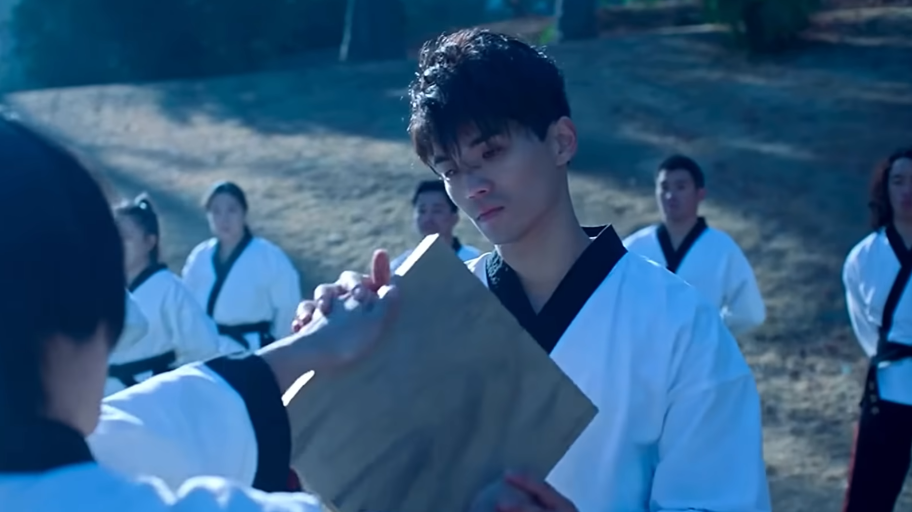
His cruelty doesn’t require an explanation, which is what makes him intriguing—truly intriguing, not just menacing like opponents in a tournament are supposed to be. At best, his background is hazy. He was raised in the dojo by teachers who were probably harsher on him than anyone else because his parents are either dead or not present. That could be interpreted as a wound he never healed. However, the show doesn’t rely too much on it, which is a wise decision. The authors appear to recognize that providing Kwon with a neat trauma explanation would have softened something that needed to remain sharp, but Kwon doesn’t want sympathy.
In addition, Brandon H. Lee, a Taekwondo master in real life, plays him. Every frame shows that portion. There is no illusion when you watch him move—a 540 spinning hook kick, a cheat 720, casual and violent at the same time. In a fight, that person truly knows what he’s doing, and it shows in ways that editing cannot fully replicate.
The season’s core is provided by his rivalries. Robby Keene has the most intense relationship with him; the two fighters, who appear to have based their entire identities on diametrically opposed ideologies, clash somewhere between Miyagi-Do and whatever Kwon stands for, which is more akin to pure aggression disguised as rivalry. In a sort of dark irony, Miguel Diaz ultimately inherits Kwon’s spot in the competition. Then there’s Axl Kovaňvić, who unintentionally ends up killing Kwon. However, the word “accidentally” needs some work because Kwon ends up fatally wounding himself while attempting to stab Axl with Kreese’s eunjangdo.
It’s an odd conclusion, and that’s on purpose. Just before it happens, Kwon sees the knife and laughs, really laughing. It sounds like someone who has at last discovered the degree of chaos that corresponds with whatever is going on inside of him. Depending on how closely you’ve been watching, that could be either tragic or frightening.
Interestingly, throughout the season, Kreese acts almost like a father figure to Kwon. Kreese’s manipulation and Kwon’s near-sincere attachment are intertwined in that relationship. Finding the most volatile young men and persuading them that anger is a skill set has always been John Kreese’s special talent. That dynamic is pushed farther than it has ever been with Kwon.
Kwon is a true Cobra Kai believer, not a student who got caught up in something and eventually found his way out, and it seems like the authors specifically included him to fill a narrative void. Eventually, the majority of the students in this show start to doubt the philosophy, soften, and change. Kwon doesn’t. Strangely, he is the most honest person in the room because he embodies the ideology without any conflict. When Cobra Kai functions as planned, he is exactly what it creates.
Instead of finding a solution, the show concludes with Kwon’s legacy being incorporated into the competition. Miguel takes his place in combat. The patch is exchanged. The sixth season advances. However, audiences hardly had time to fully comprehend the most memorable new character in Cobra Kai’s last chapter.
