

Early in Cobra Kai, a quiet, nervous child named Eli Moskowitz enters a karate dojo and is largely ignored. He has a best friend named Demetri who shares his passion for Harry Potter and Doctor Who, a cleft lip scar that makes him extremely self-conscious, and virtually no social standing at West Valley High School. He is invisible by all accepted standards. It is truly difficult to sum up what happens to him over the course of the next six seasons of the show, which may be precisely why the character has endured long after the series concluded.
Jacob Bertrand plays Eli, nicknamed Hawk after he gets a big bird and a blue mohawk tattooed across his back. He does something rather unusual in a teen drama: he makes the transformation feel earned rather than convenient. The idea behind sensei Johnny Lawrence’s advice to Eli to “flip the script” is that taking back what you’ve been made fun of can turn into a source of strength. Yes, the mohawk is a sign of defiance, but it’s also a costume. The conflict between Hawk’s armor and Eli’s true self permeates almost all of the character’s storylines.
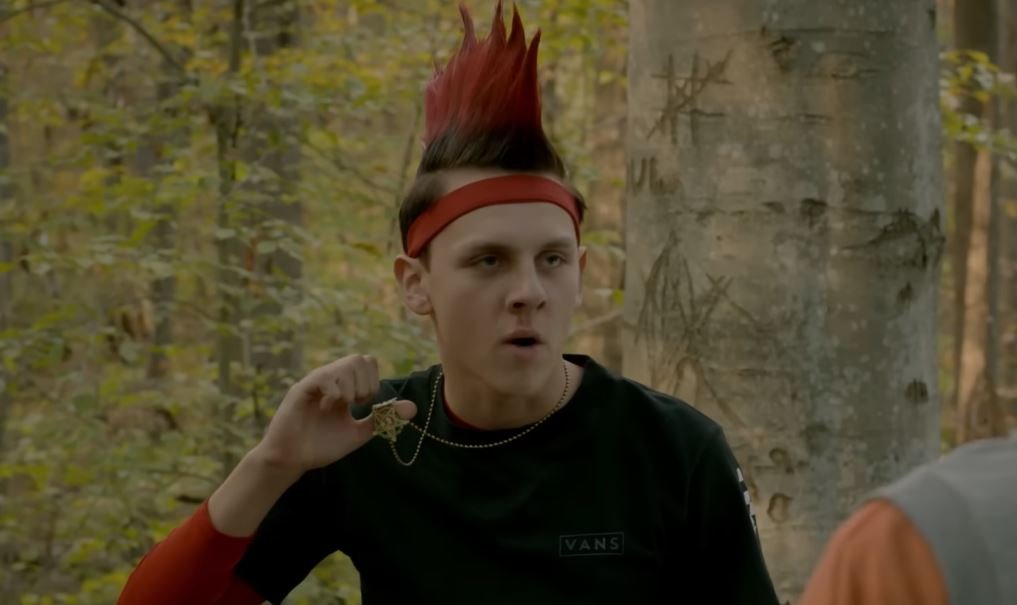
The armor functions too well for a while. Eli vanishes within it. Hawk transforms into something truly unsettling under John Kreese’s influence: hostile and capable of actual cruelty toward those who were once his friends. He assaults Demetri.
He engages in behaviors that the show accurately classifies, such as assault, vandalism, and threats. This is not softened by the authors. There is a version of this storyline that would have made it simple to forgive him right away, making the redemption neat and painless. To its credit, Cobra Kai avoids that path. When Hawk’s former Cobra Kai allies forcefully cut off his mohawk, it is portrayed as a true loss of confidence, even the tainted kind, rather than just a hairstyle.
The specificity of Eli’s fears is what makes him a compelling character. He is not an adolescent who is generally troubled. He was made fun of as a child for something physical, which he had surgery to correct and still bears the mark of. He discovered that it was easier to be feared than to be accepted. That is a distinct type of coping strategy that is easily identifiable. Additionally, there are times, particularly later in the series, when you can see Eli behind Hawk’s eyes, still subtly determining whether he is liked or just tolerated. Bertrand plays this role with a certain restraint.
The emotional core of the entire arc is the friendship with Demetri. Their relationship—they refer to themselves as Binary Brothers, which is the kind of genuinely nerdy detail that the show earns rather than invents—survives physical conflict, betrayal, and years of growing apart before reuniting. One of the series’ more subdued triumphs is the embrace between Demetri and Eli when it turns out that Eli is also going to Caltech. Not a victory in the tournament. Not a dramatic altercation. Two individuals who used to watch every Harry Potter movie together have returned to the same location.
Eli has trained with Daniel LaRusso, Chozen Toguchi, John Kreese, and Johnny Lawrence by the end of the season. In Barcelona, he has participated in international competitions. After winning the All Valley tournament, he lost confidence, regained it, and discovered something more resilient. Viewers have disagreed over whether the show ends on his full arc, but the character’s core—a bullied child attempting to discover who he is when the bullying stops—remains genuinely compelling throughout.
It is difficult to deny that Eli Moskowitz’s work is excellent because the writers grasped an aspect of identity that many television programs fail to grasp. The dramatic gesture—the tattoo, the mohawk, the tournament victory—rarely reveals the essence of who you are. It usually appears during more subdued times. Karate eventually takes a backseat. The friendship, the nerdiness, the constant scar, and the child who was never truly gone are what endure.
