

A car that briefly lifts off the ground is not the same as one that flies. Tesla blurred that line on October 15, 2026, at SpaceX’s rocket testing facility in McGregor, Texas, in front of reporters, cameras, and the internet, which was already making headlines before the vehicle touched down.
| Detail | Information |
|---|---|
| Vehicle Name | Tesla Roadster 2 (Next-Generation Roadster) |
| Event Date | October 15, 2026 |
| Event Location | SpaceX Rocket Testing Facility, McGregor, Texas |
| Key Technology | Cold-gas thrusters (10 units) + underbody fan suction system, developed with SpaceX |
| Claimed 0–60 mph Time | Under 1 second |
| Demonstrated Capabilities | Upside-down ramp driving, mid-air flip, jump over row of vehicles |
| Control Method at Demo | Remotely operated |
| Available Variants | Performance, Thrust, Rocket |
| Reservation Deposit – Performance | $50,000 |
| Reservation Deposit – Thrust | $250,000 |
| Rocket Variant Availability | By invitation only |
| Planned Production Start | 2028 |
| Public Road Flying Status | Not permitted |
| Original Roadster 2 Announcement | November 2017 |
| Collaboration Partner | SpaceX |
| Expert Assessment | Described as “hopping,” not sustained flight (Roger Connor, Smithsonian) |
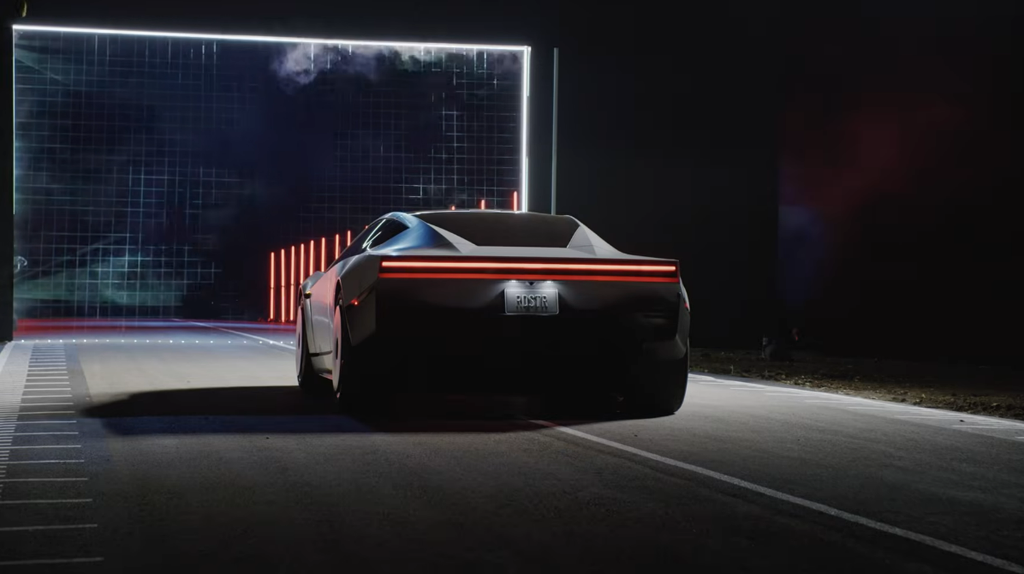
The Roadster 2 used a set of cold-gas thrusters, created in partnership with SpaceX, to flip in midair and return to the ground after driving up a curved ramp and traveling upside down using an underbody fan suction system. Later, the same vehicle reportedly accelerated from zero to sixty miles per hour in less than a second and jumped over a row of Tesla cars. As he observed from the sidelines, Elon Musk referred to it as the first flying car in history. He declared, “Flying cars are real.”
It’s difficult not to be impressed by that image. However, it’s also difficult to ignore what isn’t depicted in the video: the car taking off from a regular road, landing somewhere it wasn’t intended to land, or traveling any significant distance in the air. The demonstration took place at a private aerospace facility rather than a public street, was meticulously planned, and was managed remotely—Musk himself admitted that this was done “to make sure we don’t kill anyone.”
In an interview with CNN, Roger Connor, curator for vertical flight at the Smithsonian’s National Air and Space Museum, referred to the Roadster’s aerial movement as “hopping.” The choice of words is important. The engineering differences between sustained flight and a hop are substantial. Bumpers and crumple zones are necessary for cars to withstand collisions with the road. For an aircraft to produce lift, it must lose weight. As Connor pointed out, attempting to create a single car that performs both well involves a number of challenging trade-offs for which there is no clear answer.
Instead of using rotors or propellers, the Roadster uses ten thrusters that are connected to compressed air tanks. Repurposing SpaceX’s cold-gas thruster technology for a sports car is an unusual strategy. Applying rocket engineering to something that still has to go through traffic has a certain elegance. It’s still unclear if it will function consistently in real-world scenarios as opposed to meticulously planned demonstrations.
The second-generation Roadster was first revealed by Tesla in 2017. That was almost ten years ago. A number of scheduled delivery dates passed without a car being delivered to a customer. Musk has now stated that mass production will start in 2028, but this is a goal rather than a promise. If you’ve followed Tesla’s product timelines, you should be cautious about that date. The company has a history of engineering products that, while they rarely arrive on time, eventually do.
Performance, Thrust, and Rocket are the three versions of the vehicle that have been described. Following the event, Tesla’s website stated that the reservation deposits for the Performance and Thrust models were $50,000 and $250,000, respectively. The Rocket, which had a complete flight system, was designated as invitation-only. Almost as an afterthought, Tesla also mentioned that it is currently illegal to fly the car on public roads. To put it mildly, that. There is currently no way for something like this to be legal on public roads due to the complicated FAA regulations surrounding airborne vehicles.
There’s a feeling that Musk and Tesla in particular knew exactly what they were doing with the framing. By referring to it as a flying car, you can be sure that the story will be told everyplace. No advertising budget could match the kind of coverage it produces. Beneath the spectacle, there is something real: the SpaceX partnership is not a marketing gimmick, the vehicle did take off, and the thrusters are real. However, there is a huge difference between “left the ground at a controlled demonstration” and “flying car you can drive to work,” and it may take a very long time, if at all, for that difference to close.
It’s important to keep in mind that Tesla encountered comparable skepticism regarding the original Roadster, the Model S, Autopilot, and the Semi. Some of those uncertainties didn’t age well. Others proved to be justified. The truth about the Roadster 2 is that, as of right now, no one outside of SpaceX and Tesla is aware of what this car will truly be able to do when, or if, it is put into production.
October 15 demonstrated that Tesla is capable of producing a spectacular event in the Texas desert. Additionally, it brought up issues that the demonstration was never intended to address.
