

There is a certain energy to these kinds of discussions. They begin in the locker rooms of gyms, spread to Reddit forums, and ultimately appear on YouTube channels with eye-catching thumbnails. People continue to watch Bruce Lee vs. Khabib Nurmagomedov despite it being one of those cross-era, cross-disciplinary, and unresolvable matchups. There is something illuminating about the reason.
Here, it’s important to start with the fundamentals. At his best, Bruce Lee weighed about 135 pounds, which, by today’s MMA standards, places him in the bantamweight or featherweight range. At 155 pounds, Khabib was a lightweight competitor, but he carried a lot more weight in between bouts. That gap is not insignificant. Twenty pounds is a significant physical reality in combat sports, spread across a longer, taller frame with an elite wrestling base. Although it doesn’t determine everything, size does have a significant impact.
The grappling dimension is Lee’s bigger issue, and it’s better to face it head-on rather than ignore it. Khabib Nurmagomedov’s entire career was based on a single, brutally successful strategy: get the fight to the ground, take control, and keep applying pressure until something breaks. He did this to Conor McGregor, one of the most dangerous strikers in UFC history, a fighter whose punching mechanics and footwork at times were compared to Lee’s. That nite in Las Vegas did not end very close. The question of what Khabib’s ground game would do against a fighter without any recorded competitive grappling experience becomes fairly straightforward if it neutralized McGregor’s striking.
Dismissing Lee completely misses the point, so it’s important to take his training philosophy seriously. Because it rejected rigid martial arts forms, Jeet Kune Do, the system he created through years of intense study and physical experimentation, was truly ahead of its time.
Lee’s philosophy of combining what worked instead of adhering to a single tradition eventually shaped the evolution of mixed martial arts. In this way, Khabib’s sport owes something conceptually to the method Lee invented. That is ironic. Although Lee’s intellectual fingerprints can be found in the student body of contemporary mixed martial arts, the technical advancements in ground fighting over the previous 50 years have created something Lee has never seen in a serious competitive environment.
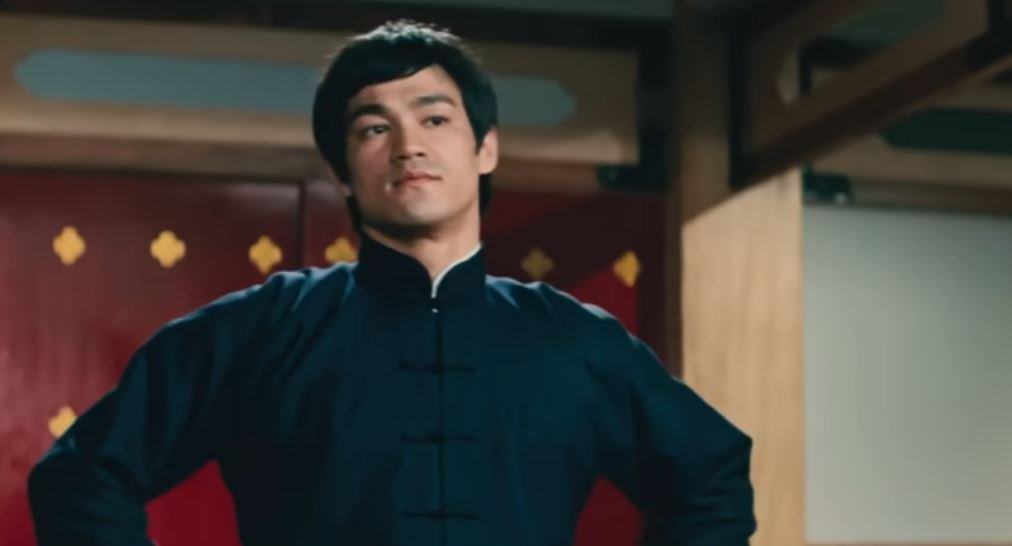
It’s difficult to ignore the fact that Lee’s most compelling arguments in this debate frequently rely on information that was never recorded. There are tales of training partners and peers finding it challenging to follow his hand movements due to his reportedly exceptional speed.
That might be the case. However, when a 155-pound athlete with elite sambo credentials approaches clinch range, speed at 135 pounds—even extraordinary speed—runs into a different kind of issue. Maintaining that distance for five rounds against a wrestling expert is a completely different challenge than anything Lee has ever encountered in his career, and it becomes crucial.
After competing against world-class opponents in each of his last bouts, Khabib retired with a 29-0 record. Despite his sincere contributions to martial arts culture, Bruce Lee never participated in any official combat sport as a professional. This is not a criticism of Lee; his background was completely different, and he made significant and long-lasting contributions to the way the world views martial arts. However, the gap in documented competitive experience is a significant factor in the particular, bounded question of a competitive fight.
Without discounting Lee or exaggerating the comparison beyond what is supported by the evidence, the honest conclusion is that Khabib would most likely prevail. Not because Lee was a fake—he wasn’t—but rather because fifty years of sport-specific advancements in ground control, submission grappling, and wrestling have created a class of athletes that the 1970s just couldn’t produce. One of the best examples that category has ever seen is Khabib.
The debate is still fascinating despite this. It simply indicates that the debate is really about something else: what Lee intended, what Khabib accomplished, and how we define greatness across unrelated eras.
