

Cobra Kai’s second season has a pivotal moment where everything comes together, but not in the way you might anticipate from a program centered around karate, rivalry, and slow-motion crane kicks. Hawk enters a high school party with the goal of winning back his ex-girlfriend Moon, freshly puffed up with Cobra Kai swagger. He sees a girl on the other side of the room, picks up a beer, and enters with what he obviously believes to be his most endearing delivery. Moon gives that girl a kiss in front of him a few seconds later. Piper is the girl’s name. It turns out that Piper is Moon’s girlfriend.
Because no one in the writers’ room attempted to make it a Moment with a capital M, it’s one of those scenes that lands harder than it should. It’s presented as pure comedy, with Hawk being reduced to size, the audience observing, and the awkwardness delightfully stretching. Beneath that awkwardness lies something the Karate Kid franchise had never done before: a real same-sex romance.
Hannah Kepple’s character Moon Taylor, Hawk’s free-spirited, peace-loving girlfriend, had been floating around the show. For the world Hawk was dragging himself into, she was always a little too advanced. She moves on after dumping him, which was justified because he had become the exact type of person her worldview disapproves of.
She moves on with Selah Austria’s character Piper Elswith, who first appears in Season 2 and subsequently becomes somewhat involved in the dojo plots of subsequent seasons. Piper has publicly identified as a lesbian and Moon as bisexual. When taken as a whole, they constitute the first LGBTQ relationship arc in any iteration of the Karate Kid universe.
The way the show framed all of this is noteworthy. A Very Special Episode doesn’t have a pause. Nobody takes a seat and engages in a lengthy, sincere discussion about acceptance or identity. The show simply lets it happen. In the same way that she enjoys crystals and positive energy, Moon’s bisexuality is a part of who she is and not a plot device for the development of another character. It’s not Hawk’s relationship that’s funny, but her discomfort. For a show that has a tendency to veer heavily toward melodrama in other parts, that is a remarkably tidy piece of writing.
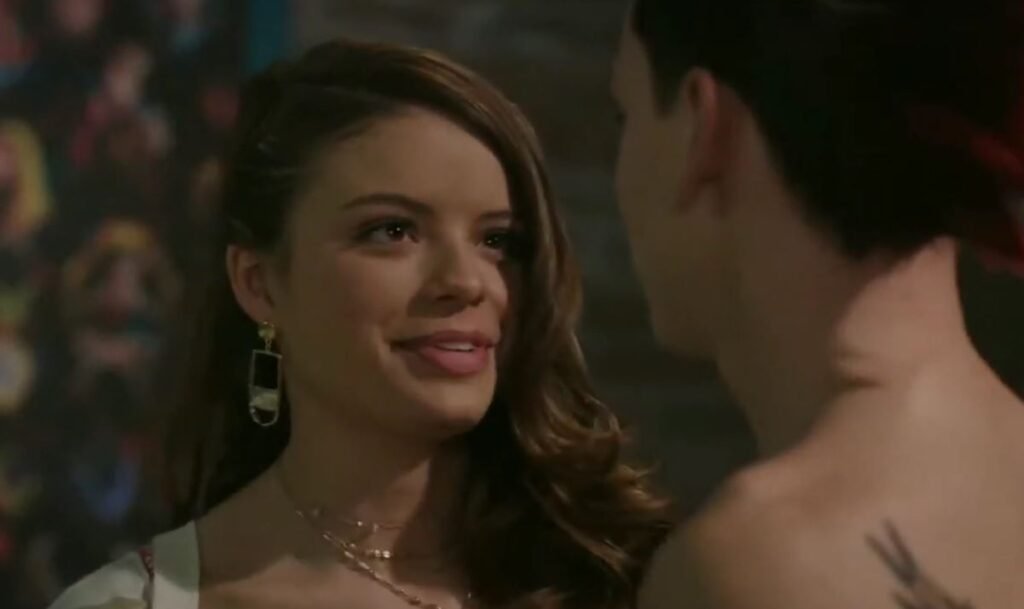
It has been fascinating to observe the fan discourse surrounding these characters. Piper in particular, a supporting character who didn’t receive enough screen time to feel fully realized, was perceived by some viewers as being overly thinly drawn. That’s a valid critique. The pairing may have been introduced by the show with better intentions than it had time to mature. Piper stays mostly in the background while Moon gains more depth throughout the series. It’s difficult to determine whether that’s a writing constraint or simply the inevitable result of a big ensemble cast.
Beyond Moon and Piper, the LGBTQ discourse surrounding Cobra Kai frequently veers away from characters and into the realm of actors. The actor who portrays Robby Keene, Tanner Buchanan, has been outspoken in support of LGBTQ rights. However, beyond the Moon and Piper arc, the show hasn’t ventured much further into that realm—at least not in terms of a verified, written canon.
Did Cobra Kai do enough? This is a serious question worth considering. If you’re gaging by ambition, probably not. However, it handled the same-sex high school relationship more gracefully than most shows do; that is, it didn’t make the audience feel lectured, treated it as normal, and incorporated it into a humorous beat. That’s not insignificant for a program based on nostalgia for the 1980s. It may even be the most Miyagi-like thing the series has done: subtle, unexpected, and deeper than it first seems.
