

In a brief scene in The Karate Kid Part II, Daniel silently sits next to Mr. Miyagi while he sobs while listening to an old recording. This scene is easy to miss if you are not paying attention. No karate. Not a lesson. Just a young child remaining near an elderly man who is grieving over something he never fully recovered from. You can learn everything about these two’s relationship from that brief, perhaps ninety-second exchange.
For many years, fans have debated whether Daniel LaRusso was Mr. Miyagi’s son. However, there isn’t much of a question. The proof is clearly visible on screen, gradually developed over the course of the three original movies and strengthened throughout each season of Cobra Kai. What makes it worthwhile to look at is how the relationship developed—not through lofty proclamations, but rather through the kind of quiet, accumulating care that true family truly exhibits.
A tragedy buried deep in Mr. Miyagi’s past that doesn’t come to light until the second movie is the loss of his wife and infant son during World War II. Working as a building maintenance man in a Reseda apartment complex and leading a simple, mostly solitary life, he had been carrying that grief by himself. Daniel, on the other hand, was a teenager who had moved to California from New Jersey with his mother; he had no father. As a result, he was severely beaten while attempting to adjust to his new surroundings. Two individuals who had similar absences happened to fall into each other’s orbit. It’s possible that at first, neither of them fully comprehended what was going on.
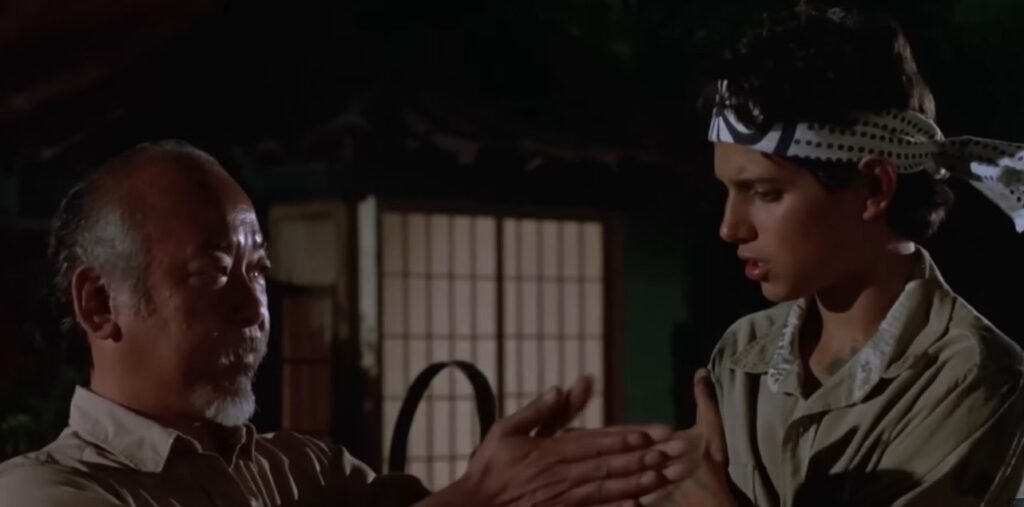
Daniel received much more from Miyagi than just karate training. After the tournament, he fixed Daniel’s bicycle, his self-esteem, and his physical wounds. After Daniel was cornered and assaulted, he attended the school’s Halloween dance. When he had no reason to intervene, he bargained on Daniel’s behalf with Kreese’s dojo. A teacher would not act in this way to shield a talented pupil. These are the actions of a parent who cannot bear to see a loved one suffer harm.
Daniel, on the other hand, never called Miyagi “Sensei.” Social media fans noticed this years ago and debated it, but when you sit with it, the explanation seems pretty clear. Referring to someone as “Sensei” places them on the other side of the formal divide. That line was never what Daniel wanted. He described Miyagi to others as both his best friend and his teacher, which is an odd combination for a teenager to use about a man in his sixties. Strange, but truthful.
For years, the honorific “Daniel-san” was confusing in and of itself. Many adults who grew up watching the movies were among the surprising number of viewers who honestly thought Miyagi was saying “Daniel, son.” It’s a simple error. The meaning was close enough to feel correct, but the audio blurs when viewed casually. The misreading hinted at something genuine, in a sense. Although Miyagi wasn’t referring to him as his son in a literal sense, the underlying emotional truth was close.
Decades have gone by when Cobra Kai picks up the tale. Daniel deals with Miyagi’s death in November 2011 in the same way that people deal with a parent’s passing: not quietly, not neatly, but with the kind of persistent grief that alters a person’s course in life. Daniel’s frequent allusions to Miyagi were deemed excessive by some viewers. However, there’s a feeling that those viewers might have missed the point. He is not fixated on a mentor. Without the one person who truly understood him, he is navigating adulthood and attempting to impart lessons that he is still trying to fully comprehend.
Daniel LaRusso and Mr. Miyagi’s relationship was neither a plot device nor a subplot. It was everything’s emotional core. When you take away the rival dojos and karate competitions, what’s left is a tale of two people who were honest enough to eventually acknowledge their need for one another. That is uncommon everyplace, including in fiction.
