

The plot of Cobra Kai is untrue. In terms of the Netflix series, that is the succinct response, and it is true. The series, which was written by Josh Heald, Hayden Schlossberg, and Jon Hurwitz, is fiction and is a continuation of a franchise that Ralph Macchio and William Zabka established over forty years. However, compared to the show itself, the longer response is more intriguing and, to be honest, a little stranger.
| Detail | Information |
|---|---|
| Show name | Cobra Kai |
| Genre | Fictional drama / continuation of The Karate Kid franchise |
| Created by | Josh Heald, Hayden Schlossberg, Jon Hurwitz |
| Based on | The Karate Kid (1984 film) |
| Original film screenwriter | Robert Mark Kamen |
| Kamen’s real-life inspiration | Being assaulted by bullies at the 1964 World’s Fair in New York |
| Kamen’s first martial arts teacher | A harsh, aggressive military veteran (inspired John Kreese) |
| Real-life Cobra Kai founder | Grandmaster Steven G. Abbate |
| Year real Cobra Kai was founded | 1971 |
| Abbate’s military background | Marine Corps veteran, Vietnam War, wounded in combat, Silver Star recipient |
| Martial art taught at real Cobra Kai | Tai Kit Kuen (Chinese Kung Fu), not Karate |
| Origin of “Cobra” in the name | “Grand Snake Fist” — a translation of Tai Kit Kuen |
| Origin of “Kai” in the name | Japanese word for “group” or “organization” |
| Notable people Abbate trained with | Bruce Lee, Ed Parker, Bill Wallace |
| Abbate’s competitive record | Approximately 300 awards across international tournaments |
| Abbate’s death | 2007, possibly cancer related to Agent Orange exposure |
| Cobra Kai name dispute | Abbate reportedly denied permission to use the name; legal dispute followed |
| John Kreese character inspiration | Loosely based on Kamen’s first martial arts teacher |
| Streaming platform | Netflix (originally launched on YouTube Red) |
| Is the show a true story? | No — fictional, though inspired by real experiences and real martial arts history |
Screenwriter Robert Mark Kamen has discussed how the original 1984 movie, The Karate Kid, drew inspiration from real life. At the 1964 World’s Fair in New York, Kamen claims he was jumped by bullies. He was drawn to martial arts as a result of that experience, and his first instructor was a tough, combative veteran whose methods and energy made an uncomfortable impression on him. Whoever that instructor was, he became ingrained in John Kreese’s DNA. Eventually, Kamen moved on, seeking something more in line with the ideology that Mr. Miyagi would subsequently represent on screen. It’s possible that the emotional core of the entire franchise came from the tension between hard aggression and something more patient.
Few people outside of devoted fan circles are aware that, long before the film was released, there was a Cobra Kai dojo. Grandmaster Steven G. Abbate, a Marine Corps veteran who had served in Vietnam and suffered combat injuries—being shot, stabbed, and struck by grenade shrapnel in two hours, earning a Silver Star—founded it in 1971. Compared to Kreese’s actions on the show, the man’s biography reads more dramatically. Those who trained under Abbate, however, recall him as demanding but genuinely decent, in contrast to Kreese. “He wasn’t evil like Kreese,” a former pupil recalled. “Training there left a lifelong impression on me.”
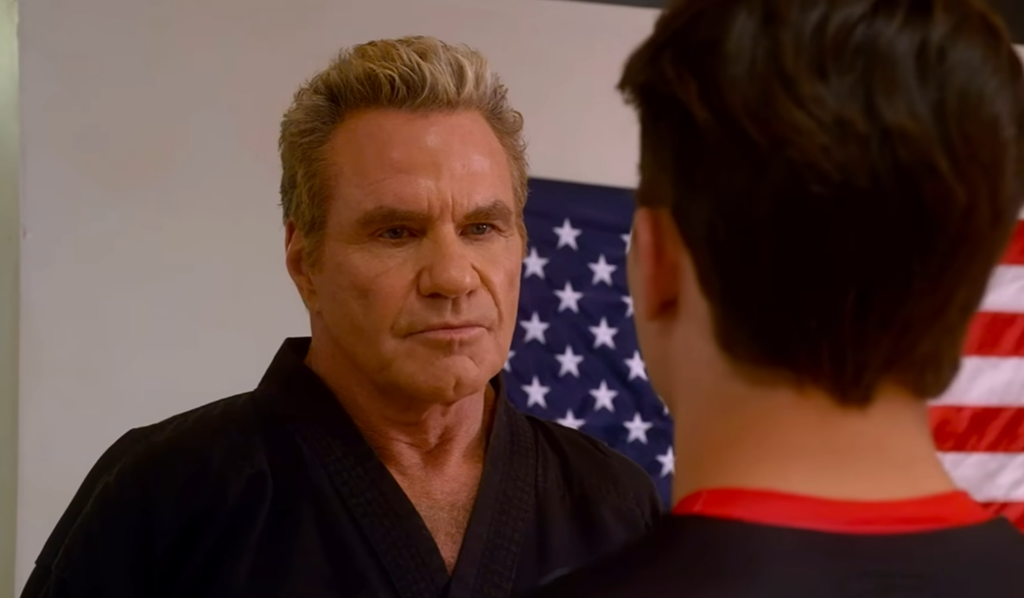
Karate was not taught at Abbate’s school. It taught a Chinese style known as Tai Kit Kuen, which he translated as “Grand Snake Fist”; the “Cobra” in Cobra Kai most likely originated from this style. The Japanese word “Kai” means “group” or “organization,” which results in a somewhat confusing name that combines Japanese and Chinese martial arts terminology. But it’s unquestionably sharp in terms of names. Abbate later trained under Bill Wallace, Ed Parker, and Bruce Lee. He won about 300 prizes in competitions held in the United States, Hong Kong, Taiwan, and Okinawa. His exposure to Agent Orange during the war may have contributed to his cancer death in 2007.
Some of his students claimed that Abbate had been asked to use the Cobra Kai name for the film. According to reports, he declined because he didn’t want the school to be connected to anything bad. In any case, the producers used it. Both parties still claim the name despite the fact that there were legal disputes that were never publicly settled. Kamen has never disclosed the precise source of it. Whether he received training from Abbate or was just aware of the institution is still unknown. He doesn’t say.
Watching Cobra Kai now gives the impression that these hazy boundaries between reality and fiction are exactly what the show benefits from. Because something like Kreese existed, he feels genuine. Real martial arts schools have always carried that tension between discipline that strengthens people and discipline that hardens them in the wrong ways, so the dojo’s moral ambiguity feels justified. That conflict was not created by the authors. They simply dramatized a long-standing issue in American martial arts culture.
The show Cobra Kai is made up. However, the world it is based on, which includes bullied children looking for self-assurance, veterans who have become teachers, and the question of whether aggression can ever be genuinely honorable, is completely real. It’s difficult to ignore the fact that the series’ most poignant moments are typically those that feel most like reality.
