

In The Karate Kid Part II, Kumiko gestures toward what seem to be old castle ruins perched against the Okinawan sky across a rocky coastline. Two young people are standing at the edge of something ancient, and the ocean is visible behind them in this serene, leisurely scene. It seemed entirely real to viewers in 1986. The location seemed to validate everything the movie had been establishing: that Mr. Miyagi’s world had real roots, real history, and a past worth visiting.
The ruins were imaginary. Not even near. In reality, what viewers were witnessing was a matte painting—a studio-produced illusion superimposed on real-time footage captured near the Halona Blowhole and Lānaʻi Lookout along Honolulu’s Kalanianaʻole Highway on the southeast shore of Oahu, Hawaii. The castle that can be seen in that scene was never there.
A painted image dropped into a real sky over a real Hawaiian coastline was added during post-production. When describing the ruins, the character Kumiko makes reference to King Sho Hashi. Although Sho Hashi was a real historical ruler of Okinawa, the crumbling building Daniel is staring at in that scene is completely made up.
Many fans who grew up watching the movie might never have fully come to terms with this. The scene has enough emotional resonance for the image to become ingrained in memory as fact. The filmmakers seem to have realized that a real location would have been almost irrelevant. The feeling was what was important, and it struck.
The choice made by the production to shoot in Hawaii instead of Okinawa was pragmatic rather than sentimental. The production team and director John G. Avildsen initially thought about filming in Okinawa, but decades of building military bases had drastically changed the island’s topography. Simply put, the story’s traditional setting was no longer present in the manner that the script required. Oahu provided the logistical ease of staying on American soil, a similar climate, and a sizable Okinawan-born community available as extras.
Eventually, fifty residents of Hawaii who were born in Okinawa were enlisted to play village scenes. Along Kamehameha Highway in Kaneohe, seven real Okinawan house replicas were built, surrounded by more than three acres of crops. Mr. Miyagi’s fictional hometown, Tomi Village, was constructed from the ground up on privately owned property whose owner, a retired local doctor, consented to filming.
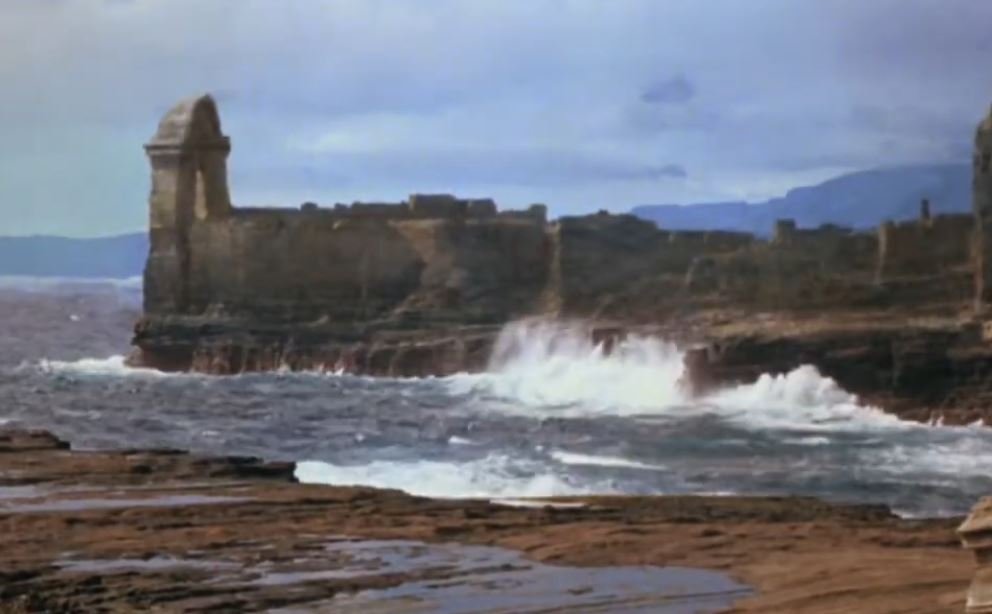
The Halona Blowhole lookout area is located along Oahu’s southeast coast and can be reached as a roadside stop for those who wish to actually visit the castle scene location. The surrounding coastline is truly breathtaking; it is wind-battered and rocky, with waves pushing water through a lava tube that shoots spray skyward. It appears cinematic on its own terms, which is likely why the setting was so effective as a backdrop. Of course, there are no castle ruins there. However, it’s difficult to avoid seeing the shot in your head when you’re standing at that section of coastline and have some idea of what was shot there.
Okinawa itself offers something the film never could: real ruins associated with King Sho Hashi, the 15th-century ruler who united the Ryukyu Kingdom, for those who are more interested in the historical reality behind the made-up scene. Two of his castles have survived in some capacity: Shuri Castle near Naha in the island’s center, which is more accessible but has been undergoing extensive renovations after a fire that destroyed much of the main structure in 2019, and Sashiki Castle in the southeast of the island, which is now mostly in ruins and requires a car to reach. The matte-painted image from the movie, which wasn’t initially inspired by any actual Japanese castle architecture, doesn’t resemble either. The artwork was a creation.
The emotional logic of the scene, however, was something the movie subtly got right. Even though Kumiko is aware that the image was staged, the sentiment remains when she shows Daniel the ruins of an old king’s castle, a location that links her people to something deeper and older than either of them. The movie is still about inheritance and the things that are passed down.
Although the castle depicted in the painting may not be real, the concept behind it is. It turns out that, whether Ralph Macchio is in the picture or not, the true history of Okinawa, the real ruins, and the real castles constructed by the real king the film alludes to are worth exploring on their own terms.
