

John Kreese sits quietly near the end of Cobra Kai’s last run and remarks, almost to himself, that he realized this far too late. It’s a brief scene. subtle. And for some reason, it lands more forcefully than anything the character has done in six seasons of dojo politics and karate fights. That’s Kreese’s peculiar power: after decades of being the antagonist, the character’s eventual admission made you feel something.
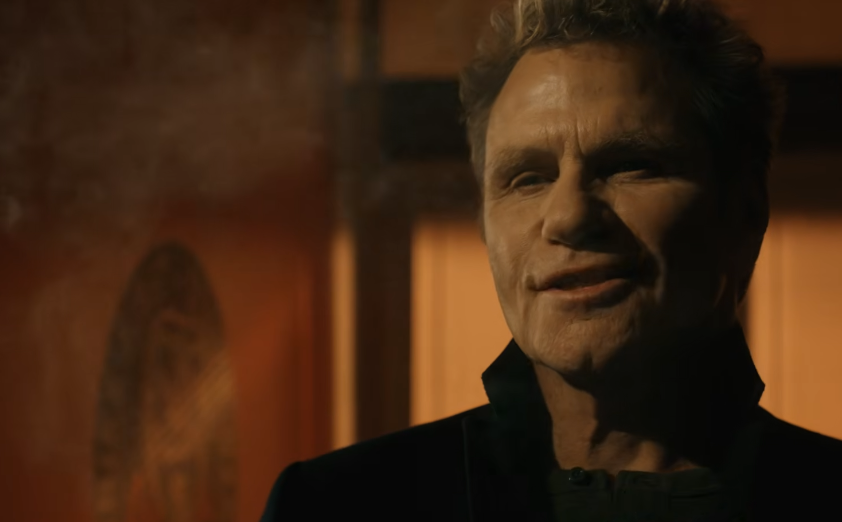
Although Kreese began in the original Karate Kid movies, he is not the same character in Cobra Kai. He was essentially set dressing for teenage rivalry in 1984, with his insane sensei yelling at his students to sweep the leg from the sidelines. Yes, it was memorable. but slender. The Cobra Kai series did this by delving back into that thinness and discovering a complete person concealed there, one molded by Vietnam, loss, and a philosophy that functioned in a combat zone and devastated everything it came into contact with during peacetime.
The backstory that the show created for him is credible. A young Kreese developed his “no mercy” philosophy out of survival rather than cruelty. He witnessed the deaths of those he loved. When he returned from the war, he discovered that the nation had moved on without him. The only place where the world still made sense was the dojo. It’s possible that Cobra Kai was more than just a business or a pastime, which is why his hold on him tightened. It was all he had left.
Cobra Kai never completely absolves him, which is what makes the character truly intriguing rather than merely sympathetically written. He actually causes harm. Teenagers are corrupted by him. Johnny Lawrence, who obviously looked up to him as a father figure, is manipulated by him, and he readily turns that love into a weapon. Kreese is at the center of the show’s generational cycle of harm. The writing is astute enough to explain how he came to be who he was without implying that his actions were justified.
Here, Martin Kove is truly deserving of praise. In the original movies, he portrayed the character with a sort of blank menace, which was all that was needed for the part. When he returned to it decades later, he discovered layers that, in all honesty, shouldn’t have worked: the tenderness he occasionally displayed toward students he truly thought he was helping, the softness beneath the cruelty, and the fleeting moments of regret. It’s interesting to watch him perform those more subdued scenes in contrast to the more dramatic, louder ones. It’s one of those performances that you don’t fully appreciate until the show is over.
For someone who spent his entire life unable to back down from a fight, the character’s ending—dying in an explosion while attempting to eliminate Terry Silver—feels appropriate. It’s not a clear-cut, fulfilling redemption arc. That’s not as messy as it is. Finally, he acknowledges that men like Johnny shouldn’t be in charge of anyone’s future and declares Johnny to be Cobra Kai’s legitimate sensei. That admission has significant weight because it comes from a character who spent years believing that his path was the only one.
Near the conclusion, he says, “If you dedicate your life to that concept, it consumes you.” And I was never able to control it.” It’s the closest the show gets to a character’s thesis statement. Kreese was already dangerous because of the world, not because of the Way of the Fist. It merely gave his damage a name and a framework. There was no turning back by the time he realized that.
