

The San Fernando Valley, a vast, sun-kissed area of suburbs located just north of the Santa Monica Mountains, is where Cobra Kai takes place. You are already familiar with this world if you grew up watching The Karate Kid in the 1980s: strip malls, apartment buildings, modest bungalows, and the incessant buzz of a city that never really seemed to care about its residents. Thirty-three years after Daniel LaRusso defeated Johnny Lawrence at the 1984 All-Valley Karate Tournament, the show returns to those same streets—or at least the concept of them.
At the beginning of the series, Johnny Lawrence is living in Reseda, drinking excessively, living in poverty, and being distant from his son. Daniel, on the other hand, has prospered. He owns a chain of auto dealerships and resides in Encino, which might as well be another planet in the Valley. The two men’s disparate geographic locations are subtly contributing significantly to the narrative. One man remained immobile. The other went up the slope. They are both in the Valley, and the tension between them contributes to the setting’s sense of significance rather than incidentality.
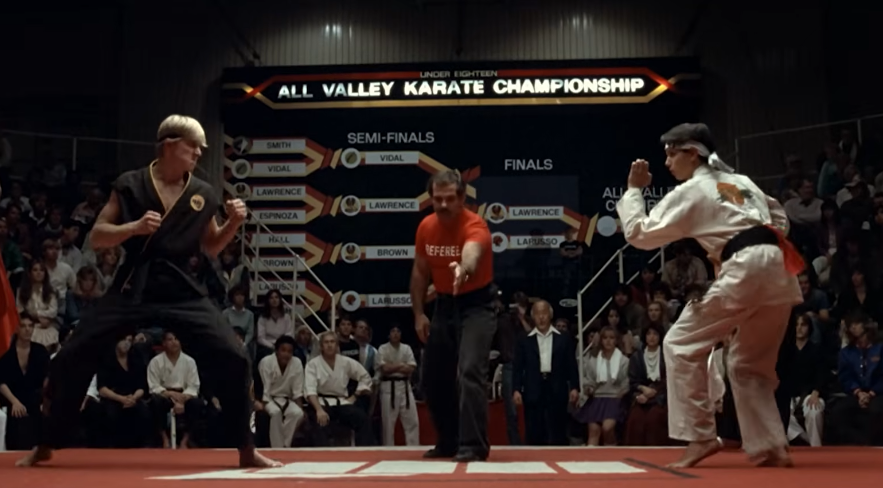
However, this is the part that many viewers find surprising. Cobra Kai was mostly shot in Atlanta, Georgia, despite all the Los Angeles vibe, including the allusions to Reseda, the All-Valley tournament, and the coastal drives. The majority of the first four seasons were filmed in different parts of the Atlanta region, such as Marietta, Union City, and Emory University’s Briarcliff Campus. Cobra Kai is one of the more prominent examples of Atlanta’s recent transformation into a sort of Hollywood satellite. There is something almost impressive about how well the production sold the illusion, and it’s possible that many fans were unaware of it.
When a portion of the action shifted to Okinawa, Japan, the third season introduced a truly distinct visual texture. Okinawa has significant narrative significance in the Karate Kid universe due to its connection to Daniel’s past and Mr. Miyagi’s origins, so those scenes weren’t merely a location change for its own sake. The Georgia-standing-in-for-California scenes never really needed to be grounded, but seeing those settings on screen did. Subsequently, the sixth season advanced even further, incorporating Barcelona, Spain into the production. By then, Cobra Kai had grown significantly beyond its modest Valley beginnings.
The San Fernando Valley seems to have always been more than just a backdrop to the show’s creators. It’s a particular kind of American place, full of people navigating lives that fall short of their expectations and neither glamorous nor particularly photogenic. The setting is intended to provide that emotional core. The mood of the show remains the same whether you’re watching scenes shot in Reseda or scenes shot in a Georgia suburb disguised to resemble Reseda. The Valley is more than just the setting for Cobra Kai. It’s the tone that the entire production aims to maintain.
Atlanta has become a sort of pilgrimage site for fans who wish to locate the actual filming locations. The LaRusso house, the dojo exteriors, and other seasonal landmarks are all tucked away in Georgia neighborhoods rather than California ones. The fictional location and the real location hardly overlap, making it an odd form of geography. However, it functions in some way. The story’s identity comes from Los Angeles. It was given a production home in Atlanta. Additionally, the characters themselves made it worthwhile to watch.
