

The San Fernando Valley, which includes Reseda, Encino, and Van Nuys—flat areas of suburban Los Angeles where strip malls and karate dojos seem to be on the same block—is the setting for Cobra Kai. The geography feels lived in when you watch the show. There’s a certain California flatness to the light. The neighborhoods appear to be in order. The parking lots, the low-slung business buildings, the signage—all of it reads Southern California without you ever having to think about it.
The majority of it was shot in Georgia. One of the more subtly impressive production choices in recent streaming television is the difference between the location where Cobra Kai appears to take place and where it was actually filmed. Throughout all six seasons, Atlanta and the nearby suburbs of Marietta, Union City, Conyers, and Newnan have doubled for Los Angeles, with only sporadic visits to the real thing.
In October 2017, the first season’s main filming got underway in the Atlanta area, passing thru Marietta, Emory University’s Briarcliff Campus, and the Tophat fields of the North Atlanta Soccer Association in East Cobb. The foundation was always Georgia, tho a few exterior shots were taken in real Los Angeles, specifically in Tarzana and Encino.
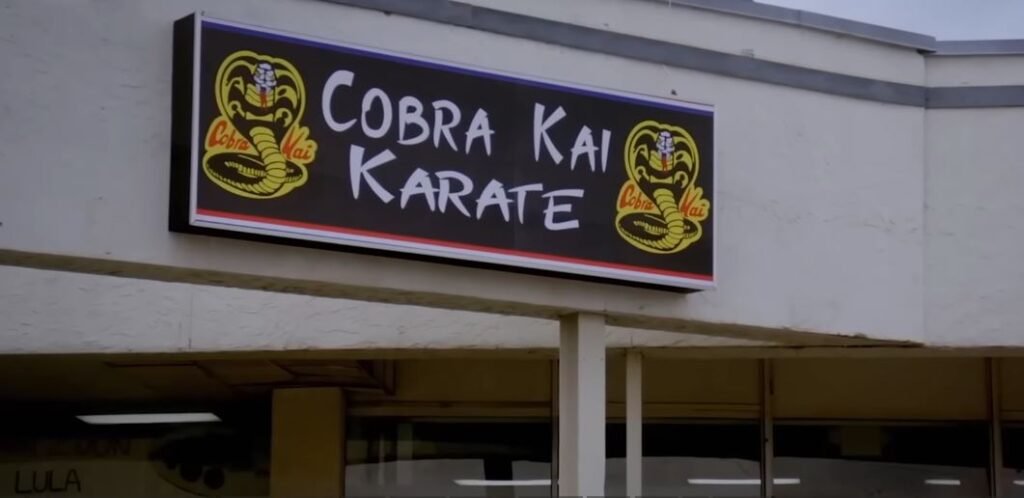
The LaRusso family’s Marietta residence, 130 Woodlawn Drive, is described throughout the series as a cozy San Fernando Valley home. The C.T. Martin Natatorium and Recreation Center on Martin Luther King Jr. Drive in Atlanta served as the location for the school scenes. The Atlanta Motors Superstore in Union City, Georgia, served as the filming location for Daniel’s car dealership, which is the main symbol of his adult success and has the billboard and Cobra Kai flier. Even tho that location is now permanently closed, fans still occasionally visit it as a kind of afterlife as a filming location.
The only significant exception that is located in California is the South Seas apartment complex. The original 1984 Karate Kid took place in that building at 19223 Saticoy Street in Reseda, and the Cobra Kai production returned to the real thing for those scenes, where Daniel and Johnny pause outside Daniel’s former residence and begin to realize how much they have in common. It feels intentional to use the actual location for that specific moment, but it’s difficult to determine how much of it was sentimental versus practical.
With a portion of the third season’s filming taking place in Okinawa, Japan, for Daniel’s return scenes, the geography was significantly expanded. Because the light is different and the architecture doesn’t have to pretend to be somewhere else, those scenes have a different visual impact than anything shot in Georgia. A two-day filming block in Puerto Rico served as a stand-in for Mexico in season five. Production teams frequently employ this kind of creative geography, which viewers hardly ever notice.
The geography was pushed the furthest of all during the last season. The Sagrada Família by Antoni Gaudí, Barceloneta Beach, and Plaça Reial served as backdrops for the majority of the sixth season’s filming, which took place in Atlanta and Barcelona, Spain. The show’s Sekai Taikai tournament, which takes place in Barcelona, was actually filmed at The Eastern, an Atlanta concert venue located in the Reynoldstown neighborhood. The W Barcelona hotel’s exterior is shown on screen; the interior scenes were most likely finished back in Georgia. Barcelona’s visual uniqueness may have been a factor in the production’s decision; a show that is set in the San Fernando Valley all the time needed its dramatic last season to look distinctly different, and the city effortlessly does so.
Observing all of this makes it difficult to ignore how adept Georgia’s production infrastructure has become at disguising itself as somewhere else. The craft that has been developed in that ecosystem is truly sophisticated, and Atlanta has been quietly building this capacity for years, attracting productions with studio infrastructure and tax incentives. That bigger picture includes Cobra Kai operating out of those same facilities for six seasons. The Valley is not what it seems. California is not where the dojo is located. Nevertheless, the show had a genuine feel, which is probably the only thing that really counts.
