

The scenery changes quickly once you’re an hour from St. Louis in almost any direction. Strip malls make way for farms. Urgent care centers are going away. You might have to drive a long way to get to the nearest hospital with a specialist if something goes wrong, like chest pain, a brain bleed, or a pulmonary embolism.
This is the medical reality in rural Missouri. It’s not new or easy. Large parts of the state haven’t had enough medical care for decades because of a lack of doctors, hospitals closing, and lack of money. But there is a slow and uneven change happening now that is based on AI, and it looks like it’s something important to pay attention to.
One of the most well-known examples is Mercy, which is one of the biggest health systems in the area. The group runs more than 50 hospitals in Missouri and nearby states, with many of them in smaller, less-served towns. They added an AI clinical platform called Aidoc to their radiology workflow. The platform does a simple but very helpful thing: it looks at imaging scans in real time and immediately alerts emergency teams to important findings like brain bleeds or dangerous blood clots. It doesn’t take the place of the radiologist. It just makes sure that nothing important is left unread while emergency room staff in a rural area are busy.
It’s hard to say enough about how much that changes things on the ground. There’s usually someone whose job it is to catch these things quickly in a big city hospital. On a Saturday night in a rural facility with a small crew, that’s not always the case. In this case, AI isn’t so much about coming up with new ideas as it is about making sure that everyone gets the same level of care, so a patient in a small-town Missouri ER gets the same level of care as someone brought to a downtown facility.
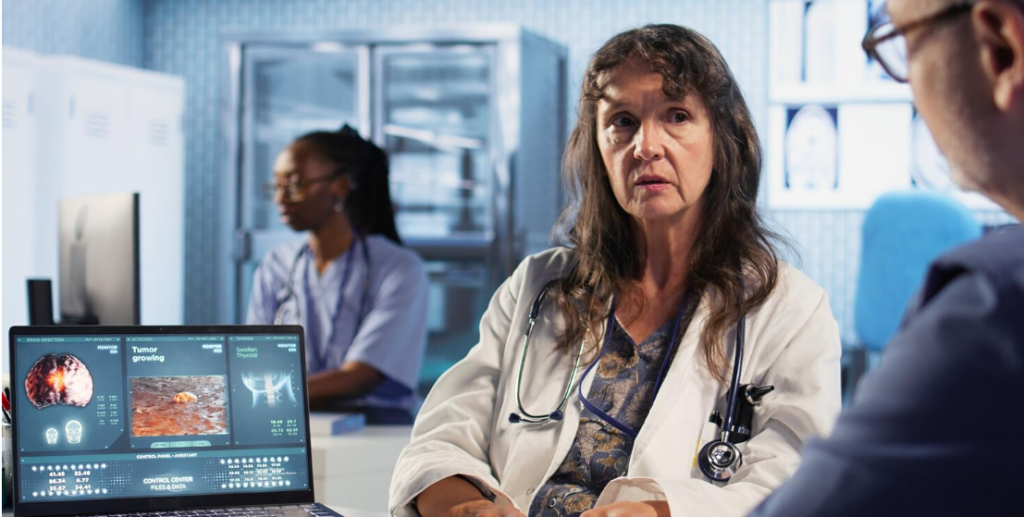
This is being talked about in a broader way, and Don Rubin, president of BioSTL, a St. Louis-based nonprofit that invests in health tech startups, has been moving it forward in a concrete way. He isn’t worried about whether AI works in healthcare; it does, but only in controlled settings and at institutions with lots of resources. He cares about who is left out. He says that the big systems will figure out how to make these tools and use them. Small providers in rural Missouri and low-income areas of cities won’t be able to do the same thing on their own because they don’t have the skills or money to do it.
BioSTL wants to create a separate nonprofit organization that will work with these smaller providers. This organization will be a partnership between BioSTL and Washington University and others. The plan is to figure out what’s wrong at the local level, test solutions that work in those situations, and then give those tools to providers who couldn’t afford to make them themselves. This kind of model doesn’t really exist yet, which is something to keep in mind. It’s still mostly just a suggestion, and putting it into action will be hard. But it’s hard to argue with the logic behind it.
It’s still not clear how fast any of this grows. The use of AI in healthcare moves more slowly than the technology itself. This is because of regulatory issues, worries about liability, and people’s natural reluctance to trust an algorithm with a diagnosis. You have good reasons to be hesitant. It’s nice to sit with them. But as I watch this happen in Missouri, where the gap between people who need care and care that is available is not just an idea, it’s a matter of geography, I get the feeling that the state may not be able to keep up its usual level of institutional caution for much longer.
It took a while for the rural medicine gap to show up. It’s not likely that closing it will either. But AI that is used carefully and with the right tools could at least keep things from getting worse.
