

One of the busiest airports in the world, Chicago O’Hare International Airport is constantly in motion, with security cameras everywhere and thousands of travelers passing through secondary screening and customs each day. Sundas Naqvi, a 28-year-old woman known to friends as Sunny, returned to O’Hare on March 5, 2026, after visiting Istanbul. She was taken aside for a follow-up examination. There is no question about that part. A $1 million federal defamation lawsuit centers on what happened next, or more accurately, what didn’t happen next. This lawsuit has put a Cook County commissioner in legal hot water and raised unsettling questions about how quickly a compelling immigration story can spread before anyone verifies its veracity.
As Naqvi’s story spread among family members and eventually the media, it was startling. She stated that she and five coworkers had been detained by Customs and Border Protection at O’Hare, taken to the Broadview ICE detention facility in suburban Chicago, and then transported more than 150 miles across state lines to the Dodge County Jail in Juneau, Wisconsin. After 43 hours in federal custody, she was released without a means of transportation and had to hitchhike to a Holiday Inn Express before her family could come get her. The story was released during a contentious political period. For months, there had been a lot of anti-ICE sentiment in the Chicago region. A gripping story about a US citizen of Pakistani heritage being caught up in harsh immigration enforcement swiftly gained traction.
Kevin Morrison, a Cook County Commissioner who was running for Congress in his district at the time and had known Naqvi’s family since high school, publicly championed the cause. On March 8, Morrison stood outside the Broadview ICE facility and displayed what he claimed to be screenshots of Naqvi’s phone’s time-stamped GPS location data, which showed her traveling from O’Hare to Broadview and ultimately to Dodge County. He claimed that DHS had fabricated their denials. According to him, the local police were involved in a “cover-up.” He described the state of affairs as “terrifying and concerning.”
The additional evidence then started to emerge.
Naqvi entered secondary inspection at 10:46 AM and left for the public area at 11:42 AM, according to surveillance footage from O’Hare that the Department of Homeland Security posted. This is less than an hour after her arrival, not forty-three hours. Naqvi claimed to be in federal custody, but a hotel folio from the Hampton Inn and Suites in Rosemont, Illinois, revealed that she had checked in at 1:17 PM that same afternoon. While Naqvi was allegedly incarcerated, her then-boyfriend gave investigators text messages from that hotel room in which she asked him to use his credit card for a spa treatment and food delivery.
The story became even more convoluted when Dodge County Sheriff Dale Schmidt received the boyfriend’s account. He admitted to investigators that he had paid for the trip to Turkey with $12,000 from his tax refund, which was a portion of the $25,000 he had spent on Naqvi when he thought they would have a serious long-term relationship. He claimed that rather than from a jail, she contacted him from the hotel. He claimed to have personally driven her from the suburban Chicago hotel to the Holiday Inn Express in Wisconsin. Her family subsequently claimed to have picked her up from the hotel following her terrifying experience of hitchhiking from federal custody. At about the time Naqvi claimed to be being released from the Dodge County Jail, surveillance footage from a convenience store located more than twenty miles away showed a woman who fit her description shopping. Just fifteen minutes before her family arrived, the Holiday Inn’s own cameras captured her entering and giving a thumbs-up in the lobby.
The Story That Traveled 150 Miles — and the Surveillance Footage That Didn’t: Inside the Morrison Naqvi Lawsuit
| Plaintiff | Dodge County Sheriff Dale Schmidt (filing in personal capacity) |
|---|---|
| Defendants | Sundas “Sunny” Naqvi (also known as Summer); Cook County Commissioner Kevin Morrison (D-15th District); 10 unidentified “John Doe” defendants |
| Sundas Naqvi’s Age | 28 |
| Naqvi’s Residence | Skokie, Illinois |
| Kevin Morrison’s Role | Cook County Commissioner, District 15; was also a congressional primary candidate at time of events |
| Alleged Incident Date | March 5–7, 2026 |
| Naqvi’s Claim | Detained by CBP at O’Hare Airport; held ~43 hours; transported to Broadview ICE facility, then to Dodge County Jail, Wisconsin; released without transport |
| DHS Official Position | Naqvi entered secondary screening at 10:46 AM on March 5; left screening to public area at 11:42 AM — approximately 56 minutes total |
| Hotel Evidence | Hampton Inn & Suites, Rosemont, IL: folio shows Naqvi checked in at 1:17 PM on March 5 — during period she claimed to be in federal custody |
| Convenience Store Evidence | Surveillance footage shows Naqvi at store 20+ miles from Dodge County Jail around time she claimed to be released from jail |
| Holiday Inn Evidence | Surveillance video shows Naqvi arriving at Holiday Inn Express, Beaver Dam, WI — 15 minutes before family pickup; caught on camera giving thumbs-up selfie |
| Alleged Romantic Scam | Ex-boyfriend reportedly spent $25,000 on Naqvi, including $12,000 for Turkey trip; paid for Hampton Inn stay; later contradicted her account to law enforcement |
| Lawsuit Filed | April 10, 2026 — U.S. District Court, Eastern District of Wisconsin |
| Presiding Judge | U.S. District Judge Brett Ludwig |
| Damages Sought | Over $1 million per defendant; punitive damages and legal fees |
| First Legal Victory | April 13 — Judge granted expedited subpoena for Naqvi’s T-Mobile records |
| Case Referral | Sheriff referred matter to FBI and Illinois State Police |
| Morrison’s Current Position | “Cannot comment on pending litigation” — lost congressional primary |
| Naqvi’s Prior History | 2019 conviction for filing false police report (Skokie); separate 2019 allegations against U of I professor later deemed “not credible”; restraining order issued against her in 2020 |
| Employer Claim | Naqvi’s LinkedIn listed SAP as employer; SAP confirmed she was never an employee |
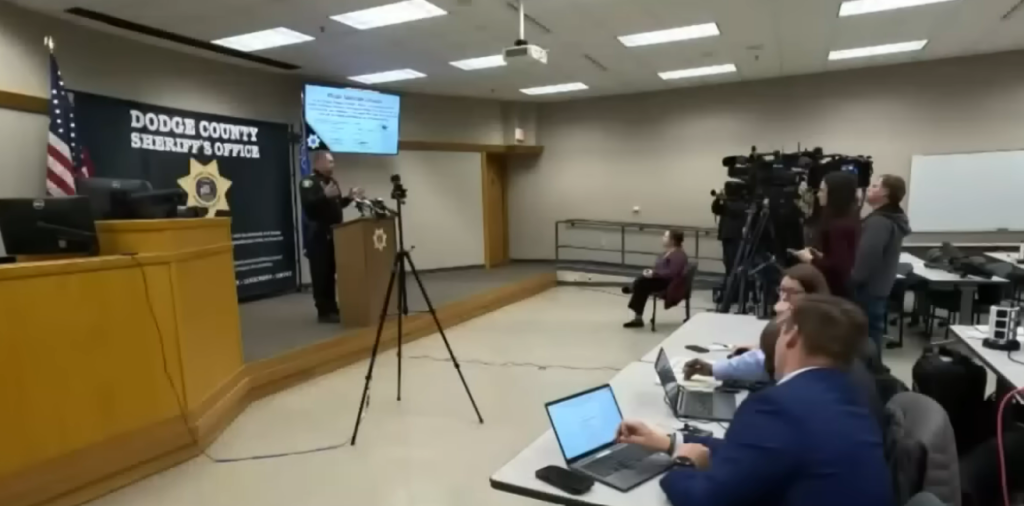
In Schmidt’s press conference on April 10, as the timeline unfolded, the sheriff’s tone became especially acerbic. Not exactly rage. Something more akin to restrained annoyance from a man whose department as a whole had been openly charged with taking part in a federal cover-up of detention of illegal immigrants. “I take it personally when my staff are called liars,” he stated. He pointed out that the Dodge County Jail is the only jail in Wisconsin that houses ICE detainees, making it an especially harmful target for a false narrative.
On April 10, Schmidt filed a $1 million defamation lawsuit in Milwaukee federal court, naming Morrison, Naqvi, and ten other unnamed parties. Judge Brett Ludwig issued an expedited subpoena for Naqvi’s T-Mobile records, including text messages, call information, and cell location data, three days later. The judge’s reasoning was clear: Naqvi had no legitimate expectation of privacy in records that might refute her public claims that she was detained and implicated the sheriff’s office.
Morrison has refrained from saying anything more than the customary “cannot comment on pending litigation” after losing his congressional primary.Naqvi has not replied to questions from the media. Her sister, who attended Morrison’s initial press conference in which she claimed that police had been “lying to our faces,” has also not replied.
Whether criminal charges will be brought is still unknown. Schmidt acknowledged that Wisconsin law does not provide him with clear criminal charges to pursue on his own, but he has referred the case to the FBI and Illinois State Police. According to his own description, the defamation lawsuit is his only legal option in Dodge County. The phone data that is currently being sought through the subpoena and the legal standard for defamation against a public official, which necessitates demonstrating that statements were made with knowledge of their falsity or reckless disregard for the truth, will both play a role in its success.
It’s difficult to ignore the fact that ICE enforcement stories in the Chicago region were, for the most part, credible and unsettling, which is why Naqvi’s story found such a ready audience. A fake account was easier to believe and more difficult to challenge in real time due to the actual abuses that occurred there. Morrison amplified it. It was reported by the media. A completely different story seemed to be taking place somewhere in a Rosemont hotel room, where room service was being ordered using someone else’s credit card.
