

The first bite of a chicken nugget that has never had a heartbeat causes a deep cognitive discomfort. The bargain of carnivory has been brutally straightforward for generations: something dies so that humans can eat it. This past Wednesday, the US Department of Agriculture granted Upside Foods and Good Meat final approval to sell chicken raised in steel vats rather than coops, permanently changing that contract. The idea of “lab-grown meat” is being brought from the world of science fiction into the controlled reality of the American food system by this decision.
This approximation is not based on plants. This is not pea protein that has been extruded into the shape of a nugget or soy that is disguised as fowl. At the cellular level, this is chicken. The chicken you may roast on a Sunday has the same savory profile, the same fibrous texture, and the same DNA. Its biography makes all the difference. This meat started as a cluster of stem cells taken from a living animal, usually without killing it, and then put into a cultivator, rather than hatching, pecking, and then confronting a slaughterhouse.
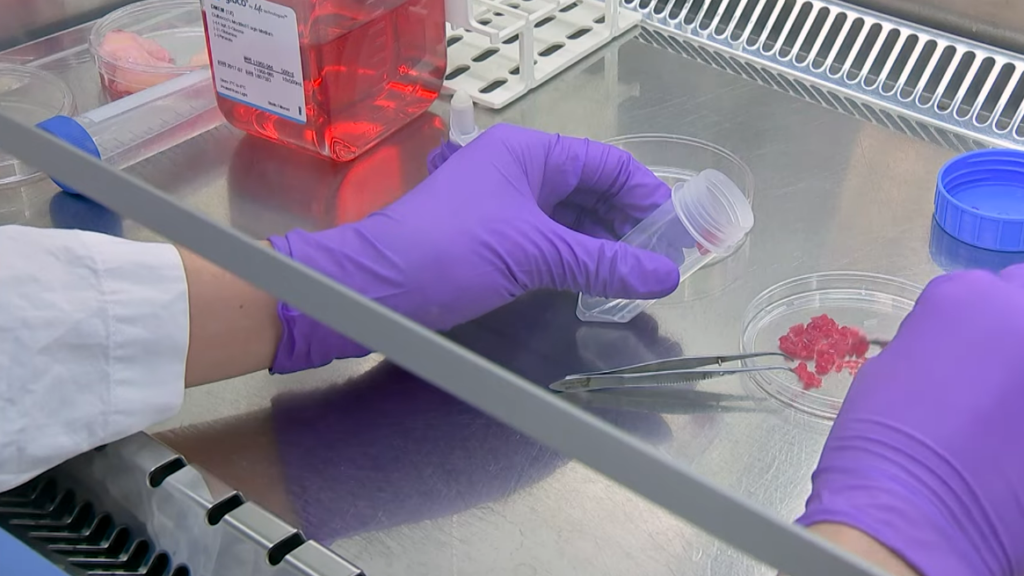
The cells are submerged in a nutrient-rich mix of sugars, salts, and amino acids in these big steel tanks that resemble microbreweries more than farms. They grow rapidly, distinguishing into fat and muscle before becoming a meat cut that a cook can sear in a skillet.
| Feature | Details |
| Regulatory Event | USDA grants final approval for sale of cell-cultivated chicken (June 2023). |
| Approved Companies | Upside Foods (California) and Good Meat (division of Eat Just). |
| Production Method | Stem cells harvested from animals are multiplied in steel bioreactors using a nutrient-rich culture medium. |
| First Availability | Limited release at Bar Crenn (San Francisco) and a José Andrés restaurant (Washington, D.C.). |
| Global Context | The U.S. is the second country (after Singapore) to legalize cultivated meat. |
| Labeling | Designated as “cell-cultivated chicken” to distinguish from traditional livestock. |
With the clearance, the US becomes just the second country in the world to permit the commercial sale of cultured meat, after Singapore did so in 2020. Although it removes a significant legislative barrier, it also allows for a far more intricate cultural discussion. The “ick” factor—the instinctive reluctance to consume something that feels artificial even though it is biological—is the question we must now address.
Proponents like Upside Foods CEO Uma Valeti, a cardiologist, compare this moment to the creation of the internet or the automobile. It provides a possible escape route from industrial agriculture’s destructive effects on the environment. A resource-hungry beast, factory farming releases greenhouse gasses into the environment while using enormous amounts of land and water. Cultivated beef promises flavor without excrement and protein without pollution.
The changeover won’t be quick or inexpensive, either.
Recently, as I stood in a grocery store aisle, looking at the rows of breasts wrapped in cellophane, I became suddenly and quietly aware of how skillfully we have already separated meat from the animal, turning a living being into a commodity long before this technology was invented.
Ironically, the conventional chicken industry is hardly a bulwark of nature, despite the fact that detractors are concerned about the “unnatural” character of bioreactor meat. These days, broilers live their brief lives in windowless sheds because they are engineered to grow so quickly that their legs frequently cannot support their bodies. In contrast, a laboratory’s sterility looks almost forgiving. Nevertheless, a stainless steel tank cannot replace the coziness of a farm, no matter how legendary that image has grown.
The first rollout will be carefully planned so that this new cuisine is associated with luxury rather than scientific research. Next week, cell-cultivated chicken won’t be available in Walmart’s freezer section. Rather, it will make its premiere on Michelin-starred restaurants’ white tablecloths. Good Meat is collaborating with chef and philanthropist José Andrés in Washington, D.C., while Upside Foods is collaborating with Dominique Crenn at her San Francisco atelier, Bar Crenn.
This Scarcity is mostly a physical and financial issue, but it is also somewhat a marketing issue. It is a technical headache to scale up manufacturing to serve a country that consumes billions of chickens every year. The cost of the nutritional media needed to feed the cells is very high, and constructing bioreactors big enough to reduce expenses is still a major challenge. According to McKinsey, by 2030, only 0.5 percent of the world’s meat supply may come from farmed beef. Although it is a beginning, it is merely a small step.
Concerns have also been raised over the process’s energy intensity. Although it conserves water and land, power is needed to maintain a bioreactor at the ideal temperature for cell growth. The carbon footprint benefit may be smaller than stated unless these facilities are powered by a green grid.
The separation of flesh from the animal is what we are seeing. It is not only a food change but also a philosophical one. We have the technology to eat meat without killing for the first time in human history. The documents have been signed by the USDA. Pans are being heated by the chefs. The industry is currently waiting to see if the American consumer is willing to eat a dish that goes against the definition of nature itself. Even though everything about how it got there has changed, the chicken has crossed the street and seems exactly the same on the other side.
