

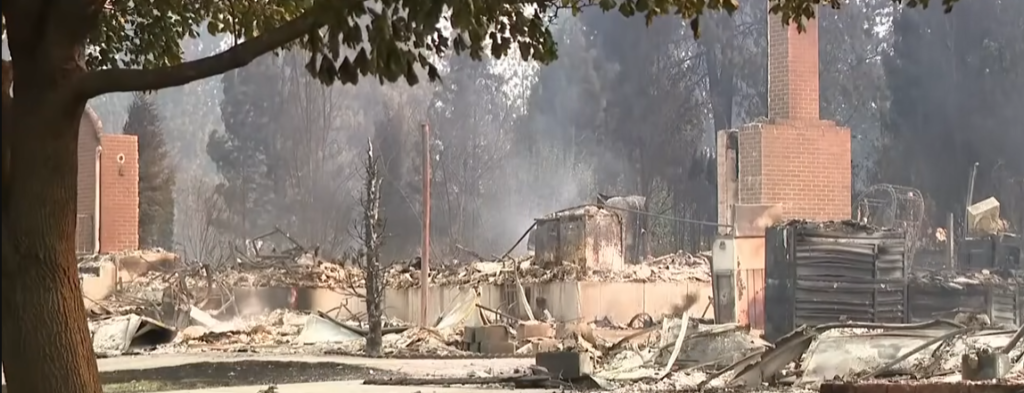
Geoff Beadles kept his eyes moving from house to house as he drove through his Spokane neighborhood after leaving with his fiancée and two dogs. Some homes had not been touched. Some were gone completely, leaving only blackened foundations and brick chimneys that stuck out like gravestones in a field. “Just driving around looking at the homes,” he said softly, “it’s just one of the most heartbreaking things I’ve ever seen in my life.”
One of the most confusing things about wildfire is how different each block is: one block is completely destroyed, while the lawn of a neighbor is still green on the next. It doesn’t make sense. The wind blows it.
There were three different fires in and around Spokane, which is the second largest city in Washington. They were the Old Trails Fire, the Fairview Fire, and the Meadowview Fire. During one weekend, they destroyed at least 600 homes, businesses, and other buildings and forced about 60,000 people to leave their homes. They went through about 8.2 square miles. That number included people who were staying at the city’s Veterans Affairs hospital. Mayor Lisa Brown of Spokane said it straight out: “the worst natural disaster our region has seen.”
On Saturday, Governor Bob Ferguson of Washington State declared a state of emergency. A “particularly dangerous situation” red flag alert was sent out by the National Weather Service for eastern Washington. This is not something that forecasters do every day. Sunday afternoon, wind gusts of 35 to 45 miles per hour were planned. Even though it was below 80 degrees Fahrenheit, that wasn’t the main issue. It was the wind.
A federal response team member from California named Benjamin Cossel was called in to help with public information. He gave a simple geography lesson: the Spokane River flows through a city of about 229,000 people, with steep canyons on both sides. We can think of those canyons as funnels. “They push the fire through the canyons, up the slopes, and then outside the slopes and around,” he explained. “It’s very, very hilly, very, very steep slopes — a lot of canyons that create really turbulent, really challenging wind scenarios.” This weekend, it felt like the land itself was against the firefighters in ways that maps don’t quite show until you’re there.
The investigators still didn’t know how the fires started. As of Sunday, no one had been hurt or gone missing, but officials were careful to call it off early. At a press conference in Spokane, U.S. Senator Maria Cantwell said, “We are not safe.” “The next couple of days will be challenging.”
Spokane wasn’t the only one. Dozens of wildfires were going on at the same time in the western United States, making it hard for all levels of government to do their jobs. Ten days had passed since the start of the fire in western Idaho and eastern Oregon. The fire had burned through nearly 525 square miles of grassland and was putting hundreds of homes at risk. Over the weekend, a fire in central Utah grew by more than three times its original size. There were more than 100 dead cattle. The people in charge there used the word “catastrophic.”
At this point, it looks like this fire season might be different from others. The Spokane area’s weather forecast didn’t give people much hope—it was supposed to stay dry, and there was no sign of any real rain. “We have weather working against us, and we have terrain working against us,” Cossel stated. In a city built between canyons and ridges, that mix of features is not a small problem. Everything is wrong.
A video from the weekend showed black smoke rising over neighborhoods, buildings that were on fire, and the smoke-covered foundations, chimneys, and ash that were left behind. Some nearby houses were still standing. People remember that randomness more than anything else. People couldn’t help but notice how close it was for a family to lose everything and still have their walls standing. That question is still very much open for tens of thousands of people in Spokane.
